Thirteenth Sunday after Pentecost
Dear Friends in Christ,
Welcome to our weekly Sunday update. This Sunday is the Thirteenth Sunday after Pentecost. The Gospel reading for last Sunday featured the Parable of the Good Samaritan who came to the aid of a traveler badly beaten by robbers. Two members of the Jewish religious hierarchy, a priest and a Levite, had passed him by before the compassionate Samaritan came to his rescue. The Gospel for this Sunday tells of an actual Samaritan who is himself a victim: one of ten lepers who cry out to Our Lord for mercy as He is making His way to Jerusalem. Jesus heals them all and tells them to go show themselves to the priests; but only the one Samaritan returns to glorify God and give thanks. Jesus says to the man, “Were not ten made clean? and where are the nine? There is no one found to return and give glory to God, but this stranger. And he said to him: Arise, go thy way; for thy faith hath made thee whole” (Luke 17:17-19). Afterwards, Jesus continued His journey to Jerusalem, knowing that there He would be branded a stranger – a Galilean foreigner – and condemned as an undesirable alien.
Calendar of Special Observances
Celebrations are those listed in the Roman Missal of 1962.
DAY, DATE – FEAST (CLASS)
Sunday, August 23 – Thirteenth Sunday after Pentecost (II)
Monday, August 24 – St. Bartholomew, Apostle (II)
Tuesday, August 25 – St. Louis IX, King and Confessor (III)
Wednesday, August 26 – Feria (IV) – Commemoration of St. Zephyrinus, Pope and Martyr
Thursday, August 27 – St. Joseph Calasanctius, Confessor (III)
Friday, August 28 – St. Augustine, Bishop, Confessor, and Doctor (III) – Commemoration of St. Hermes, Martyr
Saturday, August 29 – The Beheading of St. John the Baptist (III) –Commemoration of St. Sabina, Martyr
Thirteenth Sunday after Pentecost
The links provided below can be used to download printable copies of the Proper Prayers for the Thirteenth Sunday after Pentecost with English or Spanish translation, followed by commentary by Dr. Michael P. Foley.
Traditional Latin Mass Schedule
Diocese of Charlotte Sunday Masses
Chapel of the Little Flower (757 Oakridge Farm Road, Mooresville, NC)
- 10:00 a.m. (Low)
- 12:00 p.m. (Sung)
- Chaplain: Fr. Brandon Jones
- Chapel related questions? Email Father at: tlmchapel(at)rcdoc.org
- DONATE: To donate to the Chapel of the Little Flower click here (via Saint Ann Parish, Charlotte)
- More details: https://carolinaliturgy.org/chapel
Note: Only Sunday Latin Masses and Holy Days are offered at the Chapel. This is the only Diocese of Charlotte location which offers the Traditional Latin Mass.
Saint Thérèse of the Child Jesus and the Holy Face, the Little Flower, pray for us!
Diocese of Raleigh Sunday Masses
- 1:00 p.m., Sacred Heart (Dunn, NC)
- 4:30 p.m., - First Sunday, Holy Name Cathedral (Raleigh, NC)
- 5:00 p.m., - Fourth Sunday, Basilica of Saint Mary (Wilmington, NC)
- For additional locations and Masses please see our Mass Times webpage
Diocese of Charleston Sunday Masses
- 12:00 p.m., Prince of Peace (Taylors SC)
- 1:00 p.m., Our Lady of the Lake (Chapin SC)
- 12:00 p.m., Sacred Heart (Charleston SC)
- 5:30 p.m., Stella Maris (Sullivans Island, SC)
Diocese of Charleston Daily Traditional Latin Masses
- Prince of Peace (Taylors SC) – No daily Latin Mass this summer unless otherwise noted in the bulletin (see note below)
- For additional locations and Masses please see our Mass Times webpage
Note: The summer Mass schedule for Prince of Peace parish is in effect and according to the bulletin there will be no daily Latin Masses at Prince of Peace Monday-Saturday this summer.
As a reminder, travelers are urged to consult parish websites or offices for up-to-date information regarding possible changes in the schedule of Mass times.
Chapel of the Little Flower Announcements
Mass Intentions for Sunday
Sunday August 23, 10:00 a.m. – +Repose of the soul of Mrs. Maureen Kateri Jennings by George and Regina Hoar
Support Sacred Music at the Chapel by Joining the Schola and Choir
The Church teaches us that singing is praying twice. Please consider lending your musical talents to the beautifying of the sacred liturgy here at the Chapel of the Little Flower. If one would like more information about joining the schola and choir, please contact the Chapel music director whose contact information is at the bottom of the hymn sheets found on the table in the narthex. Thank you for your generosity.
Saint Ann Parishioner Catholic School Check In
If one is a parishioner at St. Ann parish and has children enrolled in the Catholic schools, please scan the QR code found on the table in the narthex of the Chapel. This is the new attendance check in system.
Donations for the Chapel of the Little Flower
To donate to the Chapel of the Little Flower, please make out a check to “St. Ann Catholic Church” and carefully earmark it for “Latin Mass” or “Chapel of the Little Flower”. It can be mailed to the parish (3635 Park Road, Charlotte, NC 28209). To donate online, please visit the parish’s “Chapel of the Little Flower” online donation portal at this link.
Lost and Found
If one is missing a missal, book, or other item, please see the Lost and Found table in the cry room.
Father Jones’ Contact Info
If one has questions about the Chapel of the Little Flower, that are not related to one’s parish, please email Father Jones directly at: tlmchapel(at)rcdoc.org
Visiting the Chapel of the Little Flower
If you haven’t attended Mass at the Chapel of the Little Flower yet, you are welcome to join us. Seating is adequate at both Masses, and there is plenty of parking; a cry room; open space outside for the kids after Mass. Bulletins from Saint Ann and Saint Thomas Aquinas parishes are usually available.
General Announcements
First Sunday Food & Fellowship Potluck at Saint Thomas Aquinas – Sunday September 6 will be the monthly Sunday Food and Fellowship at Saint Thomas Aquinas from 1:30 p.m. – 3:00 p.m. If you attend Mass at the Chapel, you can always drop by after Mass. Please consider bringing something to share.
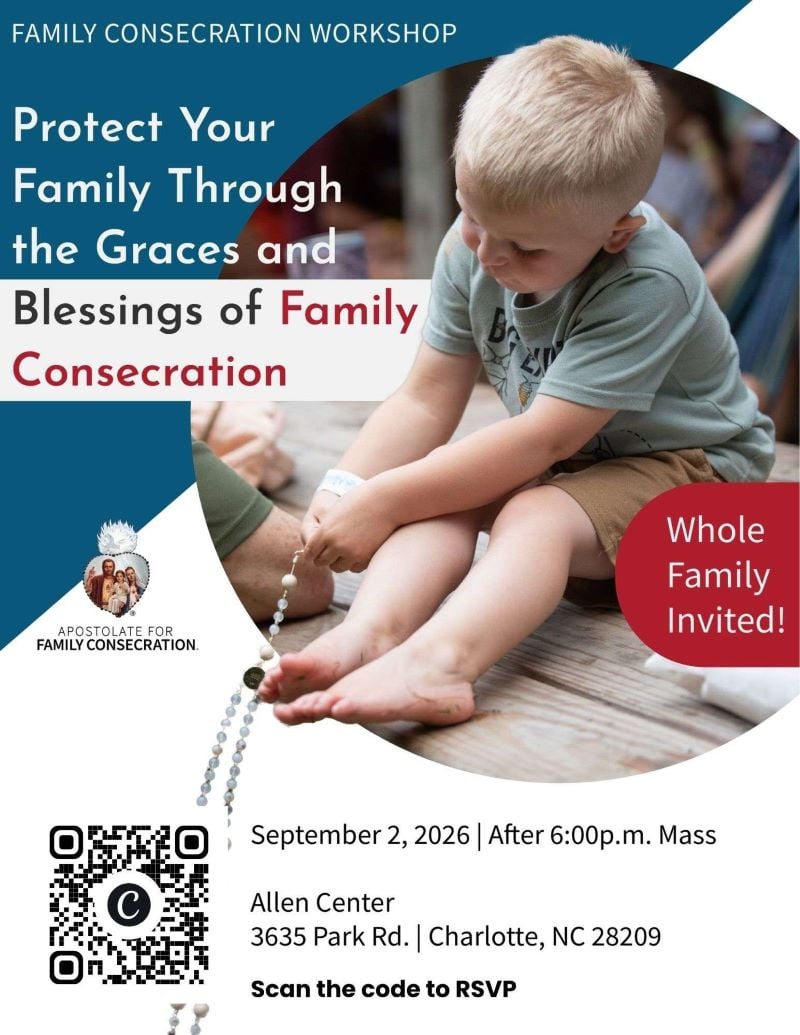
September 2nd: Family Consecration Workshop – Protecting Your Family Through the Graces and Blessings of Family Consecration – Saint Ann parish is hosting a special Family Consecration Workshop on Wednesday September 2nd after the 6:00 p.m. Mass in the Allen Center. The Workshop will help families deepen their Catholic faith within the home as well as protecting them in the battle against evil.
The Workshop explores what consecration is and how to consecrate one’s family to Jesus, through Mary, in union with Saint Joseph. It’s a great opportunity to walk alongside like-minded families in the faith. All family members are encouraged to attend the workshop. To RSVP click here or see the flyer at the end of this update.
Catholic Book on Herbs – We share a new book written by Judson Carroll and local author Steve Cunningham (of Sensus Fidelium) about herbs, from a Catholic perspective. The book is entitled Herbs that Heal: (Catholic) Home Remedies to Forage and Grow. It is available by Sophia Institute Press at this link.
Support Saint Ann and Saint Thomas Parishes – Our parishes remain the anchor of our spiritual and community lives and continue to promote the sacred traditions, devotions, speakers and catechesis important for the spiritual growth of ourselves and our families. They also need our continued financial support (and occasional visits!). Both parishes would appreciate our continued generosity.
Bishop Martin issues Pastoral Letter to the Faithful Associated with the Society of Saint Pius X
LiveMass.net – Want to watch a Latin Mass online? The Priestly Fraternity of Saint Peter (FSSP) has a broadcast apostolate which streams its Latin Masses across the world at various times of the day. To view visit: https://www.livemass.net/
Rosary for the Traditional Latin Mass – A Rosary is offered for the restoration of the Traditional Latin Mass in the church on Sundays after the 11:30 a.m. Novus Ordo Mass at Saint Thomas Aquinas Church.
Daily Holy Face Chaplet for Sacred Liturgy (perpetual novena) – For the preservation of the Traditional Latin Mass, it has been recommended to all friends of the sacred liturgy in the diocese to consider continually praying the powerful Holy Face chaplet, under the banner of Our Lady of the Holy Name. To pray the chaplet, please see this link.
Cardinal Burke’s Prayer for Pope Leo XIV – His Eminence Cardinal Raymond Burke has released a prayer for Pope Leo XIV. Please see the prayer at the links below and consider praying this daily for the Holy Father as he leads the Church. PDF copies can be accessed at these links: [English] [Español] [Latin]
Saint Augustine: First patron saint of America?
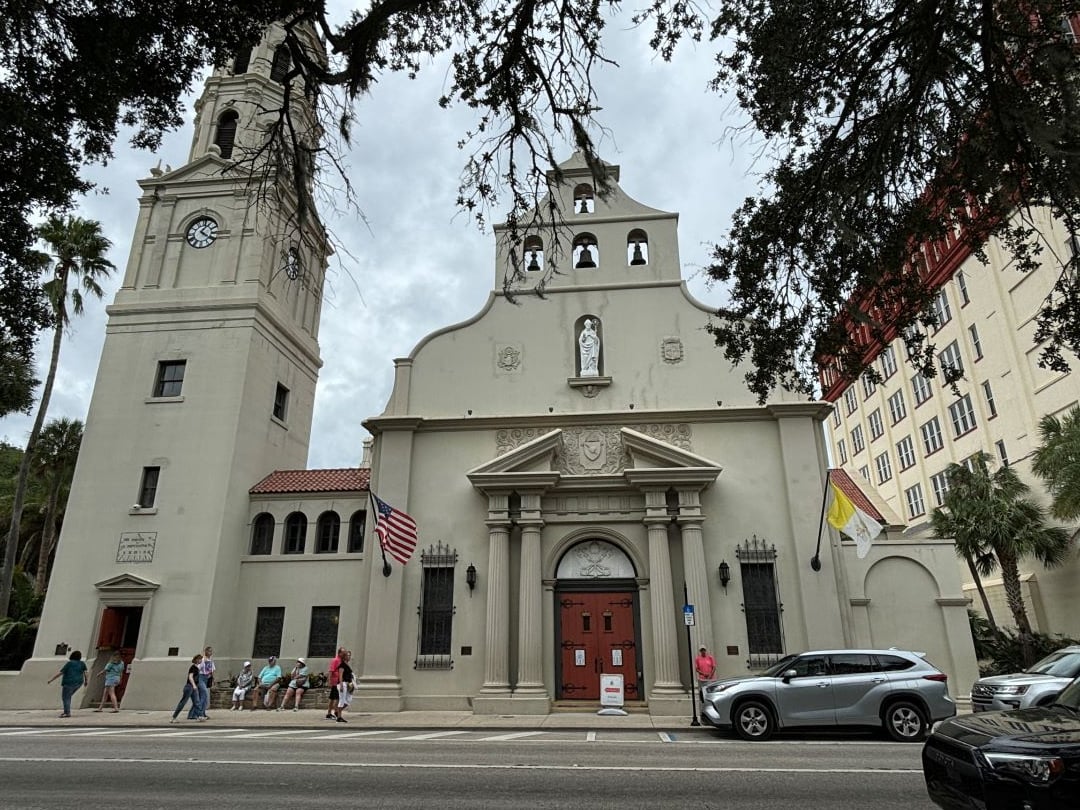
While the U.S. Bishops in 1846 declared Our Lady of the Immaculate Conception as the official patroness of the United States, the first “unofficial” patron saint of America may in fact be Saint Augustine, whose feast day is August 28.
461 years ago this week, Spanish General Pedro Menéndez de Avilés was nearing the end of his voyage to establish a permanent settlement and Catholic mission in La Florida, the Spanish-claimed land which originally included present day Florida as well as most of the east coast of present day United States including the Carolinas.
It was on August 28, 1565 - the Feast of Saint Augustine - that Menéndez sighted land, that of today's northeastern Florida; and when he made landfall 11 days later, Menéndez named the settlement after Saint Augustine.
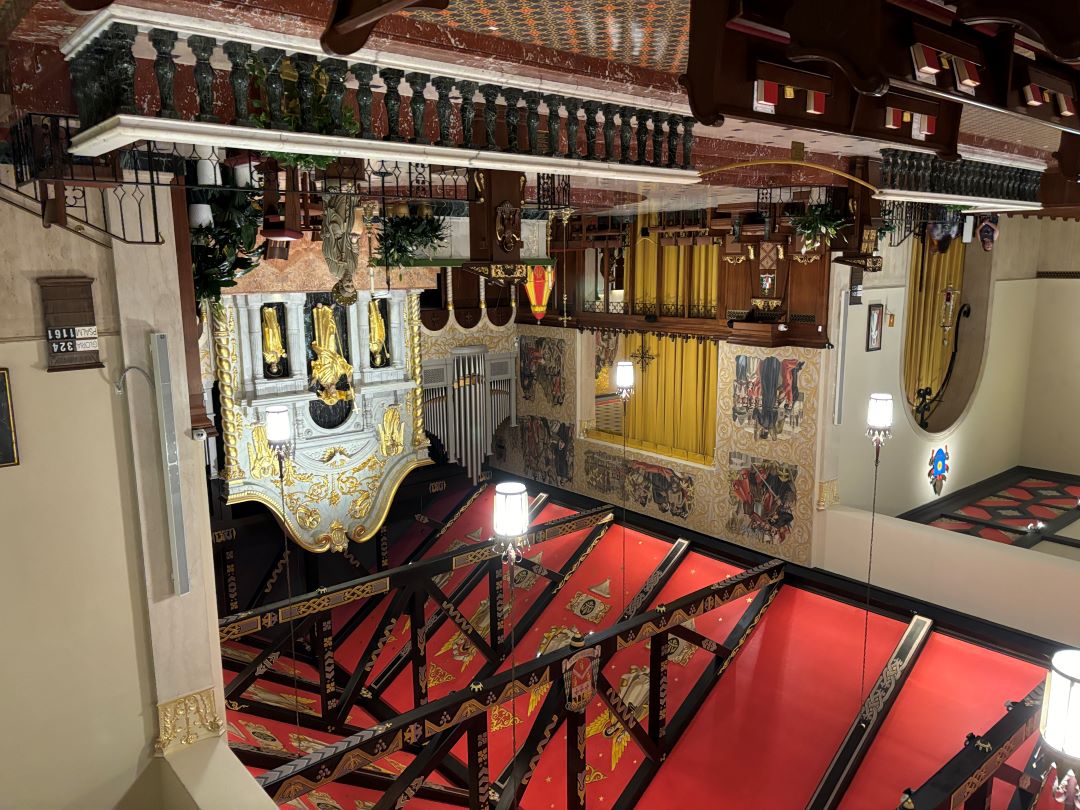
Today San Augustine, Florida remains the oldest city in the United States and the Feast of Saint Augustine marks the beginning of the Catholic Church’s permanent presence in today’s United States. It is also home to America’s first parish, the Cathedral Basilica of Saint Augustine, established in 1565.
To learn more about the Catholic history of Saint Augustine please visit the Shrine of Our Lady of La Leche and Mission Nombre de Dios in San Augustine, Florida.
Holy Face Devotions
Prayers of Reparation to the Holy Face of Jesus are offered each week at the following churches on the indicated days:
- St. James (Concord) – Monday, 10-10:30 a.m. (in the cry room)
- St. Mark – Tuesday, 5:30 p.m.
- St. Thomas Aquinas – Tuesday, 6:00 a.m.
- St. Ann – Tuesday, 7:30 a.m. (following 7:00 a.m. Mass)
- St. Michael the Archangel (Gastonia) – Tuesday, 8:30 a.m. (following 8:00 a.m. Mass)
- St. Vincent de Paul – Tuesday, 8:40 a.m.
- Holy Spirit (Denver) – Tuesday, 10-11:00 a.m. (following the 9:15 a.m. Mass)
- Saint Elizabeth of the Hill Country (Boone) – Third Tuesday, at 6:45 p.m. after Mass in the Youth Room
- St. John the Baptist (Tryon) - First Saturday, 9:30 a.m. (after 8:30 a.m Mass)
Note: Days and times may be subject to change due to holidays.
“Jesus, Your ineffable image is the star which guides my steps. Ah, You know, Your sweet Face is for me Heaven on earth” (from Canticle to the Holy Face by Saint Thérèse de Lisieux, the 19th century Discalced Carmelite nun who took the name in religion, Thérèse of the Child Jesus and the Holy Face).
Traditional Latin Mass and Liturgical News
- Photos of the Annual Eucharistic Procession by Boat in Louisiana on the Assumption by Greg DiPippo, New Liturgical Movement (August 18, 2026). [Annual Eucharistic Procession]
- The Forgotten Customs of Assumption Day by Matthew Plese, OnePeterFive (August 15, 2026). [Forgotten Customs of Assumption Day]
- The 1570 Missale Romanum and the Devotion to the Dormition in Jerusalem by Dr. Michael P. Foley, New Liturgical Movement [Devotion to the Dormition]
- Second collection to support Belmont Abbey College, Catholic News Herald (August 16, 2026). [Second Collection]
- Before and After (and After Again): An Update from Holy Innocents in Long Beach, California by Shawn Tribe, Liturgical Arts Journal (August 17, 2026). [Holy Innocents in Long Beach]
- An Italian Chapel in the Orkney Islands by Greg DiPippo, New Liturgical Movement (August 20, 2026). [Italian Chapel]
- Review of Cosima Clara Gillhammer’s Light on Darkness: The Untold Story of the Liturgy by Dr. Michael P. Foley, New Liturgical Movement (August 7, 2026). [Light on Darkness]
- Faithful invited to witness historic beatification of Georgia Martyrs, Catholic News Herald (July 31, 2026). [Georgia Martyrs]
Saints and Special Observances
Saint Louis IX, King and Confessor, was born in 1215, became King of France at the age of 12 and was very piously brought up by his mother, queen Blanche, who taught him to wish rather to die than to commit a mortal sin. He liked to be called Louis of Poissy, the place where he had been baptized, to show that his title of Christian was his most glorious title of nobility.
Assiduous in attending the offices of the Church, he ordered them to be solemnly celebrated in his palace where every day he heard two Masses. At midnight he rose for Matins and began his royal day with the office of Prime. He introduced into his chapel the custom of genuflecting at the words in the Creed: Et homo factus est, and of bowing down humbly at the passage in the Passion when Jesus expires. Both these pious practices were adopted by the Church. But never did his piety hinder him from devoting to the affairs of the kingdom the greater part of his time.
Having recovered from a serious illness he made a vow to undertake a crusade to reconquer Jerusalem. At first victorious, he fell at last into the hands of the Saracens (Muslims). Restored to freedom, he remained five years in the East helping the Christians. On his return to France, he made many pious foundations and built the Sainte Chapelle, as a precious reliquary for the holy crown of thorns and the important particle of the true Cross which Baldwin II, Emperor of Constantinople, had presented to him. Most austere himself, he was most charitable to others, and used to say: “It is more meet for a king to ruin himself in alms for God’s sake than in pomp and vain glory.”
As a servant of Christ, he continually wore the cross to show that his vow remained unaccomplished. He undertook in 1270 another crusade, but an epidemic decimated his army near Tunis and struck him down. With his arms crossed and lying on a bed of ashes, he gave up his soul to God in 1270, at the same hour that Christ died on the cross. He was heard to repeat the day before his death: “We shall go to Jerusalem.” It was in reality to heavenly Jerusalem, conquered by his patience in the midst of his adversities, where he was to reign with the King of Kings.
“O God, who didst remove blessed Louis, Thy confessor, from an earthly throne to the glory of Thy heavenly kingdom; grant, we beseech Thee, through his merits and prayers, that we may be permitted to share in the kingdom of Jesus Christ, Thy Son, the King of Kings.” – Collect from Louismas, August 25.
The Feast of Saint Louis IX, King and Confessor, is celebrated on August 25.
(Source: Liturgical notes for Feast of St. Louis, Saint Andrew Daily Missal, 1945)
Patron Saint
Among others, Saint Louis is the patron of architecture, France, construction workers, difficult marriages, distillers, parents of large families, prisoners, the sick, stone masons, and locally in the United States, the patron of the Archdioceses of New Orleans and Saint Louis.
It is only a suggestion, but with Christians continually in peril in the Middle East, Saint Louis may also be an intercessor for the protection of Christians in the Holy Land, especially during this time of conflict.
Festival of Saint Louis
Each August, in the Missouri city that bears his name, an annual festival of Saint Louis is celebrated by local Catholics. It originated as a response to the anti-Catholic vandalism occurring in that city (and others) during the summer of 2020. Whereby Catholics came and prayed the Rosary in front of the statue of Saint Louis IX on Art Hill for the intentions of an end to the violence. Now the festival has grown and now includes a multi-day traditional liturgical schedule including the public chanting of the traditional Divine Office for Feast of Saint Louis and concluding with Solemn High Mass at the Oratory of Saints Gregory and Augustine. To learn more click here.
Closing Commentary
Determined not to overlook the author of Confessions and The City of God in the week of his feast, we offer, in closing, an excerpt from the commentary of Dom Prosper Guéranger, OSB, on the feast of St. Augustine, Bishop and Doctor of the Church, followed by a link to the full text.
August 28 – St. Augustine, Bishop and Doctor of the Church
Today Augustine, the greatest and the humblest of the Doctors, is hailed by heaven, where his conversion caused greater joy than that of any other sinner; and celebrated by the Church, who is enlightened by his writings as to the power, the value, and the gratuitousness of divine grace.
Since that wonderful, heavenly conversation at Ostia, God had completed his triumph in the son of Monica’s tears and of Ambrose’s holiness. Far away from the great cities where pleasure had seduced him, the former rhetorician now cared only to nourish his soul with the simplicity of the Scriptures, in silence and solitude. But grace, after breaking the double chain that bound his mind and his heart, was to have still greater dominion over him; the pontifical consecration was to consummate Augustine’s union with that divine Wisdom, whom alone he declared he loved “for her own sole sake, caring neither for rest nor life save on her account.” From his height, to which the divine mercy had raised him, let us hear him pouring out his heart:
“Too late have I loved thee, O beauty so ancient and yet so new! Too late have I loved thee! And behold thou wast within me, and I, having wandered out of myself, sought thee everywhere without … I questioned the earth, and she answered me: I am not the one thou seekest; and all the creatures of earth made the same reply. I questioned the sea and its abyss and all the living things therein, and they answered: We are not thy God; seek above us. I questioned the restless winds, and all the air with its inhabitants replied: Anaximenes is mistaken, I am not God. I questioned the sky, the sun, the moon, the stars, and they said: We are not the God whom thou seekest. And I said to all these things that stand without at the gates of my senses: Ye have all confessed concerning my God that ye are not he, tell me now something about him. And they all cried with one great voice: It is he that made us. I questioned them with my desires, and they answered by their beauty.—Let the air and the waters and the earth be silent! Let man keep silence in his own soul! Let him pass beyond his own thought; for beyond all language of man or of Angels, he, of whom creatures speak, makes himself heard; where signs and images and figurative visions cease, there Eternal Wisdom reveals herself … Thou didst call and cry so loud that my deaf ears could hear thee; thou didst shine so brightly that my blind eyes could see thee; thy fragrance exhilarated me and it is after thee that I aspire; having tasted thee I hunger and thirst; thou hadst touched me and thrilled me and I burn to be in thy peaceful rest. When I shall be united to thee with my whole being, then will my sorrows and labors cease.”
To the end of his life Augustine never ceased to fight for the truth against all the heresies then invented by the father of lies; in his ever repeated victories, we know not which to admire most: his knowledge of the Holy Scriptures, his powerful logic, or his eloquence. We see too that divine charity which, while inflexibly upholding every iota of God’s rights, is full of ineffable compassion for the unhappy beings who do not understand those rights.
“Let those be hard upon you who do not know what labor it is to reach the truth and turn away from error. Let those be hard upon you, who know not how rare a thing it is, and how much it costs, to overcome the false images of the senses and to dwell in peace of soul. Let those be hard upon you who know not with what difficulty man’s mental eye is healed so as to be able to gaze upon the Sun of justice; who know not through what sighs and groans one attains to some little knowledge of God. Let those finally be hard upon you who have never known seduction like that whereby you are destroyed … As for me, who have been tossed about by the vain imaginations of which my mind was in search, and who have shared your misery and so long deplored it, I could not by any means be harsh to you.”
These touching words were addressed to the disciples of Manes, who were hemmed in on all sides even by the laws of the pagan emperors. How fearful is the misery of our fallen race when the darkness of hell can overpower the loftiest intellects! Augustine, the formidable opponent of heresy, was for nine years previously the convinced disciple and ardent apostle of Manicheism. This heresy was a strange variety of Gnostic dualism, which, to explain the existence of evil, made a god of evil itself; and which owed its prolonged influence to the pleasure taken in it by Satan’s pride.
Augustine sustained also a prolonged though more local struggle against the Donatists, whose teaching was based on a principle as false as the fact from which it professed to originate. This fact, which on the petitions presented by the Donatists themselves was juridically proved to be false, was that Cæcilianus, primate of Africa in 311, had received episcopal consecration from a traditor, i.e. one who had delivered up the sacred Books in time of persecution. No one, argued the Donatists, could communicate with a sinner without himself ceasing to form part of the flock of Christ; therefore, as the bishops of the rest of the world had continued to communicate with Cæcilianus and his successors, the Donatists alone were now the Church. This groundless schism was established among most of the inhabitants of Roman Africa, with its four hundred and ten bishops, and its troops of Circumcellions ever ready to commit murders and violence upon the Catholics on the roads or in isolated houses. The greater part of our Saint’s time was occupied in trying to bring back these lost sheep. [St. Augustine Bishop and Doctor of the Church]
Prayer to St. Augustine
Opening Prayer: O holy Saint Augustine, who has famously declared that “Our hearts were made for Thee, O Lord, and they are restless until they rest in Thee,” aid us in our search for Our Lord that through your intercession we may be granted the wisdom to determine the purpose God has planned for us. Pray that we be blessed with the courage to follow God’s will even at times when we do not understand. Ask Our Lord to lead us to a life worthy of His love, that we may one day share the riches of His kingdom. Petition Our Lord and Savior to ease the burden of our problems and grant our special intention, and we will honor you all of our days.
Glorious St. Augustine, you are renowned in the Christian world for your kindness, compassion, and powerful intercession. Emboldened by this, we humbly come before you to invoke your aid in asking for God’s all-powerful assistance to see us through our most pressing concern.
Glorious Saint Augustine, we boldly ask for your intercession confident in your boundless wisdom and compassion. May this devotion lead us to a life dedicated to the fulfilling the will of God, that we may one day be deemed worthy of sharing His Kingdom with you and all the saints for all eternity.
Our Father, Hail Mary, Glory Be…
St. Augustine, pray for us!
Closing Prayer:
Breathe in me, O Holy Spirit, that my thoughts may all be holy. Act in
me, O Holy Spirit, that my work, too, may be holy. Draw my heart, O Holy
Spirit, that I love but what is holy. Strengthen me, O Holy Spirit, to
defend all that is holy. Guard me, then, O Holy Spirit, that I always
may be holy. Amen.
Cathedral Basilica of Saint Augustine (FL)
America's First Parish: Established 1565