Tenth Sunday after Pentecost
Friends in Christ,
Welcome to our weekly Sunday update. This Sunday is the Tenth Sunday after Pentecost. In the Gospel for this Sunday Jesus relates the parable of the Pharisee and the publican “to some who trusted in themselves as just, and despised others” (Luke 18:9). They are represented in the parable by the Pharisee who stands proudly before God (and anyone watching) giving thanks that he is better than other men. There is a phrase in contemporary parlance to describe such behavior: virtue-signaling. People go about the business of sharing how virtuous they are in a variety of ways. Sometimes it’s just a matter of saying the “right thing” in a casual conversation, but some people go so far as to put signs in their yards listing all the things they believe that make them more virtuous than others. Sadly, the inclusivity frequently proclaimed in such displays generally excludes those despised for not sharing the same beliefs. In the parable it is the one who prays humbly in the background, acknowledging his sinfulness, who goes home justified: “because everyone that exalteth himself shall be humbled, and he that humbleth himself shall be exalted” (Luke 18:14).
**Portiuncula Indulgence – Sunday August 2nd**: On Sunday August 2nd, there is a plenary indulgence called the Portiuncula Indulgence which was first offered to only those who visited the Portiuncula chapel St. Francis of Assisi rebuilt in Italy, but now it is available to everyone in the universal Church This indulgence, the "Pardon of Assisi" can be performed at any time during the evening Saturday August 1 until midnight Sunday night August 2nd. To participate, one must go to confession (20 days before or after); receive Holy Communion at Mass on August 2nd, and enter into a parish church or Franciscan Church, and with contrition, pray the Our Father, Apostles Creed, and a prayer for the Holy Father’s intentions. To learn more visit this EWTN News article.
Feast of the Transfiguration Thursday August 6
On Thursday August 6th, the Church will celebrate the Transfiguration of Our Lord Jesus Christ. The Gospel reading for that day comes from the 17th chapter of Matthew’s Gospel in which we are told that “after six days” Jesus took Peter and James and John “up into a high mountain apart: And he was transfigured before them” (Matthew 17:1-2). What happened six days earlier? We are told in the previous chapter that Jesus revealed himself to his disciples to be the Christ and said, “If any man will come after me, let him deny himself, and take up his cross, and follow me” (Matthew 16:24). His destination is Jerusalem. On the mountain the three apostles saw Him revealed in all His glory conversing with Moses and Elias. We have to go to Luke’s Gospel to find out, “[T]hey spoke of his decease that he should accomplish in Jerusalem” (Luke 9:31). The Son of God came into the world to accomplish His own death. He did it for each of us and for all men, even those who mock Him and belittle His sacrifice.
Calendar of Special Observances
Celebrations are those listed in the Roman Missal of 1962.
DAY, DATE – FEAST (CLASS)
Sunday, August 2 – Tenth Sunday after Pentecost (II)
Monday, August 3 – Feria (IV) – Finding of the Body of St. Stephen, Protomartyr (IV)
Tuesday, August 4 – St. Dominic, Confessor (III)
Wednesday, August 5 – Dedication of the Basilica of St. Mary Major (Our Lady of the Snows) (III)
Thursday, August 6 – The Transfiguration of Our Lord Jesus Christ (II) – Commemoration of St. Sixtus and Companions, Martyrs
Friday, August 7 – St. Cajetan, Confessor (III) – Sacred Heart of Jesus (III) – Commemoration of St. Donatius, Bishop and Martyr
Saturday, August 8 – St. John Mary Vianney, Confessor (III) – Commemoration of Ss. Cyriac, Largus, and Smaragdus, Martyrs
Tenth Sunday after Pentecost
The links provided below can be used to download printable copies of the Proper Prayers for the Tenth Sunday after Pentecost with English or Spanish translation, followed by commentary by Dr. Michael P. Foley.
Traditional Latin Mass Schedule
Diocese of Charlotte Sunday Masses
Chapel of the Little Flower (757 Oakridge Farm Road, Mooresville, NC)
- 10:00 a.m. (Low)
- 12:00 p.m. (Sung)
- Chaplain: Fr. Brandon Jones
- Chapel related questions? Email Father at: tlmchapel(at)rcdoc.org
- DONATE: To donate to the Chapel of the Little Flower click here (via Saint Ann Parish, Charlotte)
- More details: https://carolinaliturgy.org/chapel
Note: Only Sunday Latin Masses and Holy Days are offered at the Chapel. This is the only Diocese of Charlotte location which offers the Traditional Latin Mass.
Saint Thérèse of the Child Jesus and the Holy Face, the Little Flower, pray for us!
Diocese of Raleigh Sunday Masses
- 1:00 p.m., Sacred Heart (Dunn, NC)
- 4:30 p.m., - First Sunday, Holy Name Cathedral (Raleigh, NC)
- 5:00 p.m., - Fourth Sunday, Basilica of Saint Mary (Wilmington, NC)
- For additional locations and Masses please see our Mass Times webpage
Diocese of Charleston Sunday Masses
- 12:00 p.m., Prince of Peace (Taylors SC)
- 1:00 p.m., Our Lady of the Lake (Chapin SC)
- 12:00 p.m., Sacred Heart (Charleston SC)
- 5:30 p.m., Stella Maris (Sullivans Island, SC)
Diocese of Charleston Daily Traditional Latin Masses
- Prince of Peace (Taylors SC) – No daily Latin Mass this summer unless otherwise noted in the bulletin (see note below)
- For additional locations and Masses please see our Mass Times webpage
Note: The summer Mass schedule for Prince of Peace parish is in effect and according to the bulletin there will be no daily Latin Masses at Prince of Peace Monday-Saturday this summer.
As a reminder, travelers are urged to consult parish websites or offices for up-to-date information regarding possible changes in the schedule of Mass times.
Feast of the Assumption, Saturday August 15
The following are the announced Latin Masses for the Feast of the Assumption on Saturday August 15. According to the U.S. Bishops, the Assumption is not a holy day of obligation this year. If more Masses are scheduled, we will post them on our website.
- Prince of Peace (Taylors SC) – 8:00 a.m. (traditional blessing of herbs)
- Our Lady of the Lake (Chapin SC) – 12:00 p.m.
The Chapel of the Little Flower will offer an External Solemnity of the Assumption on Sunday August 16.
Chapel of the Little Flower Announcements
Mass Intentions for Sunday
Sunday August 2, 10:00 a.m. – Richard and Pauline Evarts by Jean and Mitch Foreman
Donations for the Chapel of the Little Flower
To donate to the Chapel of the Little Flower, please make out a check to “St. Ann Catholic Church” and carefully earmark it for “Latin Mass” or “Chapel of the Little Flower”. It can be mailed to the parish (3635 Park Road, Charlotte, NC 28209). To donate online, please visit the parish’s “Chapel of the Little Flower” online donation portal at this link.
Lost and Found
If one is missing a missal, book, or other item, please see the Lost and Found table in the cry room.
Father Jones’ Contact Info
If one has questions about the Chapel of the Little Flower, that are not related to one’s parish, please email Father Jones directly at: tlmchapel(at)rcdoc.org
Visiting the Chapel of the Little Flower
If you haven’t attended Mass at the Chapel of the Little Flower yet, you are welcome to join us. Seating is adequate at both Masses, and there is plenty of parking; a cry room; open space outside for the kids after Mass. Bulletins from Saint Ann and Saint Thomas Aquinas parishes are usually available.
General Announcements
First Sunday Food & Fellowship Potluck at Saint Thomas Aquinas – This Sunday (August 2) will be the monthly Sunday Food and Fellowship at Saint Thomas Aquinas from 1:30 p.m. – 3:00 p.m. If you attend Mass at the Chapel, you can always drop by after Mass. Please consider bringing something to share.
Support Saint Ann and Saint Thomas Parishes – Our parishes remain the anchor of our spiritual and community lives and continue to promote the sacred traditions, devotions, speakers and catechesis important for the spiritual growth of ourselves and our families. They also need our continued financial support (and occasional visits!). Both parishes would appreciate our continued generosity.
Bishop Martin issues Pastoral Letter to the Faithful Associated with the Society of Saint Pius X
- Bishop Martin issues Pastoral Letter to the Faithful Associated with the Society of Saint Pius X
- Catholic News Herald: Bishop Martin appeals to SSPX faithful: ‘The door of the Church is open’
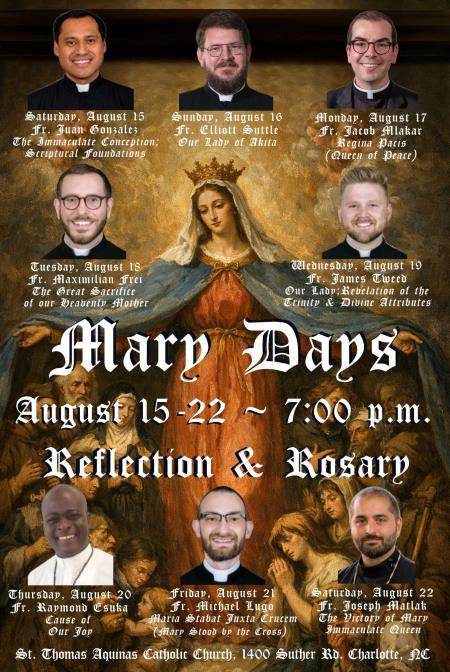
Mary Days Talks (August 15-22) – Saint Thomas Aquinas Parish's annual week-long Mary Days talks on the Blessed Virgin Mary will begin Saturday August 15 (Assumption) and conclude Friday August 22 (Feast of the Immaculate Heart of Mary). Talks will be at 7:00 p.m. daily, except on Thursday August 21, which will be a homily during the 7:00 p.m. Mass (Novus Ordo). To learn more see the flyer at the end of this update.
LiveMass.net – Want to watch a Latin Mass online? The Priestly Fraternity of Saint Peter (FSSP) has a broadcast apostolate which streams its Latin Masses across the world at various times of the day. To view visit: https://www.livemass.net/
Rosary for the Traditional Latin Mass – A Rosary is offered for the restoration of the Traditional Latin Mass in the church on Sundays after the 11:30 a.m. Novus Ordo Mass at Saint Thomas Aquinas Church.
Daily Holy Face Chaplet for Sacred Liturgy (perpetual novena) – For the preservation of the Traditional Latin Mass, it has been recommended to all friends of the sacred liturgy in the diocese to consider continually praying the powerful Holy Face chaplet, under the banner of Our Lady of the Holy Name. To pray the chaplet, please see this link.
Cardinal Burke’s Prayer for Pope Leo XIV – His Eminence Cardinal Raymond Burke has released a prayer for Pope Leo XIV. Please see the prayer at the links below and consider praying this daily for the Holy Father as he leads the Church. PDF copies can be accessed at these links: [English] [Español] [Latin]
Holy Face Devotions
Prayers of Reparation to the Holy Face of Jesus are offered each week at the following churches on the indicated days:
- St. James (Concord) – Monday, 10-10:30 a.m. (in the cry room)
- St. Mark – Tuesday, 5:30 p.m.
- St. Thomas Aquinas – Tuesday, 6:00 a.m.
- St. Ann – Tuesday, 7:30 a.m. (following 7:00 a.m. Mass)
- St. Michael the Archangel (Gastonia) – Tuesday, 8:30 a.m. (following 8:00 a.m. Mass)
- St. Vincent de Paul – Tuesday, 8:40 a.m.
- Holy Spirit (Denver) – Tuesday, 10-11:00 a.m. (following the 9:15 a.m. Mass)
- Saint Elizabeth of the Hill Country (Boone) – Third Tuesday, at 6:45 p.m. after Mass in the Youth Room
- St. John the Baptist (Tryon) - First Saturday, 9:30 a.m. (after 8:30 a.m Mass)
Note: Days and times may be subject to change due to holidays.
“Jesus, Your ineffable image is the star which guides my steps. Ah, You know, Your sweet Face is for me Heaven on earth” (from Canticle to the Holy Face by Saint Thérèse de Lisieux, the 19th century Discalced Carmelite nun who took the name in religion, Thérèse of the Child Jesus and the Holy Face).
Traditional Latin Mass and Liturgical News
- The Feast of the Holy Maccabees by Greg DiPippo, New Liturgical Movement (August 1, 2021). [Holy Maccabees]
- The Zeal of St. Alphonsus by Rev. Eugene Grimm, CSSR, Voice of the Family (July 30, 2025). [The Zeal of St. Alphonsus]
- The Fraction and Commingling by Dr. Michael P. Foley, New Liturgical Movement (July 24, 2026). [Fraction and Commingling]
- The Golden Legend of St. Peter's Chains, The Missive (July 30, 2020). [The Golden Legend of St. Peter’s Chains]
- The Basilica of Notre-Dame-des-Victoires in Paris by John Paul Sonnen, Liturgical Arts Journal (July 24, 2026). [Notre-Dame-des-Victoires]
- Interest surges in U.S. beatification of Georgia Martyrs who died defending marriage by Katie Yoder (OSV News), Catholic News Herald (July 21, 2026). [Georgia Martyrs]
- St. Martha Kills a Dragon by Greg DiPippo, New Liturgical Movement (July 29, 2025). [St. Martha Kills a Dragon]
- Our Lady of the Hogs? by Dr. Michael P. Foley, New Liturgical Movement (July 17, 2026). [Our Lady of the Centaurs]
Saints and Special Observances
Saint Jean-Marie Baptiste Vianney, Confessor, who would one day be the most famous priest in France, was born in Dardilly, a little village just north of Lyons, on May 8, 1786. He was three years old when the storming of the Bastille on July 14, 1789, triggered the French Revolution; and he was thirteen when Napoleon Bonaparte seized control of the country ten years later. His parents, Mathieu Vianney and Marie Béluze, were poor but devout peasants who managed to instill in their son their own dedication to Christ and His Church during a period when it was dangerous (and potentially fatal) to profess one’s faith.
Rather than being intimidated by the terrible violence inflicted on Christians by the revolutionary forces, young Jean-Marie was inspired by the courage and steadfastness of those who endured torture and suffered death because of their faith. Knowing that so many others were giving their very lives for the one who had been crucified to redeem mankind, he realized that he too was called to love Christ with all his heart and soul. After receiving the Body of Christ in the Eucharist for the first time, during a secret Mass celebrated by a priest evading the authorities, he decided to become a priest.
Jean-Marie Vianney was ordained to the priesthood in the seminary chapel at Grenoble on August 13, 1815, two months after the Battle of Waterloo finally brought the career of Napoleon to an end.
Assigned to the rural village of Ars, the new curé celebrated Mass in a nearly empty church at first. Refusing to be discouraged, the young priest spent hours on his knees before the tabernacle, praying day and night for the conversion of the people of Ars. Attendance at Mass began to grow as those who came heard him speak of how Christ had come into the world to save men from their sins, and of the boundless love and mercy that had led Him to the cross.
Surviving on a meager diet of dry bread and boiled potatoes, Fr. Vianney also subjected himself to self-flagellation in an effort to expiate his own sins and those of his parishioners. More and more were drawn by his message of love for Jesus Christ and the necessity of surrendering all to Him. Over time the town underwent a total transformation as the spirit of conversion gripped the entire community. The drunkenness, swearing and other vices that had plagued Ars in the past disappeared as people flocked to the confessional to be absolved by the priest consumed by love of Christ.
In 1823, as more and more people from neighboring districts were making their way to Ars to go to confession and hear Mass celebrated by the curé there, the mission was raised to the level of a parish. Fr. Vianney, believing himself unworthy to be a parish priest, thought he should be reassigned but remained in obedience to the bishop. Four years later he made his famous declaration, crying out in joy to his parishioners, “Ars, my brothers and sisters, is no longer Ars!”
Fr. Vianney celebrated Mass with total devotion, knowing himself to be standing in the place of Christ and being motivated by the solemn conviction that it was through the sacrifice of the Mass that the salvation of souls was made possible. Of the priesthood he said, “The priest has the key to the treasures of Heaven.” In his zeal to save souls he spent uncounted hours in the confessional, patiently hearing what penitents had to say and encouraging them in their efforts to reform their lives.
As his reputation spread, people came from all over Europe to make their confession to the priest at Ars. The number of confessions he heard each year increased from five figures to several hundred thousand over time. Those who came went away greatly fortified in their faith: One, when asked who it was that he had seen, answered simply, “I saw God, in a man.” They came without surcease until, on August 4, 1859, the future saint passed away two days after receiving Holy Communion and Extreme Unction from his curate.
On May 31, 1925, the Feast of Pentecost, Jean-Marie Vianney was elevated to sainthood by Pope Pius XI. Three years later, on April 23, 1928, the Pope named him patron of parish priests throughout the world. His feast is celebrated, in accordance with the traditional Roman Calendar, on the 8th of August.
Closing Commentary
In closing, we offer commentary on the Tenth Sunday after Pentecost excerpted from The Liturgical Year of Dom Prosper Guéranger, OSB, followed by a link to the full text.
Tenth Sunday after Pentecost
The destruction of Jerusalem has closed that portion of the prophetic Scriptures which were based on the institutions and history of the figurative period. The Altar of the true God, built by Solomon on the the summit of Moriah, was the authenticated evidence of the true religion, to those who were then living under the Law of expectation. Even after the promulgation of the New Testament, the continued existence of that Altar (the only one heretofore recognized by the Most High as his own), was some sort of an excuse for such of the Jews as were obstinate in clinging to the old order of things. That excuse was taken away, when the Temple was so destroyed, as that not a stone was left on stone; and the blindest partisans of the Mosaic system were compelled to acknowledge the total abrogation of a religion, which was reduced by God himself to the impossibility of ever offering those sacrifices which were essential to its existence.
The considerateness wherewith the Church had, so far, treated the Synagogue, would henceforward be unmeaning. As the beautiful queen and bride, she is now at full liberty to show herself to all the nations, subdue their wild instincts by the power of the Spirit, unify them in Christ Jesus, and put them by faith into the substantial, though not visible, possession of those eternal realities which had been foreshadowed by the Law of types and figures.
The New Sacrifice, which is no other than that of the Cross and of Eternity, is now, more than ever, evidently the one sole center where her life is fixed in God with Christ her Spouse, and from which she derives her energy in laboring for the conversion and sanctification of all future generations of men. The Church, now more than ever fruitful, is more than ever receiving of that life of Union, which is the cause of her admirable fecundity.
We cannot, therefore, be surprised that the sacred Liturgy, which is the outward expression of the Bride’s inner life, will now more than ever reflect this closeness of her Union with God. In the seventeen weeks we have still to spend of this Time after Pentecost, there is no such thing as gradation, no connection, in the Proper of the Sundays’ Masses. Even in the Lessons of the Night Office, dating from August—the historic Books have been replaced by those which are called the Sapiential and which, in due time, will be followed by the Books of Job, Tobias, Judith and Esther; and here again, there is no connection further than that of sanctity in precept or in example. So far, we have found more or less of oneness of idea between the Lessons of the Office and the Proper of the Mass; but beginning with this tenth Sunday, these are independent of each other.
Henceforward, therefore, we must limit our commentary to the Proper of each Sunday’s Mass; and in doing this, we shall be respectfully taking the teachings which the Holy Spirit, who divideth as he willeth, gives us, unitedly with the Church, in each portion of each Sunday’s Liturgy. Each Epistle and Gospel, especially; and then, each Introit and Collect, each Gradual and Offertory, each Secret, Communion and Postcommunion, each of these will be a precious and exquisitely varied instruction. We shall see all this in the Epistle of this tenth Sunday.
The
fall of Jerusalem—that great event, which told men how the prophecies
were going to be gloriously fulfilled, now that the Jewish opposition
was so completely removed—yes, the great event we were commemorating
last Sunday, is one more and solemn proclamation of the reign of the
Holy Ghost throughout the entire earth; for as we said of Him, at the
grant Pentecost solemnity, He hath filled the whole world. We have much
to learn from the tone our holy Mother the Church puts in the Liturgy of
these remaining seventeen Pentecostal Sundays. In the admirable
teachings she is now going to give to her children, there is no logical
arrangement or sequel. She is as intent as ever on leading souls to
holiness and perfection; yet it is not by following a method of any
sort, but by her applying to us the united power of the divine Sacrifice
and the word of the Scripture, to which she sweetly adds her own; and
the Holy Spirit of Love breatheth upon it all, just where he willeth,
and when he willeth. [Tenth Sunday after Pentecost]