Seventeenth Sunday after Pentecost
Friends in Christ,
Welcome to our weekly Sunday update. This Sunday is the Seventeenth Sunday after Pentecost. It has been called the Sunday of Love because of the response made by Jesus when confronted by the Pharisees in the Gospel reading for the day (Matthew 22:34-46). One of the Pharisees sought to test both the orthodoxy of Our Lord and His knowledge of Scripture, asking Him, “Master, which is the great commandment of the law?” Jesus answered by quoting first from Deuteronomy and then Leviticus: “Thou shalt love the Lord thy God with thy whole heart and with thy whole soul and with thy whole mind. This is the greatest and the first commandment. And the second is like to this: Thou shalt love thy neighbor as thyself. On these two commandments dependeth the whole law and the prophets.” Sadly, as St. Alphonsus Liguori noted of the first, “But this, which is the greatest of the commandments, is the most despised by men” (Sermon XLVI). And it is in this lack of love for God that the source of all the world’s ills, from legalized abortion to genocide, and even the corruption existing within the Church, is to be found.
Calendar of Special Observances
Celebrations are those listed in the Roman Missal of 1962.
DAY, DATE – FEAST (CLASS)
Sunday, September 20 – Seventeenth Sunday after Pentecost (II)
Monday, September 21 – St. Matthew, Apostle and Evangelist (II)
Tuesday, September 22 – St. Thomas of Villanova (III) – Commemoration of Ss. Mauritius and Companions, Martyrs
Wednesday, September 23 – Ember Wednesday in September (II) – Commemoration of St. Linus Pope and Martyr
Thursday, September 24 – Our Lady of Ransom (IV)
Friday, September 25 – Ember Friday in September (II)
Saturday, September 26 – Ember Saturday in September (II) – (USA) Commemoration of Ss. Jean de Brebeuf, Isaac Jogues and Companions, Martyrs
Liturgical note: This week are the Ember Days, a period of penance and prayer (now voluntary) in the Traditional Latin Mass calendar of 1962. Please see more in the announcement below.
Ember Days
This coming week, following The Exaltation of the Holy Cross, is one of four weeks during the traditional liturgical year designated by the Church to include special days of prayer, abstinence and fasting known as Ember Days.
These fall on Wednesday, Friday and Saturday during each Ember Week associated with a natural season. In addition to the week following the Feast of the Holy Cross (September 14), associated with the coming of autumn, Ember weeks follow the Feast of Pentecost (summer), the Feast of St. Lucy on December 13th (winter), and the first Sunday in Lent, a moveable feast near the beginning of spring.
The origin of Ember Days has been traced both to the Old Testament (Zacharias 8:19) and to the perceived need for intensified prayer at the beginning of each season in the annual cycle of agricultural activity. Intercessory prayers typically address the need for favorable weather and for protection against extreme climatic conditions and potentially catastrophic events.
Embertide 1962 fasting disciplines
- Ember Wednesday September 23: Fasting and partial abstinence*
- Ember Friday September 25: Fasting* and complete abstinence
- Ember Saturday September 26: Fasting and partial abstinence*
* The above penances are now voluntary. Partial abstinence is taking meat only once a day, only at the main meal.
September Embertide, the Old Testament and Creation
As the article by Fr. Rock, FSSP, in our Latin Mass and Liturgical News section notes, the Ember Days observed during September (near the Jewish New Year) underscore the continuity between the old covenant and the new, as well as the deeply rooted connection of Christianity to the natural world and the agricultural pursuits that have been the subject of special celebrations since the soil of the earth first was broken to receive seed.
Additionally, being that Ember Days are primarily offered in the Traditional Latin Mass of 1962, is there not a more important time to pray and fast this Ember Week for the preservation of the Traditional Latin Mass?
~
May our fasts be acceptable to Thee, O Lord; may they atone for our sins and render us worthy of Thy grace, and lead us unto life everlasting.
(Collect of Tuesday in Passion Week)
Seventeenth Sunday after Pentecost
The links provided below can be used to download printable copies of the Proper Prayers for the Seventeenth Sunday after Pentecost with English or Spanish translation, followed by commentary by Dr. Michael P. Foley.
Traditional Latin Mass Schedule
Diocese of Charlotte Sunday Masses
Chapel of the Little Flower (757 Oakridge Farm Road, Mooresville, NC)
- 10:00 a.m. (Low)
- 12:00 p.m. (Sung)
- Chaplain: Fr. Brandon Jones
- Chapel related questions? Email Father at: tlmchapel(at)rcdoc.org
- DONATE: To donate to the Chapel of the Little Flower click here (via Saint Ann Parish, Charlotte)
- More details: https://carolinaliturgy.org/chapel
Note: Only Sunday Latin Masses and Holy Days are offered at the Chapel. This is the only Diocese of Charlotte location which offers the Traditional Latin Mass.
Saint Thérèse of the Child Jesus and the Holy Face, the Little Flower, pray for us!
Diocese of Raleigh Sunday Masses
- 1:00 p.m., Sacred Heart (Dunn, NC)
- 4:30 p.m., - First Sunday, Holy Name Cathedral (Raleigh, NC)
- 5:00 p.m., - Fourth Sunday, Basilica of Saint Mary (Wilmington, NC)
- For additional locations and Masses please see our Mass Times webpage
Diocese of Charleston Sunday Masses
- 12:00 p.m., Prince of Peace (Taylors SC)
- 1:00 p.m., Our Lady of the Lake (Chapin SC)
- 12:00 p.m., Sacred Heart (Charleston SC)
- 5:30 p.m., Stella Maris (Sullivans Island, SC)
Diocese of Charleston Daily Traditional Latin Masses
- Prince of Peace (Taylors SC) – Monday - Friday, 12 noon
- Prince of Peace (Taylors SC) – Saturday, 8:00 a.m.
- For additional locations and Masses please see our Mass Times webpage
As a reminder, travelers are urged to consult parish websites or offices for up-to-date information regarding possible changes in the schedule of Mass times.
Chapel of the Little Flower Announcements
Mass Intentions for Sunday
Sunday September 20, 10:00 a.m. – Intentions of Tanya and Mike Ries by the Family
Fall/Winter Mass Intentions
The Mass Book will be open for October, November, December, and January Mass intentions this Sunday September 20th between the 10:00 and 12:00 Masses. Mass stipends, either cash or check, will be collected that day for the Mass intentions.
Free Copies of Benedictus This Weekend
Free copies of the October edition of Benedictus will be available in the narthex of the Chapel of the Little Flower this weekend. If you are new to Latin Mass or just looking to deepen your understanding of the Mass, the lectionary readings or the liturgical calendar, we can hardly recommend enough Benedictus.
Similar to the Magnificat publication, (for the Novus Ordo Mass), Benedictus is subscription-based “missalette” published monthly by Sophia Institute Press, which includes the full daily Traditional Latin Masses readings and Propers for the month - both in English and in Latin. Pick up your free copy this weekend. To learn more about Benedictus, click here.
Support Sacred Music at the Chapel by Joining the Schola and Choir
The Church teaches us that singing is praying twice. Please consider lending your musical talents to the beautifying of the sacred liturgy here at the Chapel of the Little Flower. If one would like more information about joining the schola and choir, please contact the Chapel music director whose contact information is at the bottom of the hymn sheets found on the table in the narthex. Thank you for your generosity.
Music Sheets in the Narthex
A reminder that music sheets are available in the narthex so that one may join in or follow along with the singing at the sung Mass.
Saint Ann Parishioner Catholic School Check In
If one is a parishioner at St. Ann parish and has children enrolled in the Catholic schools, please scan the QR code found on the table/wall in the narthex of the Chapel. This is the new attendance check in system.
Donations for the Chapel of the Little Flower
To donate to the Chapel of the Little Flower, please make out a check to “St. Ann Catholic Church” and carefully earmark it for “Latin Mass” or “Chapel of the Little Flower”. It can be mailed to the parish (3635 Park Road, Charlotte, NC 28209). To donate online, please visit the parish’s “Chapel of the Little Flower” online donation portal at this link.
Lost and Found
If one is missing a missal, book, or other item, please see the Lost and Found table in the cry room.
Father Jones’ Contact Info
If one has questions about the Chapel of the Little Flower, that are not related to one’s parish, please email Father Jones directly at: tlmchapel(at)rcdoc.org
Join Us at the Chapel of the Little Flower
If you haven’t attended Mass at the Chapel of the Little Flower yet, you are welcome to join us. Seating is adequate at both Masses, and there is plenty of parking; a cry room; open space outside for the kids after Mass. Bulletins from Saint Ann and Saint Thomas Aquinas parishes are usually available.
General Announcements
SAVE THE DATE Saturday October 3: Saint Ann Carnival – The Saint Ann 2026 Carnival will be held on October 3rd from 10:00 a.m. - 7:00 p.m. featuring family fun for everyone with rides and games, food and drink, bingo, bake sale, church tours, and a brand-new toddler fun zone. More information can be found in the St. Ann's bulletin, website, and social media pages. The parish hopes to see you there! Learn more at this link.
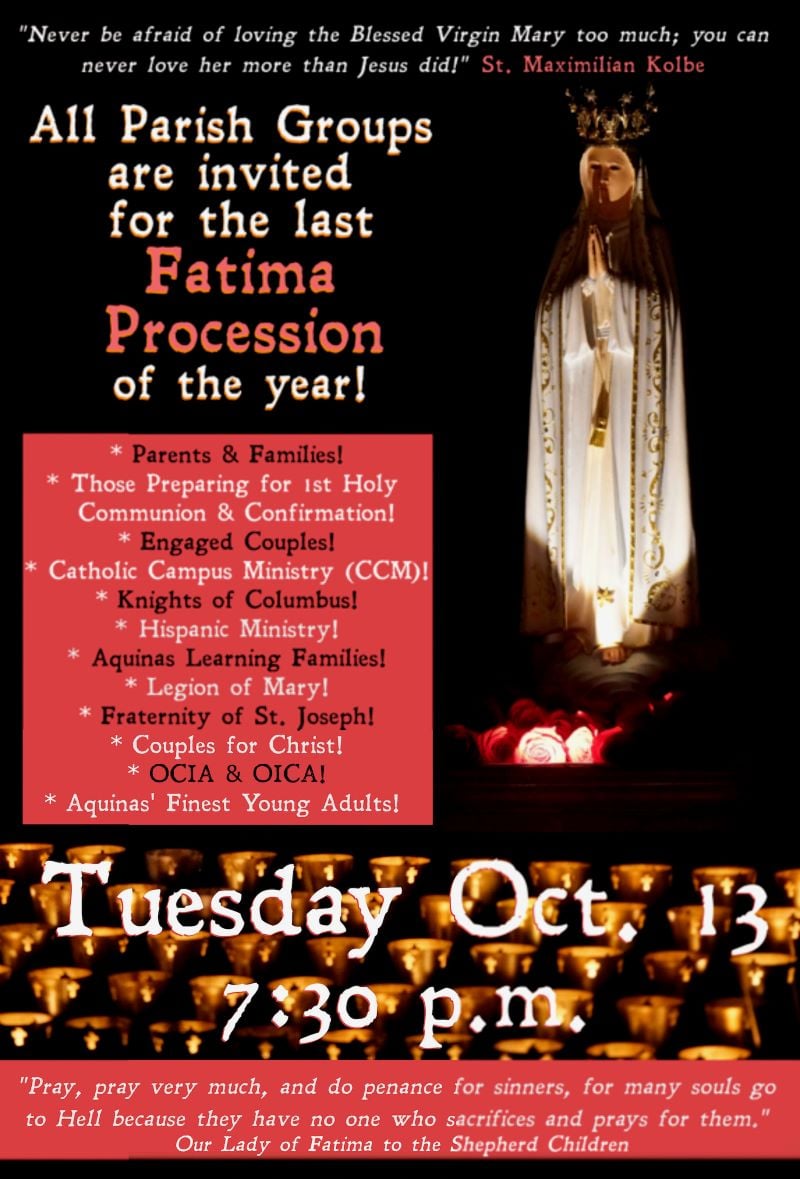
Fatima Procession at Saint Thomas Aquinas Parish – The final Fatima Procession of 2026 will be held on Tuesday October 13 at 7:30 p.m. All the faithful are invited to commemorate the 109th anniversary of the Miracle of the Sun. See the flyer at the end of this newsletter.
Support Saint Ann and Saint Thomas Parishes – Our parishes remain the anchor of our spiritual and community lives and continue to promote the sacred traditions, devotions, speakers and catechesis important for the spiritual growth of ourselves and our families. They also need our continued financial support (and occasional visits!). Both parishes would appreciate our continued generosity.
Bishop Martin issues Pastoral Letter to the Faithful Associated with the Society of Saint Pius X
LiveMass.net – Want to watch a Latin Mass online? The Priestly Fraternity of Saint Peter (FSSP) has a broadcast apostolate which streams its Latin Masses across the world at various times of the day. To view visit: https://www.livemass.net/
Rosary for the Traditional Latin Mass – A Rosary is offered for the restoration of the Traditional Latin Mass in the church on Sundays after the 11:30 a.m. Novus Ordo Mass at Saint Thomas Aquinas Church.
Daily Holy Face Chaplet for Sacred Liturgy (perpetual novena) – For the preservation of the Traditional Latin Mass, it has been recommended to all friends of the sacred liturgy in the diocese to consider continually praying the powerful Holy Face chaplet, under the banner of Our Lady of the Holy Name. To pray the chaplet, please see this link.
Cardinal Burke’s Prayer for Pope Leo XIV – His Eminence Cardinal Raymond Burke has released a prayer for Pope Leo XIV. Please see the prayer at the links below and consider praying this daily for the Holy Father as he leads the Church. PDF copies can be accessed at these links: [English] [Español] [Latin]
Holy Face Devotions
Prayers of Reparation to the Holy Face of Jesus are offered each week at the following churches on the indicated days:
- St. James (Concord) – Monday, 10-10:30 a.m. (in the cry room)
- St. Mark – Tuesday, 5:30 p.m.
- St. Thomas Aquinas – Tuesday, 6:00 a.m.
- St. Ann – Tuesday, 7:30 a.m. (following 7:00 a.m. Mass)
- St. Michael the Archangel (Gastonia) – Tuesday, 8:30 a.m. (following 8:00 a.m. Mass)
- St. Vincent de Paul – Tuesday, 8:40 a.m.
- Holy Spirit (Denver) – Tuesday, 10-11:00 a.m. (following the 9:15 a.m. Mass)
- Saint Elizabeth of the Hill Country (Boone) – Third Tuesday, at 6:45 p.m. after Mass in the Youth Room (League of St. Martin chapter)
- St. John the Baptist (Tryon) - First Saturday, 9:30 a.m. (after 8:30 a.m Mass)
Note: Days and times may be subject to change due to holidays.
“Jesus, Your ineffable image is the star which guides my steps. Ah, You know, Your sweet Face is for me Heaven on earth” (from Canticle to the Holy Face by Saint Thérèse de Lisieux, the 19th century Discalced Carmelite nun who took the name in religion, Thérèse of the Child Jesus and the Holy Face).
Traditional Latin Mass and Liturgical News
- September Embertide and the Christianizing of Eden by Fr. William Rock, FSSP, The Missive (September 20, 2021). [September Embertide]
- Liturgical Notes on the Ember Days of September by Greg DiPippo, New Liturgical Movement (September 17, 2025). [Liturgical Notes on the Ember Days]
- Our Lady of Sorrows, Our Lady of Clear Creek Abbey (September 15, 2026). [Our Lady of Sorrows]
- Ember Days: Pre-55, 1962, and Today by Matthew Plese, OnePeterFive (September 16, 2026). [Ember Days]
- Blessings of Crosses and Crucifixes by Fr. William Rock, FSSP, The Missive (September 10, 2026). [Blessing of Crosses and Crucifixes]
- Our Lady and the Cathedral of Chartres by Greg DiPippo, New Liturgical Movement (September 10, 2026). [Cathedral of Chartres]
- A Roman in America: Carmine Carapella and a Palladian Vision for Contemporary Catholic Architecture by Shawn Tribe, Liturgical Arts Journal (September 15, 2026). [A Roman in America]
- Scapular of Our Lady of Ransom by Fr. William Rock, FSSP, The Missive (September 1, 2025). [Our Lady of Ransom]
- Bishop consecrates new Our Lady of the Mountains Church by Lisa Geraci, Catholic News Herald (September 8, 2026). [Our Lady of the Mountains Church]
- Faithful invited to witness historic beatification of Georgia Martyrs, Catholic News Herald (July 31, 2026). [Georgia Martyrs]
Saints and Special Observances
Ss. Jean de Brebeuf, Isaac Jogues and Companions, Martyrs is one of the “Proper Feasts Celebrated in the Dioceses of the United States” listed in the 1962 edition of the Roman Missal. The feast may be celebrated either on September 26th or on October 19th. The life of St. Jean de Brebeuf will be sketched here; that of St. Isaac Jogues will be addressed in this space in October.
Jean de Brébeuf was born on March 25, 1593, in Condé-sur-Vire, Normandy. He entered the Society of Jesus in 1617 after completing his university studies and taught at the College of Rouen for several years, surviving an attack of tuberculosis in 1620 that threatened to bring his religious career to an early end. Ordained to the priesthood on February 19, 1622, he subsequently responded to an appeal issued by the Franciscan Recollets for the members of other orders to assist in the evangelization of the inhabitants of North America. Arriving in Québec on June 19, 1625, along with four other Jesuits, he accompanied a group of Montagnais on a hunting expedition that lasted from October through the ensuing winter. During this time, he learned not only how the native people lived but much about the languages that they spoke.
In The Jesuits in North America in the Seventeenth Century, Francis Parkman calls Jean de Brébeuf “that masculine apostle of the Faith,--the Ajax of the mission” and describes him as “a tall, strong man, with features that seemed carved by Nature for a soldier, but which the mental habits of years had stamped with the visible impress of the priesthood.” Having survived a disease that normally killed those who contracted it, the Jesuit missionary would display astonishing hardihood and unmatched fortitude throughout his years in New France and especially at the end in his martyrdom.
When a group of Hurons returning to their home territory in July of 1626 offered the Jesuit missionaries the opportunity to accompany them, they at first refused to take Brébeuf, considering him too large to be carried safely in a canoe. They only relented when sufficient payment was provided along with a promise that the Frenchman would not move while in the canoe. When the party approached waterfalls or other impediments that made it necessary to carry the craft overland for some distance, the size and strength of Brébeuf served well and earned the priest the name of Echon (“the man who carries the load”).
Devoting himself to the study of Huron customs and beliefs, Jean de Brébeuf also learned their language, prepared a grammar and phrase book, and translated the catechism for use in proselytizing the native people. He had little success in securing conversions to Christianity before being ordered back to France in July of 1629 due to hostilities between the French and English in Canada. He went back to teaching in Rouen until the restoration of peace allowed him to return to Québec in May of 1633. The Hurons, traveling in a downsized convoy because their numbers had been reduced by an epidemic, were unwilling to carry all of the Jesuit missionaries back to their home country but agreed to take Echon and one other priest, Fr. Anthony Daniel. Later joined by another priest and five lay helpers, the missionaries constructed a cabin just outside the Huron village; and Brébeuf went to work teaching the others the customs and language of the Huron people. In 1635 they undertook the hard work of evangelization, catechizing children during the day and adults at night. At the end of a year, they had baptized a dozen people: four infants and eight adults at the point of death.
Fr. Brébeuf and his companions were frequently in danger of being condemned by the Huron people they lived among and sought to convert to Christianity. When disease or famine struck, the people blamed the new religion the Frenchmen sought to impose on them; clinging to their old beliefs, sometimes it seemed only right that the interlopers should forfeit their lives to make things right again. Ultimately, a council of the Huron nation, convened in March of 1640, determined that all of the Jesuit missionaries should be put to death.
Moving to the mission headquarters at Sainte-Marie, Brébeuf escaped the sentence of death and renewed the work of evangelization with a tribe known as the Neutrals, only to be accused of plotting with the Seneca clan of the Iroquois against the people who had taken him in. He was forced to flee to Québec, where he remained for three years before returning to Saint-Marie. During his absence, the threat posed by the hostile Iroquois people had escalated; and two priests, Fr. Anthony Daniel and Fr. Isaac Jogues, had already been martyred.
On March 15, 1649, Brébeuf and Fr. Gabriel Lalemant left the mission to make their weekly tour of the Huron villages. They were staying that night in the one the missionaries called Saint-Louis when the Iroquois attacked another nearby village. The Huron women and children ran to hide in the forest; the two Jesuits remained with the men, most of whom were baptized Christians by this time. When the Iroquois overwhelmed the village defenses at dawn, the Hurons who remained alive were taken captive along with the two priests. Someone revealed the identity of Jean de Brébeuf as Echon, the most formidable shaman among the cassock-clad foreigners; and he was singled out for especially harsh treatment.
After an initial torture session at Saint-Louis, Brébeuf and Lalemant were stripped and forced to run naked through the snow to the Iroquois village. Other captives had already been assembled there; all were forced to run the gauntlet and were beaten mercilessly. Then the two Jesuits were tied to posts to be killed slowly in a manner meant to maximize the pain inflicted on the condemned. The cruelty of it exceeded even that of the English authorities who, while claiming to be Christians, tortured and executed many more Catholics during the same century. Scalded with hot irons and torched from head to toe, Jean de Brébeuf continued to stand tall, exhorting the Christians present to remain firm in the Faith. The Iroquois responded by ripping off his skin, slicing off his lower lip, shoving a hot torch down his throat, and cutting off his feet. They also poured boiling water over his head to mock the sacramental rite by which some 7,000 native inhabitants of North America had been brought into the Church by the Jesuit mission. After four hours they finally managed to stop his beating heart by ripping it from his chest and eating it.
The bodies of Fathers Brébeuf and Lalemant were recovered five days after their martyrdom and transported to Sainte-Marie for proper burial. Jean de Brébeuf was known to be a visionary whose love of Christ was such that he longed for martyrdom as the only adequate expression of the love he felt for Our Lord. Numerous miracles have been associated with his relics. He was beatified on June 12, 1925, and canonized by Pope Pius XI on June 29, 1930. The twin feast days of September 26th and October 19th are shared by eight Jesuit martyrs in all: Fathers Jean de Lalande, Isaac Jogues, Anthony Daniel, Charles Garnier, and Noel Chabanel; René Goupil, an oblate; Father Jean de Brébeuf and Father Gabriel Lalemant.
Closing Commentary
We offer, in closing, an excerpt from the commentary of Dom Prosper Guéranger, OSB, on “The Seventeenth Sunday after Pentecost,” followed by a link to the full text of the commentary from The Liturgical Year.
The Seventeenth Sunday after Pentecost
The Gospel, which is now assigned to the Mass of the seventeenth Sunday, has given it the name of the Sunday of the love of God, dating, that is, from the time when the Gospel of the cure of the dropsy and of the invitation to the wedding-feast, was anticipated by eight days. Previously, even, to that change, and from the very first, there used to be read on this seventeenth Sunday, another passage from the New Testament which is no longer found in this serial of Sundays: it was the Gospel which mentions the difficulty regarding the resurrection of the dead, which the Sadducees proposed to our Lord.
Mass.—The judgments of God are always just, whether it be, in his justice, humbling the proud or, in his mercy, exalting the humble. This day last week, we saw this Sovereign disposer of all things allotting to each his place at the divine banquet. Let us recall to mind the behavior of the guests and the respective treatment shown to the humble and the proud. Adoring these judgments of our Lord, let us sing our Introit; and as far as regards our own selves, let us throw ourselves entirely upon his mercy.
The most hateful of all the obstacles which divine love has to encounter upon earth is the jealousy of Satan, who endeavors, by an impious usurpation of his own, to rob God of the possession of our souls—souls, that is, which were created by and for Him alone. Let us unite with holy Church in praying, in the Collect, for the supernatural assistance we require for avoiding the foul contact of the hideous serpent.
The Church, by thus giving the words from St. Paul’s Epistle to the Ephesians, again takes up the subject so dear to her—the dignity of her children. She beseeches them to correspond, in a becoming manner, to their high Vocation. This Vocation, this Call, which God gives us is, as we have been so often told, the call, or invitation, made to the human family, that it would come to the sacred nuptials of the divine Union; it is the Vocation given to us to reign in heaven with the Word, who had made himself our Spouse, and our Head. The Gospel read to us eight days ago, which was formerly the one appointed for this present Sunday, and what thus brought into close connection with our Epistle—that Gospel, we say, finds itself admirably commented by these words of St. Paul to the Ephesians, and it, in turn, throws light on the Apostle’s words about the Vocation. When thou art invited to a Wedding (“cum vocatus fueris”) sit down in the lowest place! These were our Lord’s words to us last Sunday; and now, we have the Apostle saying to us: Walk worthy of the vocation in which ye are called, yes, walk in that vocation with all humility! [The Seventeenth Sunday after Pentecost]