Eleventh Sunday after Pentecost
Welcome to our weekly Sunday update. This Sunday is the Eleventh Sunday after Pentecost. The liturgy for this Sunday focuses on the importance of prayer and petition for our needs. In the Gospel for this Sunday, our Blessed Lord “groaned” to heaven to heal the deaf and dumb man (Mark 7:31-37), which, as St. Gregory the Great teaches, is to “teach us to groan to heaven to Him who reigns in heaven, that He may open our ears by the gift of the Holy Ghost, and by saliva from His mouth, that is, by the knowledge of His divine word, may loose our tongue, that it may be able to preach the truth.”
The St. Andrew Daily Missal (1945) notes the method of healing in this Gospel also mirrors the Rite of Baptism, where the priest places salt in the child’s mouth “and by the Holy Spirit, commands the unclean spirit to withdraw from the baptized person. Then he (the priest) takes a little saliva and touches the ears and the nostrils of the child with it, saying like our Lord: “Ephpheta”, open your heart to the things of faith…and the soul rises to a new life.”
Calendar of Special Observances
Celebrations are those listed in the Roman Missal of 1962.
DAY, DATE – FEAST (CLASS)
Sunday, August 9 – Eleventh Sunday after Pentecost (II)
Monday, August 10 – St. Laurence, Martyr (II)
Tuesday, August 11 – Feria (IV)
Wednesday, August 12 – St. Clare, Virgin (III)
Thursday, August 13 – Feria (IV) – Commemoration of Ss. Hyppolitus and Cassian, Martyrs
Friday, August 14 – Vigil of the Assumption (II) – Commemoration of St. Eusebius, Confessor
Saturday, August 15 – The Assumption of the Blessed Virgin Mary (I)
Eleventh Sunday after Pentecost
The links provided below can be used to download printable copies of the Proper Prayers for the Eleventh Sunday after Pentecost with English or Spanish translation, followed by commentary by Dr. Michael P. Foley.
Traditional Latin Mass Schedule
Diocese of Charlotte Sunday Masses
Chapel of the Little Flower (757 Oakridge Farm Road, Mooresville, NC)
- 10:00 a.m. (Low)
- 12:00 p.m. (Sung)
- Chaplain: Fr. Brandon Jones
- Chapel related questions? Email Father at: tlmchapel(at)rcdoc.org
- DONATE: To donate to the Chapel of the Little Flower click here (via Saint Ann Parish, Charlotte)
- More details: https://carolinaliturgy.org/chapel
Note: Only Sunday Latin Masses and Holy Days are offered at the Chapel. This is the only Diocese of Charlotte location which offers the Traditional Latin Mass.
Saint Thérèse of the Child Jesus and the Holy Face, the Little Flower, pray for us!
Diocese of Raleigh Sunday Masses
- 1:00 p.m., Sacred Heart (Dunn, NC)
- 4:30 p.m., - First Sunday, Holy Name Cathedral (Raleigh, NC)
- 5:00 p.m., - Fourth Sunday, Basilica of Saint Mary (Wilmington, NC)
- For additional locations and Masses please see our Mass Times webpage
Diocese of Charleston Sunday Masses
- 12:00 p.m., Prince of Peace (Taylors SC)
- 1:00 p.m., Our Lady of the Lake (Chapin SC)
- 12:00 p.m., Sacred Heart (Charleston SC)
- 5:30 p.m., Stella Maris (Sullivans Island, SC)
Diocese of Charleston Daily Traditional Latin Masses
- Prince of Peace (Taylors SC) – No daily Latin Mass this summer unless otherwise noted in the bulletin (see note below)
- For additional locations and Masses please see our Mass Times webpage
Note: The summer Mass schedule for Prince of Peace parish is in effect and according to the bulletin there will be no daily Latin Masses at Prince of Peace Monday-Saturday this summer.
As a reminder, travelers are urged to consult parish websites or offices for up-to-date information regarding possible changes in the schedule of Mass times.
Feast of the Assumption, Saturday August 15
The following are the announced Latin Masses for the Feast of the Assumption on Saturday August 15. According to the U.S. Bishops, the Assumption is not a holy day of obligation this year. If more Masses are scheduled, we will post them on our website.
- Prince of Peace (Taylors SC) – 8:00 a.m. (traditional blessing of herbs)
- Sacred Heart (Dunn, NC) – 10:30 a.m. (Missa Cantata)
- Our Lady of the Lake (Chapin SC) – 12:00 p.m.
The Chapel of the Little Flower will offer an External Solemnity of the Assumption on Sunday August 16. Father Jones will also bless herbs after the Masses (see Announcements below).
Propers for the Feast of the Assumption
- English (with Blessing of Herbs)
Chapel of the Little Flower Announcements
Mass Intentions for Sunday
Sunday August 9, 10:00 a.m. – Intentions of Bishop Michael Martin by the Cascio Family
Blessing of Herbs Sunday August 16
It is an ancient custom to have herbs blessed on the Feast of the Assumption. Since the Chapel will be offering the External Solemnity of the Assumption on Sunday August 16, Father Jones will kindly bless any herbs you bring after the Masses. To learn more about this tradition please click on this link.
Donations for the Chapel of the Little Flower
To donate to the Chapel of the Little Flower, please make out a check to “St. Ann Catholic Church” and carefully earmark it for “Latin Mass” or “Chapel of the Little Flower”. It can be mailed to the parish (3635 Park Road, Charlotte, NC 28209). To donate online, please visit the parish’s “Chapel of the Little Flower” online donation portal at this link.
Lost and Found
If one is missing a missal, book, or other item, please see the Lost and Found table in the cry room.
Father Jones’ Contact Info
If one has questions about the Chapel of the Little Flower, that are not related to one’s parish, please email Father Jones directly at: tlmchapel(at)rcdoc.org
Visiting the Chapel of the Little Flower
If you haven’t attended Mass at the Chapel of the Little Flower yet, you are welcome to join us. Seating is adequate at both Masses, and there is plenty of parking; a cry room; open space outside for the kids after Mass. Bulletins from Saint Ann and Saint Thomas Aquinas parishes are usually available.
General Announcements
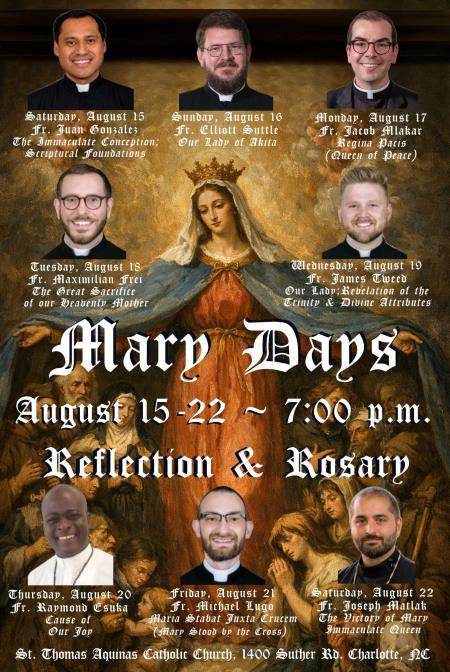
Mary Days Talks (August 15-22) – Saint Thomas Aquinas Parish's annual week-long Mary Days talks on the Blessed Virgin Mary will begin Saturday August 15 (Assumption) and conclude Friday August 22 (Feast of the Immaculate Heart of Mary). Talks will be at 7:00 p.m. daily, except on Thursday August 21, which will be a homily during the 7:00 p.m. Mass (Novus Ordo). To learn more see the flyer at the end of this update.
Support Saint Ann and Saint Thomas Parishes – Our parishes remain the anchor of our spiritual and community lives and continue to promote the sacred traditions, devotions, speakers and catechesis important for the spiritual growth of ourselves and our families. They also need our continued financial support (and occasional visits!). Both parishes would appreciate our continued generosity.
Bishop Martin issues Pastoral Letter to the Faithful Associated with the Society of Saint Pius X
LiveMass.net – Want to watch a Latin Mass online? The Priestly Fraternity of Saint Peter (FSSP) has a broadcast apostolate which streams its Latin Masses across the world at various times of the day. To view visit: https://www.livemass.net/
Rosary for the Traditional Latin Mass – A Rosary is offered for the restoration of the Traditional Latin Mass in the church on Sundays after the 11:30 a.m. Novus Ordo Mass at Saint Thomas Aquinas Church.
Daily Holy Face Chaplet for Sacred Liturgy (perpetual novena) – For the preservation of the Traditional Latin Mass, it has been recommended to all friends of the sacred liturgy in the diocese to consider continually praying the powerful Holy Face chaplet, under the banner of Our Lady of the Holy Name. To pray the chaplet, please see this link.
Cardinal Burke’s Prayer for Pope Leo XIV – His Eminence Cardinal Raymond Burke has released a prayer for Pope Leo XIV. Please see the prayer at the links below and consider praying this daily for the Holy Father as he leads the Church. PDF copies can be accessed at these links: [English] [Español] [Latin]
Holy Face Devotions
Prayers of Reparation to the Holy Face of Jesus are offered each week at the following churches on the indicated days:
- St. James (Concord) – Monday, 10-10:30 a.m. (in the cry room)
- St. Mark – Tuesday, 5:30 p.m.
- St. Thomas Aquinas – Tuesday, 6:00 a.m.
- St. Ann – Tuesday, 7:30 a.m. (following 7:00 a.m. Mass)
- St. Michael the Archangel (Gastonia) – Tuesday, 8:30 a.m. (following 8:00 a.m. Mass)
- St. Vincent de Paul – Tuesday, 8:40 a.m.
- Holy Spirit (Denver) – Tuesday, 10-11:00 a.m. (following the 9:15 a.m. Mass)
- Saint Elizabeth of the Hill Country (Boone) – Third Tuesday, at 6:45 p.m. after Mass in the Youth Room
- St. John the Baptist (Tryon) - First Saturday, 9:30 a.m. (after 8:30 a.m Mass)
Note: Days and times may be subject to change due to holidays.
“Jesus, Your ineffable image is the star which guides my steps. Ah, You know, Your sweet Face is for me Heaven on earth” (from Canticle to the Holy Face by Saint Thérèse de Lisieux, the 19th century Discalced Carmelite nun who took the name in religion, Thérèse of the Child Jesus and the Holy Face).
Traditional Latin Mass and Liturgical News
- The Vigil of St Lawrence by Greg DiPippo, New Liturgical Movement (August 9, 2025). [Vigil of St. Lawrence]
- The Cultural Legacy of Saint Clare by Dr. Michael P. Foley, New Liturgical Movement (August 12, 2022). [Legacy of Saint Clare]
- Faithful invited to witness historic beatification of Georgia Martyrs, Catholic News Herald (July 31, 2026). [Georgia Martyrs]
- Blessing of Grapes by Fr. William Rock, FSSP, The Missive (August 6, 2026). [Blessing of Grapes]
- A Double Scandal of Particularity by Dr. Michael P. Foley, New Liturgical Movement (July 31, 2026). [Double Scandal of Particularity]
- Video - Reliving History: Sydney’s Historic Glagolitic High Mass, Rorate Caeli (August 4, 2026). [Glagolitic High Mass]
- The Finding of the Relics of St. Stephen: Martyrdom and Easter Glory United by Matthew Plese, OnePeterFive (August 3, 2026). [Relics of St. Stephen]
- The Seven Defenders of Christendom: St. Patrick by Charles Coulombe, OnePeterFive (July 30, 2026). [St. Patrick]
Saints and Special Observances
The Assumption of the Blessed Virgin Mary was declared to be a dogma of the Catholic Church by Pope Pius XII on November 1, 1950. In his apostolic constitution entitled Munificentissimus Deus, the pope confirmed what Christians had believed for many centuries:
We pronounce, declare, and define it to be a divinely revealed dogma: that the Immaculate Mother of God, the ever-Virgin Mary, having completed the course of her earthly life, was assumed body and soul into heavenly glory.
Left unsaid by the pope was exactly what exactly the formula “assumed body and soul” involved. In choosing not to be more specific, he left unresolved a question about the Assumption that remains with us today: Did Mary, “having completed the course of her earthly life,” experience the separation of body and soul that is death – or was she, alone among all the men and women who have ever lived, spared death and transported directly to Heaven?
One answer to the question unposed by the pope would be that the Blessed Mother of Our Lord did, in fact, experience that separation universally associated with death, but that her body and soul were subsequently reunited in a resurrection, like that of her son, prior to being taken into Heaven. This has the appeal of recognizing that she was “only human” but like Jesus Himself was able to conquer death. Some have found a Scriptural basis for this view in what God said to the serpent in the Garden: “I will put enmities between thee and the woman, and thy seed and her seed: she shall crush thy head, and thou shalt lie in wait for her heel (Genesis 3:15).
The other answer – that Mary did not die but simply went straight to Heaven when she had “completed the course of her earthly life” – may seem to be more consistent with another Marian dogma pronounced a century before that of the Assumption. In the papal bull, Ineffabilis Deus, issued in 1854, Pope Pius IX declared the Blessed Virgin to be unique among all mankind:
We declare, pronounce, and define that the doctrine which holds that the most Blessed Virgin Mary, in the first instance of her conception, by a singular grace and privilege granted by Almighty God, in view of the merits of Jesus Christ, the Saviour of the human race, was preserved from all stain of original sin, is a doctrine revealed by God and therefore to be believed firmly and constantly by all the faithful.
As the consequence of original sin, incurred by Adam and Eve and their progeny unto the end of time, was death, one might believe that because Mary was “preserved from all stain of original sin” she was singularly exempted from the consequence imposed on the rest of humanity.
What are we to believe, since the Church leaves the actual details of the Assumption to our discretion? An early legend held that Mary did in fact die in the presence of all the Apostles except Thomas. He, having missed the obsequies and perhaps even doubting her demise, insisted that her coffin be opened, so that he could view the remains. The others, choosing to indulge “doubting Thomas,” did as he asked, only to discover that the coffin, like the tomb in which Our Lord had been laid, was empty.
Pope St. John Paul II, who was greatly devoted to Our Lady, believed that, like Our Lord, she had risen from the dead before her Assumption into Heaven. The opinion of the faithful has been divided on the matter from the beginning and will presumably remain so until that day when our souls are reunited with our bodies at the Final Judgement. Nevertheless, there seems to be a growing consensus in favor of the idea that Mary died, as all of us will, but rose again, as Jesus had done – unlike the rest of us who will not rise in our bodies until that last day.
The Assumption of the Blessed Virgin Mary is celebrated by the Church each year on the 15th of August.
Closing Commentary
In closing, we offer commentary on the Eleventh Sunday after Pentecost excerpted from The Liturgical Year of Dom Prosper Guéranger, OSB, followed by a link to the full text.
Eleventh Sunday after Pentecost
With the Greeks, this Sunday—their eleventh of Saint Matthew—is called The Kings Parable, who calls his servants to account. In the Western Church, it has gone under the name of Sunday of the deaf and dumb, ever since the Gospel of the Pharisee and Publican has been assigned to the tenth. Today’s Mass, as we now have it, still gives evidence as to what was its ancient arrangement. Our commentary on today’s liturgy will show us this very plainly.
In those years when Easter falls nearest to the 21st of March, the Books of Kings are continued as lessons of Matins up to, but never beyond, this Sunday. The sickness of the good king Ezechias, and the miraculous cure he obtained by his prayers and tears are then the subject of the first Lessons of the Night Office.
Mass.—The learned and pious Abbot Rupert—writing on this Sunday’s Mass previous to the change made in the order of the Gospel Lessons—thus explains the Church’s reason for selecting the following Introit: “The Publican, in the Gospel, accuses himself, saying: I am not worthy to lift up mine eyes to heaven! St. Paul, in the Epistle, does in like manner, and says: I am the least of the Apostles, who am not worthy to be called an Apostle, because I persecuted the Church of God. As, then, this Humility, which is set before us that we may practice it, is the guardian of the union between the servants of God, because if keeps them from being puffed up one against the other—it is most appropriate that we should first sing the Introit, which tells us that God maketh men, in His house, abide together as though they were but one soul.”
The Collect, which follows, is most touching, when we see it in the light of the Gospel which, originally, was fixed for this Sunday. Thou that connection has now been broken, yet the appropriateness is still very striking; for the Epistle, as Abbot Rupert was just telling us, continues to urge us to Humility, by proposing to us the example of St. Paul; the Humility of the repentant Publican has been anticipated. Our Mother the Church is all emotion at beholding this Publican—this object of contempt to the Jew—striking his breast, and scarce able to put his sorrow into words: she, with motherly tenderness, comes and takes up his faltering prayer, and gives it her own eloquence. Nothing could exceed the delicate way in which she asks of the Omnipotent, that in his infinite mercy, he would restore peace to troubled consciences, by pardoning them their sins, and granting them what they, poor sinners, are too afraid to presume to ask for. [Eleventh Sunday after Pentecost]