Twenty-fourth and Last Sunday after Pentecost
Friends in Christ,
Welcome to our weekly Sunday update. This Sunday is the Twenty-fourth and Last Sunday after Pentecost. Because the date of Easter (and thus of Pentecost) varies from one year to the next, the number of Sundays intervening between Pentecost and the First Sunday of Advent may be as many as twenty-eight but not less than twenty-four. The last Sunday before Advent is always designated the twenty-fourth after Pentecost. When there are more than twenty-four intervening, the gap in the liturgical calendar is filled by the resumption of Sundays after Epiphany. The last Sunday after Pentecost being the last of the liturgical year, it is fitting that the liturgy directs our attention to the end of days: the final triumphant consummation of God’s work with regard to His Creation. The Last Judgment calling humanity to account will be preceded by a period of “great tribulation” described by Our Lord in the Gospel reading for this last Sunday of the year: For there shall be then great tribulation, such as hath not been from the beginning of the world until now, neither shall be . . . but for the sake of the elect those days shall be shortened.
Calendar of Special Observances
Celebrations are those listed in the Roman Missal of 1962.
DAY, DATE – FEAST (CLASS)
Sunday, November 22 – Twenty-fourth and last Sunday after Pentecost (II)
Monday, November 23 – St. Clement I, Pope and Martyr (III) – Commemoration of St. Felicity, Martyr
Tuesday, November 24 – St. John of the Cross, Confessor and Doctor (III) – Commemoration of St. Chrysogonus, Martyr
Wednesday, November 25 – St. Catherine of Alexandria, Virgin and Martyr (III)
Thursday, November 26 – St. Sylvester, Abbot (III) – Commemoration of St. Peter Alexandrinus, Bishop and Martyr
Friday, November 27 – Our Lady of the Miraculous Medal (IV) / Feria (IV)
Saturday, November 28 – Our Lady on Saturday (IV)
Twenty-fourth and Last Sunday after Pentecost
The links provided below can be used to download printable copies of the Proper Prayers for the Twenty-fourth and Last Sunday after Pentecost with English or Spanish translations, followed by commentary by Dr. Michael P. Foley.
Traditional Latin Mass Schedule
Diocese of Charlotte Sunday Masses
Chapel of the Little Flower (757 Oakridge Farm Road, Mooresville, NC)
- 10:00 a.m. (Low)
- 12:00 p.m. (Sung)
- Chaplain: Fr. Brandon Jones
- Chapel related questions? Email Father at: tlmchapel(at)rcdoc.org
- DONATE: To donate to the Chapel of the Little Flower click here (via Saint Ann Parish, Charlotte)
- More details: https://carolinaliturgy.org/chapel
Note: Only Sunday Latin Masses and Holy Days are offered at the Chapel. This is the only Diocese of Charlotte location which offers the Traditional Latin Mass.
Saint Thérèse of the Child Jesus and the Holy Face, the Little Flower, pray for us!
Diocese of Raleigh Sunday Masses
- 1:00 p.m., Sacred Heart (Dunn, NC)
- 4:30 p.m., - First Sunday, Holy Name Cathedral (Raleigh, NC)
- 5:00 p.m., - Fourth Sunday, Basilica of Saint Mary (Wilmington, NC)
- For additional locations and Masses please see our Mass Times webpage
Diocese of Charleston Sunday Masses
- 12:00 p.m., Prince of Peace (Taylors SC)
- 1:00 p.m., Our Lady of the Lake (Chapin SC)
- 12:00 p.m., Sacred Heart (Charleston SC)
- 5:30 p.m., Stella Maris (Sullivans Island, SC)
Diocese of Charleston Daily Traditional Latin Masses
- Prince of Peace (Taylors SC) – Monday - Friday, 12 noon
- Prince of Peace (Taylors SC) – Saturday, 8:00 a.m.
- For additional locations and Masses please see our Mass Times webpage
As a reminder, travelers are urged to consult parish websites or offices for up-to-date information regarding possible changes in the schedule of Mass times.
Advent Latin Mass Schedule
Feast of the Immaculate Conception - Tuesday December 8 (as announced)
- 7:00 p.m., Chapel of the Little Flower (Mooresville NC)
- 12 noon, Prince of Peace (Taylors SC)
- 6:30 p.m., Our Lady of the Lake (Chapin SC)
Reminder: The Feast of the Immaculate Conception is a Holy Day of Obligation.
Rorate Traditional Latin Masses
- Saturday December 5, 6:30 a.m., Prince of Peace (Taylors SC) - Low Mass with hymns
- Saturday December 12, 6:30 a.m., Prince of Peace (Taylors SC) - Solemn High Mass
- Saturday December 19, 6:30., Prince of Peace (Taylors SC) - Low Mass
A Rorate Mass is a beautiful Mass by candlelight before dawn during a Saturday in Advent, honoring Our Lady and the expectation of the Light of the World being born on Christmas.
Chapel of the Little Flower Announcements
Mass Intentions for Sunday
Sunday November 22, 12:00 p.m. – Repose of the soul of Tom Savoy (+) and consolation of the family
Feast of the Immaculate Conception - Tuesday December 8, 7pm (Holy Day of Obligation)
The Chapel will offer a 7:00 p.m. Mass on the Feast of the Immaculate Conception, Tuesday December 8. This is a Holy Day of Obligation.
Support Sacred Music at the Chapel by Joining the Schola and Choir
Saint Paul exhorts us "Be filled with the Spirit...singing and making melody to the Lord with all your heart" (Ephesians 5:18-19) and St. Augustine teaches us that “singing belongs to those who love.” Please consider lending your musical talents toward beautifying the sacred liturgy here at the Chapel of the Little Flower. If one would like more information about joining the schola and choir, please contact the Chapel music director whose contact information is at the bottom of the hymn sheets found on the table in the narthex. Thank you for your generosity.
Music Sheets Available in the Narthex
A reminder that music sheets are available in the narthex so that one may join in or follow along with the singing at the sung Mass.
Saint Ann Parishioner Catholic School Check In
If one is a parishioner at St. Ann parish and has children enrolled in the Catholic schools, please scan the QR code found on the table/wall in the narthex of the Chapel. This is the new attendance check in system.
Donations for the Chapel of the Little Flower
To donate to the Chapel of the Little Flower, please make out a check to “St. Ann Catholic Church” and carefully earmark it for “Latin Mass” or “Chapel of the Little Flower”. It can be mailed to the parish (3635 Park Road, Charlotte, NC 28209). To donate online, please visit the parish’s “Chapel of the Little Flower” online donation portal at this link.
Lost and Found
If one is missing a missal, book, or other item, please see the Lost and Found table in the cry room.
Father Jones’ Contact Info
If one has questions about the Chapel of the Little Flower, that are not related to one’s parish, please email Father Jones directly at: tlmchapel(at)rcdoc.org
Join Us at the Chapel of the Little Flower
If you haven’t attended Mass at the Chapel of the Little Flower yet, you are welcome to join us. Seating is adequate at both Masses, and there is plenty of parking; a cry room; open space outside for the kids after Mass. Bulletins from Saint Ann and Saint Thomas Aquinas parishes are usually available.
General Announcements
*New* Classic Catholic Novels for Children and Youth: Saint Bosco Books, a new publisher of Catholic books in Texas, has just reprinted several old Catholic novels for children and youth. These chapter books are written with a Catholic worldview, have been reviewed by adults and loved by children of various ages. These novels make a great Christmas gift. Visit: https://saintboscobooks.com/
Enroll the Souls of the Faithful Departed – The Traditional Carmelite Hermits of Our Lady of Mt. Carmel (Colorado and Pennsylvania) are offering an All Souls Enrollment during the month of November. Throughout November, the community will dedicate 30 Holy Masses (Traditional Carmelite Rite), along with the daily prayers and sacrifices of the Hermits, for the souls of the faithful departed who are enrolled. To learn more or enroll, click here.
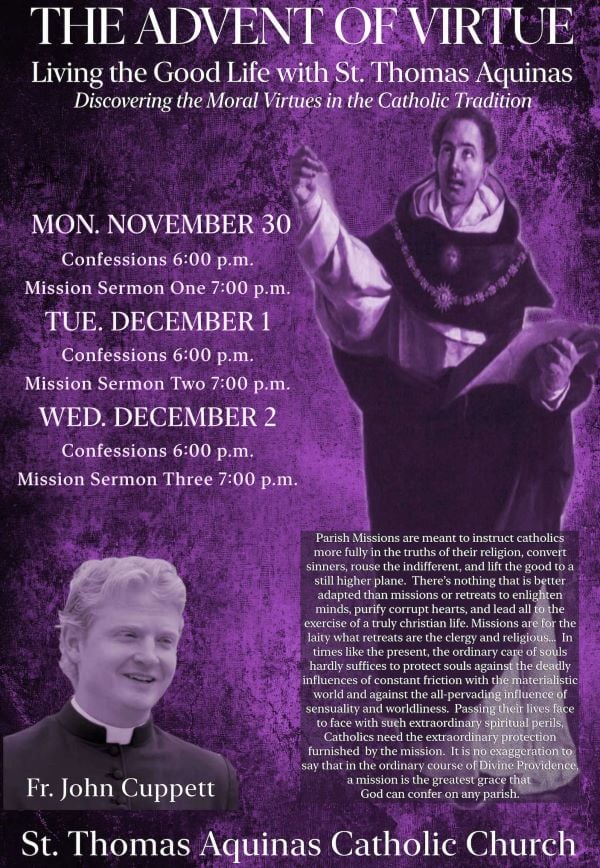
Saint Thomas Aquinas Advent Mission with Fr. Cuppett – Saint Thomas Aquinas parish in Charlotte is holding an Advent mission at 7:00 p.m. from Monday November 30 – Wednesday December 2nd. Confessions will be offered beforehand at 6:00 p.m. The retreat will be led by Fr. James Cuppert (Christ the King High School Chaplain) and is entitled: The Advent of Virtue: Discovering the Moral Virtues in the Catholic Tradition. See flyer at the end of this update.
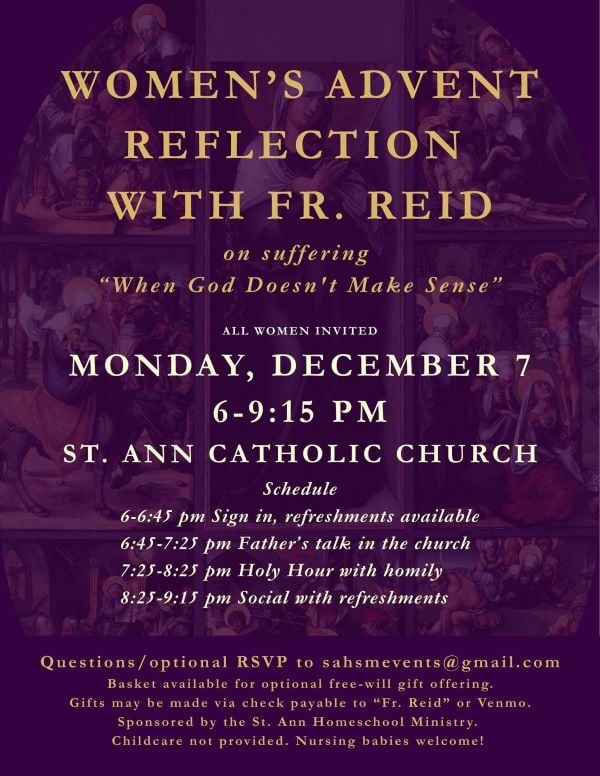
Saint Ann’s Women’s Advent Reflection with Fr. Reid - A Women’s Advent Reflection will be held at Saint Ann parish on Monday December 7 from 6:15 - 9:00 p.m. Father Reid will lead a reflection on the topic of suffering, “When God Doesn’t Make Sense”. The event will also include a Holy Hour followed by a social hour with refreshments. To learn more please see the flyer at the end of this update.
Support Saint Ann and Saint Thomas Parishes – Our parishes remain the anchor of our spiritual and community lives and continue to promote the sacred traditions, devotions, speakers and catechesis important for the spiritual growth of ourselves and our families. They also need our continued financial support (and occasional visits!). Both parishes would appreciate our continued generosity.
Bishop Martin issues Pastoral Letter to the Faithful Associated with the Society of Saint Pius X
LiveMass.net – Want to watch a Latin Mass online? The Priestly Fraternity of Saint Peter (FSSP) has a broadcast apostolate which streams its Latin Masses across the world at various times of the day. To view visit: https://www.livemass.net/
Rosary for the Traditional Latin Mass – A Rosary is offered for the restoration of the Traditional Latin Mass in the church on Sundays after the 11:30 a.m. Novus Ordo Mass at Saint Thomas Aquinas Church.
Daily Holy Face Chaplet for Sacred Liturgy (perpetual novena) – For the preservation of the Traditional Latin Mass, it has been recommended to all friends of the sacred liturgy in the diocese to consider continually praying the powerful Holy Face chaplet, under the banner of Our Lady of the Holy Name. To pray the chaplet, please see this link.
Cardinal Burke’s Prayer for Pope Leo XIV – His Eminence Cardinal Raymond Burke has released a prayer for Pope Leo XIV. Please see the prayer at the links below and consider praying this daily for the Holy Father as he leads the Church. PDF copies can be accessed at these links: [English] [Español] [Latin]
Holy Face Devotions
Prayers of Reparation to the Holy Face of Jesus are offered each week at the following churches on the indicated days:
- St. James (Concord) – Monday, 10-10:30 a.m. (in the cry room)
- St. Mark – Tuesday, 5:30 p.m.
- St. Thomas Aquinas – Tuesday, 6:00 a.m.
- St. Ann – Tuesday, 7:30 a.m. (following 7:00 a.m. Mass)
- St. Michael the Archangel (Gastonia) – Tuesday, 8:30 a.m. (following 8:00 a.m. Mass)
- St. Vincent de Paul – Tuesday, 8:40 a.m.
- Holy Spirit (Denver) – Tuesday, 10-11:00 a.m. (following the 9:15 a.m. Mass)
- Saint Elizabeth of the Hill Country (Boone) – Third Tuesday, at 6:45 p.m. after Mass in the Youth Room (League of St. Martin chapter)
- St. John the Baptist (Tryon) - First Saturday, 9:30 a.m. (after 8:30 a.m Mass)
Note: Days and times may be subject to change due to holidays.
“Jesus, Your ineffable image is the star which guides my steps. Ah, You know, Your sweet Face is for me Heaven on earth” (from Canticle to the Holy Face by Saint Thérèse de Lisieux, the 19th century Discalced Carmelite nun who took the name in religion, Thérèse of the Child Jesus and the Holy Face).
Traditional Latin Mass and Liturgical News
- Blessing of Bird Meat by Fr. William Rock, FSSP, The Missive (November 9, 2026). [Blessing of Bird Meat]
- Liturgical Notes on the Presentation of the Virgin Mary by Greg DiPippo, New Liturgical Movement (November 21, 2024). [Presentation of the Virgin Mary]
- The Blessing of Fire by Fr. William Rock, FSSP, The Missive (November 17, 2025). [The Blessing of Fire]
- The Feast of the Presentation of the Blessed Virgin Mary by Dr. Michael P. Foley, New Liturgical Movement (November 20, 2026). [The Feast of the Presentation History]
- St Gertrude the Great on Praying for the Dead by Greg DiPippo, New Liturgical Movement (November 16, 2026). [St Gertrude the Great]
- Please Support The New Liturgical Movement and The Church Music Association of America by Fr. Robert Pasley, New Liturgical Movement (November 16, 2026). [Support New Liturgical Movement]
- Priestly Fraternity of Saint Peter: Now over 600 members, 25 priestly ordinations this year, Rorate Caeli (November 13, 2026). [FSSP now over 600 members]
- Blessed are the meek: Reflections on the Georgia Martyrs by Deacon Matthew Newsome, Catholic News Herald (November 11, 2026). [Blessed are the meek]
- Clergy in the Charlotte diocese linked to the First Thanksgiving, Catholic News Herald (December 1, 2025). [Clergy Linked to First Thanksgiving]
- The first Thanksgiving Mass in the New World, Catholic News Herald (November 18, 2022). [First Thanksgiving Mass]
- Researchers explore misconceptions about Latin Mass community by McKenna Snow, Zeale (November 5, 2026). [Misconceptions about Latin Mass community]
Saints and Special Observances
St. Catherine of Alexandria, Virgin and Martyr, and St. Peter, Bishop of Alexandria, Martyr, appear on the traditional liturgical calendar back-to-back, St. Catherine on November 25th and St. Peter on the 26th. As both are associated with the Egyptian city of Alexandria, one naturally wonders if they might have lived at the same time as well as in the same place. As far as they can be known, these are the facts:
Both were born in Alexandria in the latter part of the third century. Peter was highly educated and served as head of the school at Alexandria before being elected Patriarch of the city in 302. His tenure as patriarch lasted ten years, but he spent much of that time in exile due to the persecution of Christians initiated in 303. The legal rights of Christians were rescinded in that year with the adoption of laws requiring their compliance with traditional pagan religious practices. Peter continued to lead and instruct his flock by letters written from afar. He also made secret visits to the city to conduct services and to encourage and assist those imprisoned, widowed or orphaned. He remained a stout defender of orthodox Christianity throughout this time but urged leniency with regard to those who sought to save their lives by bowing to the demands exerted by the civil authority. He was captured and imprisoned in 311 and beheaded by order of the emperor. The last, most violent and widespread of persecutions came to an end two years later when the Edict of Milan restored the rights of Christians.
While there is no solid evidence regarding the date of St. Catherine’s birth, it is believed she was born around 287. She is said to have had a vision of the Child Jesus with the Virgin Mary that led her to become a Christian when she was about fifteen. Tradition holds that she was of noble birth, beautiful and devoted to learning. As her conversion likely occurred around the time Peter ascended to the patriarchate, it is conceivable that she studied under him and may have come to know him before he became patriarch of Alexandria.
Catherine is credited with winning hundreds of converts to Christianity prior to her martyrdom at the age of eighteen in the year 305. She is said to have rebuked the emperor Maxentius for the cruelty of the persecutions already underway at the time of her conversion. He responded by assembling fifty learned men to debate the young woman who dared to defy him. Some among them, swayed by her arguments, decided to become Christians; put to the sword, they became martyrs as well.
The emperor had Catherine imprisoned and subjected to cruel torture. Hundreds who came to visit her in prison were converted to Christianity, many of them suffering martyrdom. Deciding to eliminate the nuisance she posed once and for all, the emperor devised an especially terrible way in which to kill her. He had blades fixed to the outer rim of a breaking wheel in such a way that when she was rolled along on it, she would hacked to pieces. But when the soldiers began to roll the wheel, the blades flew off, sparking flashes like lightning in all directions. Rather than undertake the construction of a new wheel, the frightened soldiers beheaded their prisoner on the spot. This incident eventually gave rise to the celebration of her feast day with pyrotechnic displays featuring fireworks known by the name “Catherine’s Wheel” that, spinning around, emitted sparks in all directions.
St. Catherine is considered one of the Fourteen Holy Helpers whose intercession in heaven is thought to be especially efficacious when invoked by the prayers of the faithful. St. Joan of Arc identified her as one of the saints who appeared to her to offer encouragement and counsel. A flight of angels is said to have recovered Catherine’s body when she died and carried it to Mount Sinai for burial. There is a monastery there named in her honor.
The feast of St. Catherine was actually removed from the liturgical calendar when the General Roman Calendar was revised in 1969. It was restored as an optional memorial in 2002. The feast of this great saint remains, of course, on the traditional liturgical calendar of 1962.
Closing Commentary
We offer, in closing, an excerpt from Dom Prosper Guéranger’s commentary on the “Twenty-fourth Sunday after Pentecost.” A link to the full text from The Liturgical Year follows.
Twenty-fourth Sunday after Pentecost
Several times, during Advent, we meditated on the circumstances which are to accompany the Last Coming of Christ our Lord; and in a few days, the same great teachings will be again brought before us, filling our souls with a salutary fear. May we, then, be permitted, on this last Sunday of our Liturgical Year, to address ourselves in a prayer of desire and praise to our adorable Lord and King, the solemn honor whose Judgment is to be the consummation of his work, and the signal of his triumph.
Oh Jesus! who then art to come to deliver thy Church and avenge that God who has so long borne every sort of insult from his creature man, that day of thy coming will indeed be terrible to the sinner! He will then understand how the Lord hath made all things for himself, all, even the ungodly who, on the evil day, is to show forth the divine justice. The whole world, fighting on his side against the wicked shall then, at last, be avenged for that slavery of sin, which had been forced upon it. Vainly will the wicked cry out to the rocks to fall upon them and hide them from the face of him who then be seated on his throne: the abyss will refuse to engulf them: in obedience to him who holds the keys of death and hell, it will give forth, to a man, its wretched victims and set them at the foot of the dread tribunal. O Jesus, how magnificent will not thy power then appear! The heavenly hosts will also be standing around thee, forming thy brilliant court and assembling thy elect from the four quarters of the earth.
For we also, we thy redeemed, who had become thy members by becoming the members of thy beloved Church—we are to be there on that day, and our place, O ineffable mystery! is to be the one thou hast reserved for thy Bride, it is to be thy own throne, where seated, we shall judge the very angels. Even now, all those blessed of the Father, all those elect, whose youth, like that of the eagle, has been so often renewed by their receiving thy precious Blood—have they not had their eyes fitted to gaze, and without being dazzled, on the Sun of Justice, when he shall appear in the heavens? The tediousness of their long exile has given such keenness to their hunger that nothing will have power to stay their flight, once the sacred prey of thy divine Body shall be shown them! What hindrance could be strong enough to check the impetuosity of the love which will bring them all together to the banquet of the eternal Pasch? The trumpet of the Archangel, which will ring through the graves of the just, is to be a summons calling them not to death, but to life—to the sight of the old enemy’s destruction—to a redemption, which is to include their very bodies—to the unimpeded passover to the true Land of promise—in a word, to the Pasch, and this tie, quite real, and for all, and forever. What will not be the joy of that true Day of the Lord!—what joy for them that have, by faith, lived in Christ and loved him without seeing him! Identifying themselves with thee, O Jesus, notwithstanding the weakness of the flesh, they have continued here below thy life of suffering and humiliation: what a triumph when, delivered forever from sin and vested in their immortal bodies, they shall be borne aloft before thy face, that they may forever be with thee! [Twenty-Fourth Sunday after Pentecost]