Twelfth Sunday after Pentecost
Dear Friends in Christ,
Welcome to our weekly Sunday update. This Sunday is the Twelfth Sunday after Pentecost. In the Gospel reading for the day, Jesus is confronted by “a certain lawyer [who] stood up, tempting Him, and saying: Master, what must I do to possess eternal life?” Jesus responds by asking what he had learned from the Law, and the man is ready with the right answer: “Thou shalt love the Lord thy God with thy whole heart . . . and thy neighbor as thyself.” But, harboring a narrow interpretation of the obligation to love others, he asks, “And who is my neighbor?” Jesus responds by sharing His famous parable of the Good Samaritan in which a priest and a Levite – men obligated by religious vocation and social standing to care for others – display a notable lack of charity. It is left to a foreigner of dubious religious belief and practice to exert the love necessary to aid the wounded man. Jesus asks, “Which of these three . . . was neighbor to him that fell among robbers?” The lawyer can only answer, “He that showed mercy to him.” “Go,” says Our Lord, “and do thou in like manner.”
Schedule note: ** This Sunday the Chapel of the Little Flower will offer the External Solemnity of the Assumption of the Blessed Virgin Mary, which is normally celebrated on August 15. Mass will be followed by a blessing of herbs. Please see the Propers and Chapel Announcements below.**
Calendar of Special Observances
Celebrations are those listed in the Roman Missal of 1962.
DAY, DATE – FEAST (CLASS)
Sunday, August 16 – Twelfth Sunday after Pentecost (II) – Commemoration of St. Joachim, Father of the Blessed Virgin Mary, Confessor
Monday, August 17 – St. Hyacinth, Confessor (III)
Tuesday, August 18 – Feria (IV) – Commemoration of St. Agapitus, Martyr
Wednesday, August 19 – St. John Eudes, Confessor (III)
Thursday, August 20 – St. Bernard, Abbot and Doctor of the Church (III)
Friday, August 21 – St. Jane Frances de Chantal (III)
Saturday, August 22 – Immaculate Heart of the Blessed Virgin Mary (III) – Commemoration of Ss. Timothy, Hippolytus and Symphorianus, Martyrs
Twelfth Sunday after Pentecost (External Solemnity of the Assumption)
The links provided below can be used to download printable copies of the Proper Prayers for the Twelfth Sunday after Pentecost with English or Spanish translation, followed by commentary by Dr. Michael P. Foley.
For those attending the Chapel of the Little Flower, the Proper Prayers are provided for the External Solemnity of the Assumption of the Blessed Virgin Mary (August 15), which will be celebrated on Sunday August 16.
Propers for the External Solemnity of the Assumption
- English (with Blessing of Herbs)
Traditional Latin Mass Schedule
Diocese of Charlotte Sunday Masses
Chapel of the Little Flower (757 Oakridge Farm Road, Mooresville, NC)
- 10:00 a.m. (Low)
- 12:00 p.m. (Sung)
- Chaplain: Fr. Brandon Jones
- Chapel related questions? Email Father at: tlmchapel(at)rcdoc.org
- DONATE: To donate to the Chapel of the Little Flower click here (via Saint Ann Parish, Charlotte)
- More details: https://carolinaliturgy.org/chapel
Note: Only Sunday Latin Masses and Holy Days are offered at the Chapel. This is the only Diocese of Charlotte location which offers the Traditional Latin Mass.
Saint Thérèse of the Child Jesus and the Holy Face, the Little Flower, pray for us!
Diocese of Raleigh Sunday Masses
- 1:00 p.m., Sacred Heart (Dunn, NC)
- 4:30 p.m., - First Sunday, Holy Name Cathedral (Raleigh, NC)
- 5:00 p.m., - Fourth Sunday, Basilica of Saint Mary (Wilmington, NC)
- For additional locations and Masses please see our Mass Times webpage
Diocese of Charleston Sunday Masses
- 12:00 p.m., Prince of Peace (Taylors SC)
- 1:00 p.m., Our Lady of the Lake (Chapin SC)
- 12:00 p.m., Sacred Heart (Charleston SC)
- 5:30 p.m., Stella Maris (Sullivans Island, SC)
Diocese of Charleston Daily Traditional Latin Masses
- Prince of Peace (Taylors SC) – No daily Latin Mass this summer unless otherwise noted in the bulletin (see note below)
- For additional locations and Masses please see our Mass Times webpage
Note: The summer Mass schedule for Prince of Peace parish is in effect and according to the bulletin there will be no daily Latin Masses at Prince of Peace Monday-Saturday this summer.
As a reminder, travelers are urged to consult parish websites or offices for up-to-date information regarding possible changes in the schedule of Mass times.
Chapel of the Little Flower Announcements
Mass Intentions for Sunday
Sunday August 16, 12:00 p.m. – Intentions of Zelie Consoli by the Consoli Family
Blessing of Herbs Sunday August 16
It is an ancient custom to have herbs blessed on the Feast of the Assumption. Since the Chapel will be offering the External Solemnity of the Assumption on Sunday August 16, Father Jones will kindly bless any herbs you bring immediately after the Masses in the narthex.
A table will be set up in the narthex near the family restroom to place one's herbs. Please place them on the table before Mass. To learn more about this tradition please click on this link.
Donations for the Chapel of the Little Flower
To donate to the Chapel of the Little Flower, please make out a check to “St. Ann Catholic Church” and carefully earmark it for “Latin Mass” or “Chapel of the Little Flower”. It can be mailed to the parish (3635 Park Road, Charlotte, NC 28209). To donate online, please visit the parish’s “Chapel of the Little Flower” online donation portal at this link.
Lost and Found
If one is missing a missal, book, or other item, please see the Lost and Found table in the cry room.
Father Jones’ Contact Info
If one has questions about the Chapel of the Little Flower, that are not related to one’s parish, please email Father Jones directly at: tlmchapel(at)rcdoc.org
Visiting the Chapel of the Little Flower
If you haven’t attended Mass at the Chapel of the Little Flower yet, you are welcome to join us. Seating is adequate at both Masses, and there is plenty of parking; a cry room; open space outside for the kids after Mass. Bulletins from Saint Ann and Saint Thomas Aquinas parishes are usually available.
General Announcements
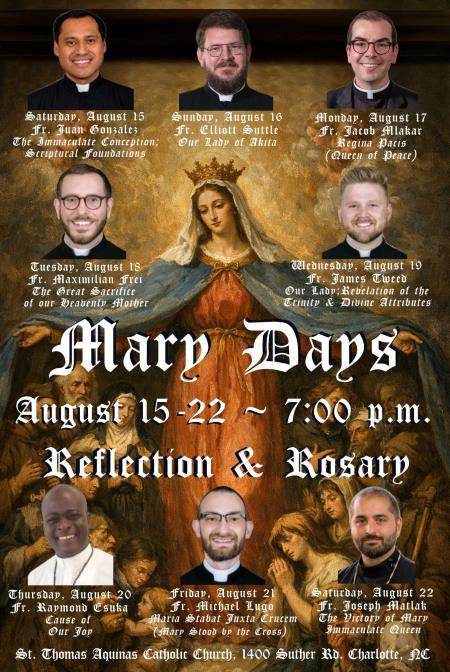
Mary Days Talks (August 15-22) – Saint Thomas Aquinas Parish's annual week-long Mary Days talks on the Blessed Virgin Mary are underway and will conclude Saturday August 22 (Feast of the Immaculate Heart of Mary). Talks will be at 7:00 p.m. daily, except on Thursday August 20, which will be a homily during the 7:00 p.m. Mass (Novus Ordo). To learn more see the flyer at the end of this update.
Catholic Book on Herbs – With the blessing of herbs coming up this weekend, it is timely to share a new book written by Judson Carroll and local author Steve Cunningham (of Sensus Fidelium) about herbs, from a Catholic perspective. The book is entitled Herbs that Heal: (Catholic) Home Remedies to Forage and Grow. It is available by Sophia Institute Press at this link.
Feast of Saint Philomena – This past Tuesday August 11 was the historical Feast of Saint Philomena the Wonderworker, who although removed from the calendar in 1960 still has a popular devotion and many still seek her recourse. She is believed to have been a 2nd century martyr buried in the Roman catacombs. Centuries later in 1802 her remains were accidentally discovered during excavations and were eventually interred in Mugnano, Italy, where many miracles occurred over the years. St. John Vianney (whose feast day was earlier this month) had a deep devotion to her. The Sanctuary Shrine of Saint Philomena in Mugnano is a wonderful resource on learning more about this recently discovered ancient saint.
Support Saint Ann and Saint Thomas Parishes – Our parishes remain the anchor of our spiritual and community lives and continue to promote the sacred traditions, devotions, speakers and catechesis important for the spiritual growth of ourselves and our families. They also need our continued financial support (and occasional visits!). Both parishes would appreciate our continued generosity.
Bishop Martin issues Pastoral Letter to the Faithful Associated with the Society of Saint Pius X
LiveMass.net – Want to watch a Latin Mass online? The Priestly Fraternity of Saint Peter (FSSP) has a broadcast apostolate which streams its Latin Masses across the world at various times of the day. To view visit: https://www.livemass.net/
Rosary for the Traditional Latin Mass – A Rosary is offered for the restoration of the Traditional Latin Mass in the church on Sundays after the 11:30 a.m. Novus Ordo Mass at Saint Thomas Aquinas Church.
Daily Holy Face Chaplet for Sacred Liturgy (perpetual novena) – For the preservation of the Traditional Latin Mass, it has been recommended to all friends of the sacred liturgy in the diocese to consider continually praying the powerful Holy Face chaplet, under the banner of Our Lady of the Holy Name. To pray the chaplet, please see this link.
Cardinal Burke’s Prayer for Pope Leo XIV – His Eminence Cardinal Raymond Burke has released a prayer for Pope Leo XIV. Please see the prayer at the links below and consider praying this daily for the Holy Father as he leads the Church. PDF copies can be accessed at these links: [English] [Español] [Latin]
Holy Face Devotions
Prayers of Reparation to the Holy Face of Jesus are offered each week at the following churches on the indicated days:
- St. James (Concord) – Monday, 10-10:30 a.m. (in the cry room)
- St. Mark – Tuesday, 5:30 p.m.
- St. Thomas Aquinas – Tuesday, 6:00 a.m.
- St. Ann – Tuesday, 7:30 a.m. (following 7:00 a.m. Mass)
- St. Michael the Archangel (Gastonia) – Tuesday, 8:30 a.m. (following 8:00 a.m. Mass)
- St. Vincent de Paul – Tuesday, 8:40 a.m.
- Holy Spirit (Denver) – Tuesday, 10-11:00 a.m. (following the 9:15 a.m. Mass)
- Saint Elizabeth of the Hill Country (Boone) – Third Tuesday, at 6:45 p.m. after Mass in the Youth Room
- St. John the Baptist (Tryon) - First Saturday, 9:30 a.m. (after 8:30 a.m Mass)
Note: Days and times may be subject to change due to holidays.
“Jesus, Your ineffable image is the star which guides my steps. Ah, You know, Your sweet Face is for me Heaven on earth” (from Canticle to the Holy Face by Saint Thérèse de Lisieux, the 19th century Discalced Carmelite nun who took the name in religion, Thérèse of the Child Jesus and the Holy Face).
Traditional Latin Mass and Liturgical News
- The Vigil of the Assumption by Greg DiPippo, New Liturgical Movement (August 14, 2024). [Vigil of the Assumption]
- Blessings on the Feast of the Assumption of the Blessed Virgin Mary by Dr. Michael P. Foley, New Liturgical Movement (August 11, 2023). [Blessings on the Feast of the Assumption]
- The Feasts of St Lawrence by Greg DiPippo, New Liturgical Movement (August 10, 2025). [Feasts of St Lawrence]
- St Romanus the Martyr by Greg DiPippo, New Liturgical Movement (August 9, 2026). [St Romanus the Martyr]
- The Forgotten History of the First Poor Clare Community in Rome by Ishmael Adibuah, National Catholic Register (August 11, 2026). [Forgotten History]
- 7 things to know about St. Clare of Assisi, the patron saint of television by Francesca Pollio Fenton, EWTN News (August 11, 2026). [7 things to know about St. Clare of Assisi]
- Miracles of St Clare of Assisi by Greg DiPippo, New Liturgical Movement (August 12, 2026). [Miracles of St Clare of Assisi]
- 250 years after independence, the little-known story of colonial America’s Catholics by Tyler Arnold, National Catholic Register (August 3, 2026). [Colonial America’s Catholics]
- Review of Cosima Clara Gillhammer’s Light on Darkness: The Untold Story of the Liturgy by Dr. Michael P. Foley, New Liturgical Movement (August 7, 2026). [Light on Darkness]
- The Cultural Legacy of Saint Clare by Dr. Michael P. Foley, New Liturgical Movement (August 12, 2022). [Legacy of Saint Clare]
- Faithful invited to witness historic beatification of Georgia Martyrs, Catholic News Herald (July 31, 2026). [Georgia Martyrs]
Saints and Special Observances
(To see last week’s Saints and Special Observances on the Assumption of the Blessed Virgin Mary please click on this link).
Saint Bernard of Clairvaux, Abbott and Doctor of the Church, was born in Fontaines, France, in the year 1090, the third of seven children – all but one boys – brought into the world by well-to-do parents who belonged to the upper rank of French nobility. His father and mother, Tescelin de Fontaine and Alèthe de Montbard, were devout Catholics who sent him at the age of nine to be educated by the secular canons of Saint-Vorles in Châtillon-sur-Seine. He learned how to think rationally and speak convincingly by studying rhetoric, dialectics and grammar, as well as poetry and literature. His course of study also included Scripture and theology, subjects in which he excelled because of his particular interest in them.
Deeply devoted to the Blessed Virgin Mary, Bernard was moved by the death of his mother in his twentieth year to discern a religious vocation. His decision to enter the Abbey of Notre Dame at Cîteaux was initially opposed by his family; but when he went in 1113, all of his brothers except the youngest followed, along with another 30 young men of noble birth. Even his youngest brother made his way to Cîteaux eventually, and the lone daughter in the Fontaine family became a Benedictine nun.
The Abbey of Notre Dame had been established in 1098 by a group of Benedictine monks determined to restore strict observance of the Rule of Saint Benedict. They became the Order of Cistercians, a name derived from the location of the order’s origin in Cîteaux. They came to be called the White Monks because of the white robes they wore to distinguish them from the Benedictines who dressed in black. When Bernard and his brothers, and their noble companions, arrived at the abbey, they fell on their faces before the front gate, humbly beseeching Abbott Stephen Harding to let them enter. He was only too happy to do so.
During his 25-year tenure as abbott. Stephen Harding’s inspirational leadership helped to bring about tremendous growth in the ranks of the Cistercian order. Many new monasteries were established, including one at a place called Clairvaux for which Bernard was named founding abbott in 1115, only two years after taking the habit. Noted for his holiness and commitment to monastic reform, Bernard wrote prolifically throughout his years in religion, preparing 300 sermons for delivery to the monks entrusted to his care and producing more than 500 letters in connection with the many activities he undertook. He was responsible for the establishment of 68 new monasteries located throughout western Europe, provided frequent service to popes and bishops who sought his assistance, and sustained a vigorous defense of the Faith against the threat of heretical movements.
When Pope Honorius II convoked the Council of Troyes in 1128, Bernard was elected to serve as secretary. In the course of the Council, the Cistercian monk drafted the Rule of the Knights Templar that was to serve as the ideal expression of Christian nobility. When the Pope died two years later, schism resulted from the selection of two successors, Innocent II and Anacletus II. Driven from Rome by his rival’s supporters, Innocent II was forced to seek refuge in France where King Louis VI convened a meeting of French bishops to settle the matter; the bishops turned it over to Bernard who decided in favor of Innocent II. He went on to spend almost a decade conducting the diplomacy necessary to win final acceptance of his decision. It came in 1139 at the Second Council of the Lateran which formally condemned the remaining adherents of the Antipope Anacletus II.
A visit to Clairvaux by Malachy, the Primate of All Ireland, resulted in a close personal friendship between the Archbishop of Armagh and the Cistercian Abbott. Malachy wanted to join the Order of Cistercians, but his request was denied by the Pope. The Irish bishop passed away at Clairvaux in 1148. He is perhaps best-known today as the purported author of the Prophecy of Popes, a document of unknown provenance that surfaced in 1590. The document is essentially a list of 112 future popes, each identified not by name but by a descriptive phrase, based on visions Saint Malachy is said to have experienced.
The last Pope listed is called “Peter the Roman, who will pasture his sheep in many tribulations, and when these things are finished, the city of seven hills will be destroyed, and the dreadful judge will judge his people.” Saint Bernard, who documented many of Malachy’s miracles, made no mention of The Prophecy of Popes.
Bernard composed a series of 86 sermons on the Song of Songs and preached a famous sermon at Vézelay in 1146 in support of the Second Crusade. Hymns he wrote include, among others, the enduring classic, “O Sacred Head Now Wounded (Surrounded).” His numerous literary works include On Grace and Free Choice, On Loving God, In Praise of the New Knighthood, and The Life and Death of Saint Malachy, Bishop of Ireland. There is much more that could be said of this amazing monk who exerted a powerful influence on monastic life and on the world at large during the 12th century. His intense love of Jesus Christ, and his devotion to the Blessed Mother of Our Lord, are both evident in the classic works of theology and Mariology which he composed. Writing in the 15th century, Dante Alighieri made Saint Bernard the final guide in the poet’s epic journey, leading him in the final canto of The Divine Comedy to that Light that shines in the highest Heaven.
Bernard was signaling—he smiled—to me
to turn my eyes on high; but I, already
was doing what he wanted me to do,
because my sight, becoming pure, was able
to penetrate the ray of Light more deeply—
that Light, sublime, which in Itself is true.
Bernard died on August 20, 1153, and was buried in the Abbey at Clairvaux that had been his monastic home for 40 years. His remains were transferred to Troyes Cathedral after the Abbey was destroyed by the revolutionary regime in 1792.
Canonized by Pope Alexander III on January 18, 1174, Bernard was named a Doctor of the Church in 1830. On the 800th anniversary of his death, Pope Pius XII issued an encyclical in his honor entitled Doctor Mellifluus (link).
The feast day of St. Bernard, Abbott and Doctor of the Church, is celebrated on the 20th day of August.
Closing Commentary
In closing, we offer commentary on the Assumption of the Blessed Virgin Mary excerpted from The Liturgical Year of Dom Prosper Guéranger, OSB, followed by a link to the full text.
August 15 – Assumption of the Most Blessed Virgin Mary
Today the Virgin Mary ascended to heaven; rejoice, for she reigns with Christ forever.” The Church will close her chants on this glorious day with this sweet antiphon which resumes the object of the feast and the spirit in which it should be celebrated.
No other solemnity breathes, like this one, at once triumph and peace; none better answers to the enthusiasm of the many and the serenity of souls consummated in love. Assuredly that was as great a triumph when our Lord, rising by his own power from the tomb, cast hell into dismay; but to our souls, so abruptly drawn from the abyss of sorrows on Golgotha, the suddenness of the victory caused a sort of stupor to mingle with the joy of that greatest of days. In presence of the prostrate Angels, the hesitating Apostles, the women seized with fear and trembling, one felt that the divine isolation of the Conqueror of death was perceptible even to his most intimate friends, and kept them, like Magdalene, at a distance.
Mary’s death, however, leaves no impression but peace; that death had no other cause than love. Being a mere creature, she could not deliver herself from that claim of the old enemy; but leaving her tomb filled with flowers, she mounts up to heaven, flowing with delights, leaning upon her Beloved. Amid the acclamations of the daughters of Sion, who will henceforth never cease to call her blessed, she ascends surrounded by choirs of heavenly spirits joyfully praising the Son of God. Nevermore will shadows veil, as they did on earth, the glory of the most beautiful daughter of Eve. Beyond the immovable Thrones, beyond the dazzling Cherubim, beyond the flaming Seraphim, onward she passes, delighting the heavenly city with her sweet perfumes. She stays not till she reaches the very confines of the Divinity; close to the throne of honor where her Son, the King of ages, reigns in justice and in power; there she is proclaimed Queen, there she will reign for evermore in mercy and in goodness.
Here on earth Libanus and Amana, Sanir and Hermon dispute the honor of having seen her rise to heaven from their summits; and truly the whole world is but the pedestal of her glory, as the moon is her footstool, the sun her vesture, the stars of heaven her glittering crown. “Daugher of Sion, thou art all fair and sweet,” cries the Church, as in her rapture she mingles her own tender accents with the songs of triumph: “I saw the beautiful one as a dove rising up from the brooks of waters; in her garments was the most exquisite odor; and as in the days of spring, flowers of roses surrounded her and lilies of the valley.”
The same freshness breathes from the facts of Bible history wherein the interpreters of the sacred Books see the figure of Mary’s triumph. As long as this world lasts a severe law protects the entrance to the eternal palace; no one, without having first laid aside the garb of flesh, is admitted to contemplate the King of heaven. There is one, however, of our lowly race, whom the terrible decree does not touch; the true Esther, in her incredible beauty, advances without hindrance through all the doors. Full of grace, she is worthy of the love of the true Assuerus; but on the way which leads to the awful throne of the King of kings, she walks not alone; two handmaids, one supporting her steps, the other holding up the long folds of her royal robe, accompany her; they are the angelic nature and the human, both equally proud to hail her as their mistress and lady, and both sharing in her glory.
If we go back from the time of captivity, when Esther saved her people, to the days of Israel’s greatness, we find our Lady’s entrance into the city of endless peace, represented by the Queen of Saba coming to the earthly Jerusalem. While she contemplates with rapture the magnificence of the mighty prince of Sion, the pomp of her own retinue, the incalculable riches of the treasure she brings, her precious stones and her spices, plunge the whole city into admiration. There was brought no more, says the Scripture, such abundance of spices as these which the Queen of Saba gave to King Solomon. [The Assumption of the Most Blessed Virgin Mary]