Second Sunday of Lent
Friends in Christ,
Welcome to our weekly Sunday update. Last week, in the Gospel for the First Sunday of Lent, we were told that after Jesus had fasted forty days in the desert “the devil took him up into a very high mountain, and shewed him all the kingdoms of the world, and the glory of them” (Matthew 4:8). They would be His, if He would but fall down and worship Satan. In this week’s Gospel for the Second Sunday of Lent we see Jesus on another mountain in a very different light. Taking Peter and James and John “up into a high mountain apart . . . he was transfigured before them. And his face did shine as the sun: and his garments became white as snow” (Matthew 17:1b-2a). On the mountain of the Transfiguration, Our Lord reveals Himself to be something more than an ordinary man subject to hunger and tempted by the things of this world: He is, in the words of the Father, “my beloved Son, in whom I am well pleased” (Matthew 17:5b).
Calendar of Special Observances
Celebrations are those listed in the Roman Missal of 1962.
DAY, DATE – FEAST (CLASS)
Sunday, March 1 – Second Sunday of Lent (I)
Monday, March 2 – Feria of Lent (III)
Tuesday, March 3 – Feria of Lent (III)
Wednesday, March 4 – Feria of Lent (III) – Commemoration of St. Casimir, Confessor – Commemoration of St. Lucius, Pope and Martyr
Thursday, March 5 – Feria of Lent (III)
Friday, March 6 – Feria of Lent (III) – Commemoration of Ss. Perpetua and Felicity, Martyrs
Saturday, March 7 – Feria of Lent (III) – Commemoration of St. Thomas Aquinas, Confessor and Doctor of the Church
Second Sunday of Lent
The links provided below can be used to download printable copies of the Proper Prayers for the Second Sunday of Lent with English or Spanish translation, followed by commentary by Dr. Michael P. Foley.
Traditional Latin Mass Schedule
Diocese of Charlotte Sunday Masses
Chapel of the Little Flower (757 Oakridge Farm Road, Mooresville, NC)
- 10:00 a.m. (Low)
- 12:00 p.m. (Sung)
- Chaplain: Fr. Brandon Jones
- Chapel related questions? Email Father at: tlmchapel(at)rcdoc.org
- More details: https://carolinaliturgy.org/chapel
Note: Only Sunday Latin Masses and Holy Days are offered at the Chapel. This is the only Diocese of Charlotte location which offers the Traditional Latin Mass.
Saint Thérèse of the Child Jesus and the Holy Face, the Little Flower, pray for us!
Diocese of Raleigh Sunday Masses
- 1:00 p.m., Sacred Heart (Dunn, NC)
- 4:30 p.m. - First Sunday, Holy Name Cathedral (Raleigh, NC)
- For additional locations and Masses please see our Mass Times webpage
Diocese of Charleston Sunday Masses
- 12:00 p.m., Prince of Peace (Taylors SC)
- 1:00 p.m., Our Lady of the Lake (Chapin SC)
- 12:00 p.m., Sacred Heart (Charleston SC)
- 5:30 p.m., Stella Maris (Sullivans Island, SC)
Diocese of Charleston Daily Traditional Latin Masses
- Prince of Peace (Taylors SC) – Monday-Friday, 12:00 p.m.
- Prince of Peace (Taylors SC) – Saturday, 8:00 a.m.
- For additional locations and Masses please see our Mass Times webpage
As a reminder, travelers are urged to consult parish websites or offices for up-to-date information regarding possible changes in the schedule of Mass times.
Traditional Fasting and Abstinence Disciplines During Lent
For those looking to practice the traditional Lenten disciplines in place in 1962, we share a helpful 2010 document from Mater Ecclesiae Latin Mass Chapel in Berlin, New Jersey, which explains the differences between the traditional Lenten rules for fasting and abstinence (now voluntary) that accompanied the Traditional Latin Mass and the current rules. [Discipline of 1962 for Fast during Lent]
Chapel of the Little Flower Announcements
Mass Intentions for Sunday
Sunday March 1 - Intentions of Ronald Severson by the Severson Family
Donations for Easter Flowers
The Chapel of the Little Flower will be accepting donations for
Easter flowers. There will be envelopes available for you to use for
your cash or check donation. You may donate in honor or in memory of a
loved one. More details available in the narthex at The Chapel.
Update on Mass intentions
Mass intentions have now been filled through the spring and new Masses are currently unavailable. The Mass intentions book will be opened sometime later this spring for the next quarter of Masses.
Lost and Found
The Chapel has a growing collection of items left behind after Mass. If one is missing a missal, book, or other item, please see the new table in the cry room.
Father Jones’ Contact Info
If one has questions about the Chapel of the Little Flower, that are not related to one’s parish, please email Father Jones directly at: tlmchapel(at)rcdoc.org
Visiting the Chapel of the Little Flower
If you haven’t attended Mass at the Chapel of the Little Flower yet, you are welcome to join us in Lent. Seating is adequate at both Masses, and there is plenty of parking; a cry room; open space outside for the kids after Mass. Bulletins from Saint Ann or Saint Thomas Aquinas parishes are usually available.
Annual Novena to Saint Gregory the Great
(Tuesday March 3 - Wednesday March 11)
The feast of Pope Saint Gregory the Great is on Thursday March 12. To honor the Pope who codified the Latin Mass and the sacred Chant which bears his name (Gregorian), and to pray for the continued preservation of the Traditional Latin Mass, we invite our readers to pray this annual novena in the 9 days ahead of Saint Gregory’s Feast Day (March 3-11).
The prayer is below and can also be downloaded as PDF at this link.
Novena to St. Gregory the Great
Pray Daily March 3- March 11 (Feast Day March 12)
St. Gregory, you are known for your zeal for the Catholic faith, love of liturgy, and compassion and mercy toward those in need. Please help and guide us so that we may share in these virtues and thereby bring Jesus into the hearts of our families and all we encounter.
We especially ask for blessings on our parish family, our priests and our deacons. We also ask that you graciously intercede for us before God so that we might be granted the special assistance and graces that we seek:
(Intention: Continued preservation of the Traditional Latin Mass).
Help us to live as a faithful child of God and to attain the eternal happiness of heaven. St. Gregory the Great, pray for us. Amen.
General Announcements
First Sunday Food & Fellowship Potluck at Saint Thomas Aquinas – This Sunday (March 1) will be the monthly Sunday Food and Fellowship at Saint Thomas Aquinas from 1:30 p.m. – 3:00 p.m. If you attend Mass at the Chapel, you can always drop by after Mass.
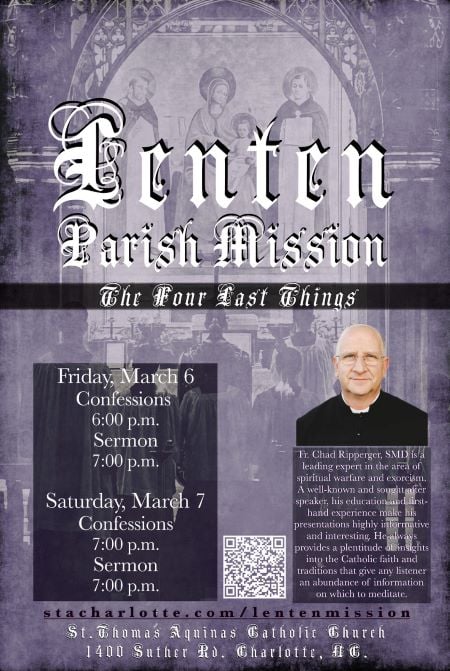
(NEXT WEEKEND) Fr. Ripperger to Offer Lenten Mission at Saint Thomas Aquinas (March 6-7) – Saint Thomas Aquinas parish is blessed to welcome back Fr. Chad Ripperger, SMD, a priest and exorcist with the Society of the Most Sorrowful Mother, to offer a Lenten Parish Mission in March on Friday March 6 at 7:00 p.m. and Saturday March 7 at 7:00 p.m. Please note: As noted last year, the conference is geared toward adults, and would not be appropriate for younger children. Registration is required. To register click here.
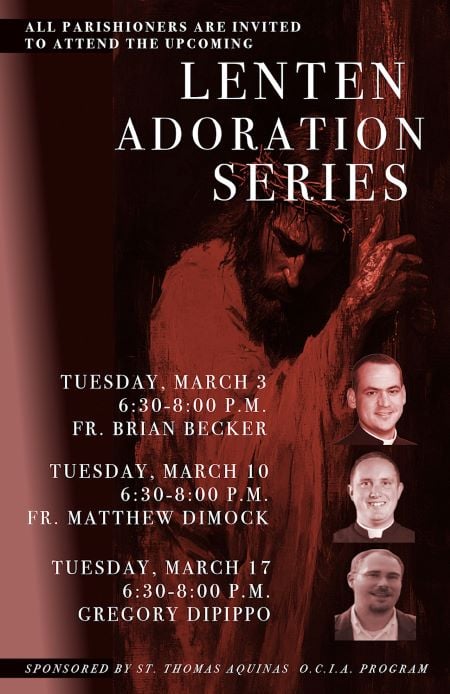
Lenten Adoration Series (Saint Thomas Aquinas) – The parish will hold a Lenten Adoration series on the first three Tuesday evenings in March. Each evening will feature a reflection followed by Adoration of the Blessed Sacrament. This is a stellar lineup of speakers:
- Tuesday March 3, 6:30-8:00 p.m. (Fr. Brian Becker, St. Joseph Seminary)
- Tuesday March 10, 6:30-8:00 p.m. (Fr. Matthew Dimock, Sacred Heart parish)
- Tuesday March 17, 6:30-8:00 p.m. (Greg DiPippo - Editor, New Liturgical Movement)
Please see the flyer at the end of this update.
Support Saint Ann and Saint Thomas Parishes – Our parishes remain the anchor of our spiritual and community lives and continue to promote the sacred traditions, devotions, speakers and catechesis important for the spiritual growth of ourselves and our families. They also need our continued financial support (and occasional visits!). Both parishes would appreciate our continued generosity - especially in Lent.
Rosary for the Traditional Latin Mass – A Rosary is offered for the restoration of the Traditional Latin Mass in the church on Sundays after the 11:30 a.m. Novus Ordo Mass at Saint Thomas Aquinas Church.
Daily Holy Face Chaplet for Sacred Liturgy (perpetual novena) – For the preservation of the Traditional Latin Mass, it has been recommended to all friends of the sacred liturgy in the diocese to consider continually praying the powerful Holy Face chaplet, under the banner of Our Lady of the Holy Name. To pray the chaplet, please see this link.
Cardinal Burke’s Prayer for Pope Leo XIV – His Eminence Cardinal Raymond Burke has released a prayer for Pope Leo XIV. Please see the prayer at the links below and consider praying this daily for the Holy Father as he leads the Church. PDF copies can be accessed at these links: [English] [Español] [Latin]
Holy Face Devotions
Prayers of Reparation to the Holy Face of Jesus are offered each week at the following churches on the indicated days:
- St. James (Concord) – Monday, 10-10:30 a.m. (in the cry room)
- St. Mark – Tuesday, 5:30 p.m.
- St. Thomas Aquinas – Tuesday, 6:00 a.m.
- St. Ann – Tuesday, 7:30 a.m. (following 7:00 a.m. Mass)
- St. Michael the Archangel (Gastonia) – Tuesday, 8:30 a.m. (following 8:00 a.m. Mass)
- St. Vincent de Paul – Tuesday, 8:40 a.m.
- Holy Spirit (Denver) – Tuesday, 10-11:00 a.m. (following the 9:15 a.m. Mass)
- Saint Elizabeth of the Hill Country (Boone) – Third Tuesday, at 6:45 p.m. after Mass in the Youth Room
- St. John the Baptist (Tryon) - First Saturday, 9:30 a.m. (after 8:30 a.m Mass)
Note: Days and times may be subject to change due to holidays.
“Jesus, Your ineffable image is the star which guides my steps. Ah, You know, Your sweet Face is for me Heaven on earth” (from Canticle to the Holy Face by Saint Thérèse de Lisieux, the 19th century Discalced Carmelite nun who took the name in religion, Thérèse of the Child Jesus and the Holy Face).
Traditional Latin Mass and Liturgical News
- The Station Churches of the Ember Days of Lent by Greg DiPippo, New Liturgical Movement (February 21, 2024). [Stational Churches of the Ember Days of Lent]
- Letter to the Presbyter of the Archdiocese of Madrid by Pope Leo XIV, Holy See (January 28, 2026). [Letter to Madrid Priests] (English translation courtesy of Google Translate)
- The 40 Days of Lent by Fr. William Rock, FSSP, The Missive (February 18, 2024). [The 40 Days of Lent]
- The Canaanite Woman in the Liturgy of Lent by Greg DiPippo, New Liturgical Movement (February 26, 2026). [Canaanite Woman in the Liturgy]
- Georgia martyrs killed for defending marriage to be beatified in U.S. this October by Kate Quiñones, EWTN News, (February 19, 2026). [Georgia Martyrs]
- Ave Regina Caelorum by Greg DiPippo, New Liturgical Movement (February 3, 2025). [Ave Regina Caelorum]
Saints and Special Observances
Saints Perpetua and Felicity are among the fifteen apostles and martyrs named in the prayer recited by the celebrant at Mass following consecration of the host. The inclusion of their names – along with those of several apostles, the first martyr and other early saints – is evidence of the ancient origins of the Mass still celebrated today.
Perpetua and Felicity suffered martyrdom in the year 203 during the persecution of Christians initiated by the emperor Severus who ruled from 193 until 211 A.D. Little is known about many of the victims of the early persecutions due to the lack of historical documentation. In contrast, a written record of the events leading to the martyrdom of these two women was left by Perpetua herself. Her diary, written in the last days before her execution and supplemented by the testimony of others who knew her, was preserved in the martyrology entitled Passio Sanctarum Martyrum Perpetuae et Felicitatis (The Passion of the Holy Martyrs Perpetua and Felicity). The martyrology was widely read and even used for readings during celebration of the liturgy.
A well-educated Carthaginian of noble birth, still nursing an infant son, twenty-two-year-old Vibia Perpetua was willing to risk death in order to become a Christian like her mother. Her pagan father feared the consequences of her decision and tried unsuccessfully to change her mind. “Don’t flaunt your insistence, or you’ll destroy us all,” he told his daughter. “For if anything happens to you, none of us will ever be able to speak freely and openly again.” Perpetua responded that she could not be called by any other name than what she was – a Christian. This reply so angered her father that he attacked her.
Then my father moved with this word came upon me to tear out my eyes; but he vexed me only, and he departed vanquished, he and the arguments of the devil. Then because I was without my father for a few days I gave thanks unto the Lord; and I was comforted because of his absence. In this same space of a few days we were baptised, and the Spirit declared to me, I must pray for nothing else after that water [of baptism] save only endurance of the flesh. A few days after we were taken into prison, and I was much afraid because I had never known such darkness. O bitter day!
Perpetua was arrested along with four other catechumens: Felicity, a slave-girl eight months pregnant, and her fellow-slave named Revocatus; and two free men, Saturninus and Secundulus. They were joined in prison by their catechist, Saturus, who voluntarily surrendered to the authorities, proclaiming himself to be a Christian. The intense darkness Perpetua experienced in the first days of her imprisonment was due in part to the wretched conditions of the prison itself and the rough treatment accorded the prisoners by their guards. Separated from the child she was still breastfeeding, Perpetua also endured both the psychic pain of separation and the physical agony of unrelieved lactation.
By bribing their guards, the prisoners were able to secure better living conditions; and Perpetua was able to have her baby brought to her to nurse, lifting the darkness of her painful imprisonment. Her father came to visit her in prison and, falling to his knees, begged her, for his sake and that of her family, to renounce her faith and save her life. She told him that God’s will would be done, and he went away sorrowful.
When Perpetua was summoned to trial, along with her companions, her father appeared in court with his grandson in his arms. Hilarion, the procurator, urged her to take pity on both: “Spare, said he, thy father’s grey hairs; spare the infancy of the boy. Make sacrifice for the Emperors’ prosperity.”
And I answered: I will not sacrifice. Then said Hilarian: Art thou a Christian? And I answered: I am a Christian. And when my father stood by me yet to cast down my faith, he was bidden by Hilarian to be cast down and was smitten with a rod. And I sorrowed for my father’s harm as though I had been smitten myself; so sorrowed I for his unhappy old age. Then Hilarian passed sentence upon us all and condemned us to the beasts; and cheerfully we went down to the dungeon.
Perpetua had a series of visions during her imprisonment, mostly confirming the martyrdom that awaited her; but, awakening from the last of these on the day before she was to die, she realized it was not wild beasts with which she was destined to contend but the devil himself. Her diary concluded with these words: “Thus far have I written this, till the day before the games; but the deed of the games themselves let him write who will.”
As a pregnant woman could not be executed for fear of shedding innocent blood, Felicity feared that she would not be able to share in the martyrdom of Perpetua and their companions; but two days before the games she went into labor. The guards mocked her suffering, saying, “If you think you suffer now, how will you stand it when you face the wild beasts?”: To which the courageous slave-girl responded, “Now I’m the one who is suffering, but in the arena, another will be in me suffering for me because I will be suffering for him.” She delivered in time a baby girl who was adopted by one of the Christian women of Carthage.
Thus were Perpetua, Felicity and their other companions able to enter the arena and achieve their glorious martyrdom together. The feast day of Saints Perpetua and Felicity is listed on the 6th of March in the Roman Calendar.
Sources: Perez, Melissa C., Vibia Perpetua’s Diary: A Woman’s Writing in a Roman Text of its Own (Orlando: University of Central Florida, 2009); Shewring, W. H., translator, The Passion of SS. Perpetua & Felicity, MM. together with the Sermons of S. Augustine on these Saints (London: Sheed and Ward, 1931); Catholic Online/Saints & Angels, “Sts. Perpetua and Felicity” (catholic.org).
Closing Commentary
As we continue in the penitential season of Lent, we offer an excerpt from the commentary by Dom Prospér Guéranger on the Second Sunday of Lent followed by a link to the full text.
Second Sunday of Lent
Jesus was about to pass from Galilee into Judea, that he might go up to Jerusalem and be present at the Feast of the Pasch. It was that last Pasch, which was to begin with the immolation of the figurative lamb, and end with the sacrifice of the Lamb of God, who taketh away the sins of the world. Jesus would have his disciples know him. His works had borne testimony to him, even to those who were, in a manner, strangers to him; but as for his Disciples, had they not every reason to be faithful to him, even to death? Had they not listened to his words, which had such power with them that they forced conviction? Had they not experienced his love, which it was impossible to resist? and had they not seen how patiently he had borne with their strange and untoward ways? Yes, they must have known him. They had heard one of their company, Peter, declare that he was the Christ, the Son of the Living God. Notwithstanding this, the trial to which their faith was soon to be put, was to be of such a terrible kind that Jesus would mercifully arm them against temptation by an extraordinary grace...
...Is it not to be feared that these Disciples of his, when they witness his humiliations and sufferings, will lose their courage? They have lived in his company for three years; but when they see that the things he foretold would happen to him are really fulfilled, will the remembrance of all they have seen and heard keep them loyal to him? or will they turn cowards and flee from him?—Jesus selects three out of the number who are especially dear to him: Peter, whom he has made the Rock, on which his Church is to be built, and to whom he has promised the Keys of the kingdom of heaven; James, the son of Thunder, who is to be the first Martyr of the Apostolic College; and John, James’ brother, and his own Beloved Disciple. Jesus has resolved to take them aside, and show them a glimpse of that glory which, until the day fixed for its manifestation, he conceals from the eyes of mortals. He therefore leaves the rest of his Disciples in the plain near Nazareth, and goes, in company with the three privileged ones, towards a high hill called Thabor, which is a continuation of Libanus, and which the Psalmist tells us was to rejoice in the Name of the Lord. No sooner has he reached the summit of the mountain, than the three Apostles observe a sudden change come over him; his Face shines as the sun, and his humble garments become white as snow. They observe two venerable men approach, and speak with him upon what he was about to suffer in Jerusalem. One is Moses, the lawgiver; the other is Elias, the Prophet, who was taken up from earth on a fiery chariot, without having passed through the gates of death.
These two great representatives of the Jewish Religion, the Law and the Prophets, humbly adore Jesus of Nazareth. The three Apostles are not only dazzled by the brightness which comes from their Divine Master; but they are filled with such a rapture of delight that they cannot bear the thought of leaving the place. Peter proposes to remain there forever, and build three tabernacles, for Jesus, Moses and Elias. And while they are admiring the glorious sight, and gazing on the beauty of their Jesus’ human Nature, a bright cloud overshadows them, and a voice is heard speaking to them: it is the voice of the Eternal Father, proclaiming the Divinity of Jesus, and saying: This is my beloved Son! [Second Sunday of Lent]