Quinquagesima Sunday
Friends in Christ,
Welcome to our weekly Sunday update. The first reading in the liturgy for Quinquagesima Sunday – the third of the three Sundays in the pre-Lenten season of Septuagesima – is Saint Paul’s great discourse on charity (I Corinthians:13). In the penultimate verse of the reading, the Apostle says, “We see now through a glass in a dark manner: but then face to face. Now I know in part: but then I shall know even as I am known.”
This metaphorical association of limited vision with lack of comprehension echoes the Gospel for the preceding Sunday (Sexagesima): Jesus told His disciples that he spoke in parables “that seeing they may not see, and hearing they may not understand” (Luke 8:10). In this week’s Gospel reading (Luke 18:31-43), Jesus tells the twelve Apostles all that is to happen when they reach Jerusalem; but, while seeing and hearing, they do not understand what He is saying to them.
The failure of sight equated with unknowing is finally overcome by the miracle performed by Jesus as He and His Apostles approach Jericho. “Son of David, have mercy on me,” the blind man pleads, acknowledging the presence of the Messiah. When Jesus asks, “What wilt thou that I do to thee?” he responds, “Lord, that I may see.”
In ten brief words, Jesus grants the man vision while illuminating the way which transcends the darkness of unknowing: “Receive thy sight, thy faith hath made thee whole.” Able to see in an instant, the man follows Jesus, giving glory to God. So are we called to see with the eyes of faith in order to be made whole and follow Our Lord even to Jerusalem.
Calendar of Special Observances
Celebrations are those listed in the Roman Missal of 1962.
DAY, DATE – FEAST (CLASS)
Sunday, February 15 – Quinquagesima Sunday (II)
Monday, February 16 – Feria (IV)
Tuesday, February 17 – Feria (IV)
Wednesday, February 18 – Ash Wednesday (I)
Thursday, February 19 – Thursday after Ash Wednesday (III)
Friday, February 20 – Friday after Ash Wednesday (III)
Saturday, February 21 – Saturday after Ash Wednesday (III)
Quinquagesima Sunday
The links provided below can be used to download printable copies of the Proper Prayers for Quinquagesima Sunday. A link to Dr. Michael P. Foley’s New Liturgical Movement commentary is also provided.
Traditional Latin Mass Schedule
Diocese of Charlotte Sunday Masses
Chapel of the Little Flower (757 Oakridge Farm Road, Mooresville, NC)
- 10:00 a.m. (Low)
- 12:00 p.m. (Sung)
- Chaplain: Fr. Brandon Jones
- Chapel related questions? Email Father at: tlmchapel(at)rcdoc.org
- More details: https://carolinaliturgy.org/chapel
Note: Only Sunday Latin Masses and Holy Days are offered at the Chapel. This is the only Diocese of Charlotte location which offers the Traditional Latin Mass.
Saint Thérèse of the Child Jesus and the Holy Face, the Little Flower, pray for us!
Diocese of Raleigh Sunday Masses
- 1:00 p.m., Sacred Heart (Dunn, NC)
- 4:30 p.m. - First Sunday, Holy Name Cathedral (Raleigh, NC)
- For additional locations and Masses please see our Mass Times webpage
Diocese of Charleston Sunday Masses
- 12:00 p.m., Prince of Peace (Taylors SC)
- 1:00 p.m., Our Lady of the Lake (Chapin SC)
- 12:00 p.m., Sacred Heart (Charleston SC)
- 5:30 p.m., Stella Maris (Sullivans Island, SC)
Diocese of Charleston Daily Traditional Latin Masses
- Prince of Peace (Taylors SC) – Monday-Friday, 12:00 p.m.
- Prince of Peace (Taylors SC) – Saturday, 8:00 a.m.
- For additional locations and Masses please see our Mass Times webpage
As a reminder, travelers are urged to consult parish websites or offices for up-to-date information regarding possible changes in the schedule of Mass times.
Upcoming Special Latin Masses
Wednesday February 18: Ash Wednesday
- 12:00 p.m. – Prince of Peace (Taylors SC) (Includes distribution of ashes)
- **NEW: 10:00 a.m. – Our Lady of the Lake (Chapin SC) (Includes distribution of ashes)** (There will not be an evening Latin Mass as previously announced)
For additional Lenten Masses and events please see our Lenten Masses webpage.
Traditional Fasting and Abstinence Disciplines During Lent
For those looking to practice the traditional Lenten disciplines in place in 1962, we share a helpful 2010 document from Mater Ecclesiae Latin Mass Chapel in Berlin, New Jersey, which explains the differences between the traditional Lenten rules for fasting and abstinence (now voluntary) that accompanied the Traditional Latin Mass and the current rules. [Discipline of 1962 for Fast during Lent]
Chapel of the Little Flower Announcements
Mass Intentions for Sunday
Sunday February 15 - Bailey Van Nosdall by the Family
Mass intentions for the Chapel of the Little Flower Reopen February 15 at 11:30 a.m.
The Mass book for the Chapel of the Little Flower will be open again on Sunday, February 15 at 11:30 to allow attendees of both Masses the opportunity to request Mass intentions. One Mass each Sunday will be available and the requestor will be able to specify which Mass one would like to request (10 a.m. or 12 noon). If you have already had a Mass offered, please allow others the opportunity to request a Mass. The minimum stipend is $15 and checks must be made out to "Diocese of Charlotte" with "Chapel Mass Stipend" in the memo line or cash will also be accepted. Please be prepared to choose which Mass you are requesting.
Lost and Found
The Chapel has a growing collection of items left behind after Mass. If one is missing a missal, book, or other item, please see the new table in the cry room.
Father Jones’ Contact Info
If one has questions about the Chapel of the Little Flower, that are not related to one’s parish, please email Father Jones directly at: tlmchapel(at)rcdoc.org
Parish Bulletins Now Available at the Chapel
To help Chapel attendees/visitors stay connected with their parishes, the Chapel is providing Sunday bulletins from Saint Ann and Saint Thomas Aquinas parishes.
General Announcements
Traditional Carmelite Lenten Enrollment – Lent is approaching and the Discalced Hermits of Our Lady of Mount Carmel invite the faithful to enroll their family and friends in this annual Lenten Enrollment. The Hermits will be offering the following for the benefit of those enrolled:
- 40 Traditional Latin Masses celebrated according to the Carmelite Rite;
- 40 days of prayer according to the Divine Office, as well as other daily prayers; and
- 40 days of fasting and penance.
Intentions can be for the living or deceased. There is no charge for enrollment, but the Discalced Hermits survive entirely on alms received from the laity to support their apostolate. Please remember the Hermits in your almsgiving during the Season of Lent.
The deadline to enroll is Tuesday February 17, the day before Ash Wednesday. To enroll in the Lenten Enrollment, click here.
(NEW) New Book on Litany of Humility – In previous weeks we shared a book, Meditation on the Litany of Humility published by Sensus Fidelium Press. This week we share a complimentary book by Patrick O’Hearn, entitled Humility of the Saints: The Litany of Humility Made Flesh, which “[i]ncludes prayers, spiritual insights and the saints’ most profound insights on the virtue that made Heaven possible for them”. It is published by Sophia Institute Press and can be found at this link. An ideal book during Lent.
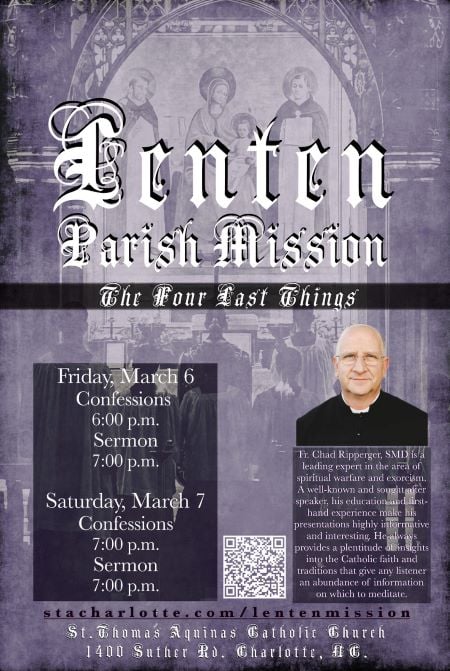
Fr. Ripperger to Offer Lenten Mission at Saint Thomas Aquinas (March 6-7) – Saint Thomas Aquinas parish is blessed to welcome back Fr. Chad Ripperger, SMD, a priest and exorcist with the Society of the Most Sorrowful Mother (the Doloran Fathers), to offer a Lenten Parish Mission in March. Father will offer the mission on Friday March 6 at 7:00 p.m. and Saturday March 7 at 7:00 p.m. Please note: As noted last year, the conference is geared toward adults, and would not be appropriate for younger children. Registration is required. To register click here.
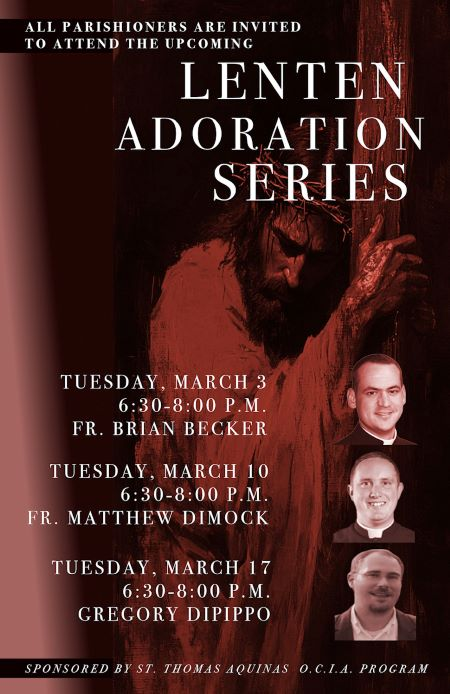
Lenten Adoration Series (Saint Thomas Aquinas) – The parish will hold a Lenten Adoration series on the first three Tuesday evenings in March. Each evening will feature a reflection followed by Adoration of the Blessed Sacrament. This is a stellar lineup of speakers:
- Tuesday March 3, 6:30-8:00 p.m. (Fr. Brian Becker, St. Joseph Seminary)
- Tuesday March 10, 6:30-8:00 p.m. (Fr. Matthew Dimock, Sacred Heart parish)
- Tuesday March 17, 6:30-8:00 p.m. (Greg DiPippo - Editor, New Liturgical Movement)
Please see the flyer at the end of this update.
Support Saint Ann and Saint Thomas Parishes – Our parishes remain the anchor of our spiritual and community lives and continue to promote the sacred traditions, devotions, speakers and catechesis important for the spiritual growth of ourselves and our families. They also need our continued financial support (and occasional visits!). Both parishes would appreciate our continued generosity - especially as we approach Lent.
Prayer Request: Healing of Tony Reitz
Rosary for the Traditional Latin Mass – A Rosary is offered for the restoration of the Traditional Latin Mass in the church on Sundays after the 11:30 a.m. Novus Ordo Mass at Saint Thomas Aquinas Church.
Daily Holy Face Chaplet for Sacred Liturgy (perpetual novena) – For the preservation of the Traditional Latin Mass, it has been recommended to all friends of the sacred liturgy in the diocese to consider continually praying the powerful Holy Face chaplet, under the banner of Our Lady of the Holy Name. To pray the chaplet, please see this link.
Cardinal Burke’s Prayer for Pope Leo XIV – His Eminence Cardinal Raymond Burke has released a prayer for Pope Leo XIV. Please see the prayer at the links below and consider praying this daily for the Holy Father as he leads the Church. PDF copies can be accessed at these links: [English] [Español] [Latin]
Holy Face Devotions
Prayers of Reparation to the Holy Face of Jesus are offered each week at the following churches on the indicated days:
- St. James (Concord) – Monday, 10-10:30 a.m. (in the cry room)
- St. Mark – Tuesday, 5:30 p.m.
- St. Thomas Aquinas – Tuesday, 6:00 a.m.
- St. Ann – Tuesday, 7:30 a.m. (following 7:00 a.m. Mass)
- St. Michael the Archangel (Gastonia) – Tuesday, 8:30 a.m. (following 8:00 a.m. Mass)
- St. Vincent de Paul – Tuesday, 8:40 a.m.
- Holy Spirit (Denver) – Tuesday, 10-11:00 a.m. (following the 9:15 a.m. Mass)
- Saint Elizabeth of the Hill Country (Boone) – Third Tuesday, at 6:45 p.m. after Mass in the Youth Room
- St. John the Baptist (Tryon) - First Saturday, 9:30 a.m. (after 8:30 a.m Mass)
Note: Days and times may be subject to change due to holidays.
“Jesus, Your ineffable image is the star which guides my steps. Ah, You know, Your sweet Face is for me Heaven on earth” (from Canticle to the Holy Face by Saint Thérèse de Lisieux, the 19th century Discalced Carmelite nun who took the name in religion, Thérèse of the Child Jesus and the Holy Face).
Novena to the Holy Face (Concludes Tuesday February 17)
Tuesday concludes the annual novena to the Holy Face of Jesus, in preparation for the Feast of the Holy Face which traditionally occurs on Shrove Tuesday, February 17 (the day before Ash Wednesday).
To participate in the novena, please pray this prayer daily through Tuesday February 17.
O Lord Jesus Christ, in presenting ourselves before Thy adorable Face, to ask of Thee the graces of which we stand in most need, we beseech Thee, above all, to give us that interior disposition of never refusing, at any time, to do what Thou require of us by Thy holy commandments and Divine inspirations.
O Good Jesus, Who hast said: “Ask and you shall receive, seek and you shall find, knock and it shall be opened to you,” give us, O Lord, that faith which obtains all, or supply in us what may be deficient. Grant us, by the pure effect of Thy charity, and for Thy eternal glory, the graces that we need and that we seek from Thy infinite mercy. (here mention your petition)
Be merciful to us, O God, and reject not our prayers, when amid our afflictions, we call upon Thy Holy Name and seek with love and confidence Thy Adorable Face. We thank Thee, O Lord, for all Thy benefits, and we entreat Thee to engrave in our hearts feelings of love and gratitude, putting upon our lips songs of thanksgiving, to Thine eternal praise. Amen
Traditional Latin Mass and Liturgical News
- Septuagesima: The Time that the Land Forgot by Dr. Michael P. Foley, The New Liturgical Movement (February 3, 2021). [Septuagesima]
- An American Diocese Institutes Lenten Stational Churches by Greg DiPippo, New Liturgical Movement (February 10, 2026). [Stational Churches]
- What Motivated 70,000 Young Mexicans to Make a Pilgrimage to Christ the King? by Diego López Colín, National Catholic Register (February 10, 2026). [Christ the King Pilgrimage]
- FSSP In Urbe: Santissima Trinità dei Pellegrini by John Paul Sonnen, Liturgical Arts Journal (February 6, 2026). [FSSP In Urbe]
- The Reading of Genesis in Septuagesima by Greg DiPippo, New Liturgical Movement (February 16, 2025). [Reading of Genesis]
- Blessings of Bees and Silkworms by Fr. William Rock, FSSP, The Missive (February 2, 2026). [Blessing of Bees and Silkworms]
- Ave Regina Caelorum by Greg DiPippo, New Liturgical Movement (February 3, 2025). [Ave Regina Caelorum]
Saints and Special Observances
Saint Robert Southwell, S.J. is one of the Forty Martyrs of England and Wales condemned for their Catholic faith and executed by the government of England between 1535 and 1679. Canonized by Pope Saint Paul VI in 1970, the Forty Martyrs are memorialized on October 25th, the date of their canonization, in the revised (post-1962) liturgical calendar. The group includes 31 priests apprehended for offering the Holy Sacrifice of the Mass in Latin, ten of whom were members of the Society of Jesus.
Pope Saint John Paul II subsequently beatified another 86 victims of the English persecution on November 22, 1987. Sixty-six members of this second group of martyrs were priests condemned for saying Mass in Latin. Another 160 martyrs had been beatified or canonized prior to 1970, making a total of no less than 286 priests, religious and lay men and women executed for the crime of Catholicism during nearly a century and a half of the English persecution.
Robert Southwell was among the first handful of Jesuits sent back from Europe to serve as secret missionaries to the Catholics in England. Fr. Edmund Campion, a noted Oxford scholar prior to his conversion to Catholicism, had reentered the country in June of 1580 with Fr. Robert Parsons, who served as superior of the Jesuit Mission. Captured in July of the following year, Fr. Campion was imprisoned in the Tower and tortured on the rack over the ensuing four months before being tried and condemned and finally executed on December 1, 1581.
Having volunteered for the Mission, Fr. Southwell returned to England in 1586 to celebrate Mass and administer the other sacraments mostly in and around London. He managed to evade the authorities for six years before being captured on June 26, 1592. Imprisoned and tortured for two-and-a-half years, he was finally brought to trial in February of 1595 and convicted of treason under the 1585 Act Against Jesuits and Seminarists. Condemned on the 20th of February to be hanged, drawn and quartered, he was executed at Tyburn on February 21, 1595.
Born in 1561 at Horsham St. Faith’s in Norfolk, the future saint was the youngest son of Richard Southwell and his wife, Bridget, the daughter of Sir Roger Copley. Southwell’s father was the illegitimate son of Sir Richard Southwell, a political actor of considerable influence. Sir Richard had served Henry VIII as commissioner for the closure of the monasteries, overseeing the seizure of property held by the religious orders, after the king broke with the pope and declared himself to be the head of the Church in England. Raised in the Catholic faith, Robert was sent to the Jesuit school at Douai in 1576 but went to Paris the following year when political unrest led to fighting in the Low Countries. After returning briefly to Douai, he made his way to Rome where he was admitted to the Jesuit novitiate on October 17, 1578, and took vows two years later. Having completed his studies for the priesthood, he was ordained and appointed prefect of studies at the English College, serving in that capacity until he left on the English Mission.
While living the covert life of an outlawed Catholic priest for six years, Southwell wrote both poetry and prose and achieved considerable popularity as a poet in spite of his enforced anonymity. Ben Jonson said he would have been content to destroy many of his own verses if he could have written Southwell’s short poem, “The Burning Babe,” instead. Southwell’s longest poem, “St. Peter’s Complaint,” was also greatly admired. According to Joseph Pearce, “It is probable that the martyr and poet, Robert Southwell, dedicated a volume of his religious poems to Shakespeare and it is possible that this influenced The Rape of Lucrece” (The Quest for Shakespeare, p.171). Shakespeare’s epic poem has been interpreted as a coded critique of Elizabeth’s totalitarian regime.
Initially issued in manuscript or printed on a secret press, Southwell’s poetry was widely read and admired by both Catholics and Protestants. It is believed the press was maintained by the wife of Philip Howard, Earl of Arundel, whose household Southwell served as private chaplain. His first full-length prose work, An Epistle of Comfort, was addressed to the earl who was imprisoned for his faith in the Tower for ten years before dying of dysentery in 1595. Southwell’s other prose works, written to encourage the persecuted Catholics of England, included Short Rules of a Good Life, his Epistle unto His Father, his Letter to Sir Robert Cecil, The Triumphs over Death, and Mary Magdalen’s Tears, among others.
Southwell was finally betrayed by the daughter of a man whose house he had visited in order to say Mass. After being tortured and assaulted by the queen’s favorite priest-hunter, the sadistic Richard Topcliffe, the girl gave up the priest. Taken into custody, Southwell was held for several days in Topcliffe’s house where he was tortured in an unsuccessful attempt to extort information about other Catholics. Transferred to the Gatehouse at Westminster, he survived the abominable conditions of that prison until he was transported to the Tower, where he continued to write while awaiting trial.
Subjected to torture on 13 separate occasions, Fr. Southwell steadfastly refused to provide any information regarding the Catholic population in England. On the scaffold, he denied ever having had any treasonous intent, insisting that he had only returned to England to meet the spiritual needs of the country’s Catholics. His personal feast day is commemorated on February 21st, the date of his execution at Tyburn.
Closing Commentary
Finally, as we near the end of the pre-Lenten season of Septuagesima, we turn again to The Liturgical Year of Dom Prosper Guéranger for an excerpt from his reflection on “Quinquagesima Sunday.”:
Quinquagesima Sunday
The Church gives us to-day another subject for our meditation: it is the Vocation of Abraham. When the waters of the Deluge had subsided, and mankind had once more peopled the earth, the immorality, which had previously excited God’s anger, again grew rife among men. Idolatry, too, into which the ante-diluvian race had not fallen, now showed itself, and human wickedness seemed thus to have reached the height of its malice. Foreseeing that the nations of the earth would fall into rebellion against him, God resolved to select one people that should be peculiarly his, and among whom should be preserved those sacred truths, which the Gentiles were to lose sight of. This new people was to originate from one man, who would be the father and model of all future believers. This was Abraham. His faith and devotedness merited for him that he should be chosen to be the Father of the children of God, and the head of that spiritual family, to which belong all the elect, both of the old and new Testament.
It is necessary, therefore, that we should know Abraham, our father and our model. This is his grand characteristic:- fidelity to God, submissiveness to his commands, abandonment and sacrifice of everything in order to obey his holy will. Such ought to be the prominent virtues of every Christian. Let us, then, study the life of our great Patriarch, and learn the lessons it teaches. . . .
Could the Christian have a finer model than this holy Patriarch, whose docility and devotedness in following the call of his God are so perfect? We are forced to exclaim, with the Holy Fathers: “O true Christian, even before Christ had come on the earth! He had the spirit of the Gospel, before the Gospel was preached!
He was an Apostolic man, before the Apostles existed!” God calls him: he leaves all things, - his country, his kindred, his father’s house, - and he goes into an unknown land. God leads him, - he is satisfied; he fears no difficulties; he never once looks back. Did the Apostles themselves more? But, see how grand is his reward. God says to him: In thee shall all the kindred of the earth be blessed. [Quinquagesima Sunday]