Fourth Sunday of Lent (Laetare Sunday)
Friends in Christ,
Welcome to our weekly Sunday update. This Sunday, the fourth in Lent, is known as Laetare Sunday because the Mass begins with the invocation: Laetáre, Jerúsalem: et convéntum fácite, omnes qui dilígitis eam: gaudéte cum laetítia, qui in tristítia fuístis. “Rejoice, O Jerusalem: and come together all you that love her: rejoice with joy, you that have been in sorrow” (Isaias 66:10).
The Introit for the Fourth Sunday of Lent calls on us to pause in this season of sorrow and penance, suspending for one day our anticipation of those sad events foretold by Our Lord that lie at the end of his journey to Jerusalem. Today we are to look ahead instead with joy to their ultimate culmination in the heavenly banquet. The reading from the sixth chapter of the Gospel According to Saint John tells how Jesus fed five thousand with five barley loaves and two fishes and had twelve baskets filled with the fragments that remained after all had eaten.
The source of the joy we celebrate this Sunday lies in the knowledge that Jesus gives of Himself all that is needed for our nourishment and more. In the words of Our Lord quoted by Saint John later in the same chapter of his Gospel: “I am the living bread which came down from heaven. If any man eat of this bread, he shall live forever; and the bread that I will give, is my flesh, for the life of the world” (John 6:51-52).
Calendar of Special Observances
Celebrations are those listed in the Roman Missal of 1962.
DAY, DATE – FEAST (CLASS)
Sunday, March 15 – Fourth Sunday of Lent (I)
Monday, March 16 – Feria of Lent (III)
Tuesday, March 17 – Feria of Lent (III) – Commemoration of St. Patrick, Bishop and Martyr
Wednesday, March 18 – Feria of Lent (III) – Commemoration of St. Cyril, Bishop of Jerusalem, Confessor, and Doctor of the Church (III)
Thursday, March 19 – St. Joseph, Spouse of the Blessed Virgin Mary, Confessor (I) – Feria of Lent
Friday, March 20 – Feria of Lent (III)
Saturday, March 21 – Feria of Lent (III) – Commemoration of St. Benedict, Abbot
Fourth Sunday of Lent
The links provided below can be used to download printable copies of the Proper Prayers for the Fourth Sunday of Lent with English or Spanish translation, followed by commentary by Dr. Michael P. Foley.
Traditional Latin Mass Schedule
Diocese of Charlotte Sunday Masses
Chapel of the Little Flower (757 Oakridge Farm Road, Mooresville, NC)
- 10:00 a.m. (Low)
- 12:00 p.m. (Sung)
- Chaplain: Fr. Brandon Jones
- Chapel related questions? Email Father at: tlmchapel(at)rcdoc.org
- DONATE: To donate to the Chapel of the Little Flower click here (via Saint Ann Parish, Charlotte)
- More details: https://carolinaliturgy.org/chapel
Note: Only Sunday Latin Masses and Holy Days are offered at the Chapel. This is the only Diocese of Charlotte location which offers the Traditional Latin Mass.
Saint Thérèse of the Child Jesus and the Holy Face, the Little Flower, pray for us!
Diocese of Raleigh Sunday Masses
- 1:00 p.m., Sacred Heart (Dunn, NC)
- 4:30 p.m. - First Sunday, Holy Name Cathedral (Raleigh, NC)
- For additional locations and Masses please see our Mass Times webpage
Diocese of Charleston Sunday Masses
- 12:00 p.m., Prince of Peace (Taylors SC)
- 1:00 p.m., Our Lady of the Lake (Chapin SC)
- 12:00 p.m., Sacred Heart (Charleston SC)
- 5:30 p.m., Stella Maris (Sullivans Island, SC)
Diocese of Charleston Daily Traditional Latin Masses
- Prince of Peace (Taylors SC) – Monday-Friday, 12:00 p.m.
- Prince of Peace (Taylors SC) – Saturday, 8:00 a.m.
- For additional locations and Masses please see our Mass Times webpage
As a reminder, travelers are urged to consult parish websites or offices for up-to-date information regarding possible changes in the schedule of Mass times.
Upcoming Special Latin Masses (as announced)
Thursday March 19: Feast of Saint Joseph
- 12:00 p.m. – Prince of Peace (Taylors SC)
- 6:30 p.m. – Our Lady of the Lake (Chapin SC)
Wednesday March 25: Feast of the Annunciation
- 6:30 p.m. – Our Lady of the Lake (Chapin SC)
Sunday March 29: Palm Sunday (Special Mass times only)
- 12:30 p.m. – Prince of Peace - Blessing of Palms in the Parish House and Procession (followed by a Solemn Latin Mass) - Note special time of 12:30 p.m.
For additional Lenten Masses and events please see our Lenten Masses webpage.
Traditional Fasting and Abstinence Disciplines During Lent
For those looking to practice the traditional Lenten disciplines in place in 1962, we share a helpful 2010 document from Mater Ecclesiae Latin Mass Chapel in Berlin, New Jersey, which explains the differences between the traditional Lenten rules for fasting and abstinence (now voluntary) that accompanied the Traditional Latin Mass and the current rules. [Discipline of 1962 for Fast during Lent]
Chapel of the Little Flower Announcements
Mass Intentions for Sunday
Sunday March 15, 12:00 p.m. – Repose of the soul of Michael Quinn (+) by the Quinn Family
Donations for Easter Flowers
The Chapel of the Little Flower will be accepting donations for Easter flowers. There will be envelopes available for you to use for your cash or check donation. You may donate in honor or in memory of a loved one. More details available in the narthex at The Chapel. Checks should be made payable to Saint Ann Catholic Church, and write in the memo “Chapel of the Little Flower Easter Flowers”
Donations for the Chapel of the Little Flower
There is a new procedure for making donations to the Chapel of the Little Flower. Please make out a check to “St. Ann Catholic Church” and carefully earmark it for “Latin Mass” or “Chapel of the Little Flower”. It can be mailed to the parish (3635 Park Road, Charlotte, NC 28209). To donate online, please visit the parish’s “Chapel of the Little Flower” online donation portal at this link.
Update on Mass intentions
Mass intentions have now been filled through the spring and new Masses are currently unavailable. The Mass intentions book will be opened sometime later this spring for the next quarter of Masses.
Lost and Found
The Chapel has a growing collection of items left behind after Mass. If one is missing a missal, book, or other item, please see the new table in the cry room.
Father Jones’ Contact Info
If one has questions about the Chapel of the Little Flower, that are not related to one’s parish, please email Father Jones directly at: tlmchapel(at)rcdoc.org
Visiting the Chapel of the Little Flower
If you haven’t attended Mass at the Chapel of the Little Flower yet, you are welcome to join us in Lent. Seating is adequate at both Masses, and there is plenty of parking; a cry room; open space outside for the kids after Mass. Bulletins from Saint Ann and Saint Thomas Aquinas parishes are usually available.
General Announcements
LiveMass.net – Want to watch a Latin Mass online? The Priestly Fraternity of Saint Peter (FSSP) has a broadcast apostolate which streams its Latin Masses across the world at various times of the day. To view visit: https://www.livemass.net/
Saint Ann Men’s Reflection Thursday March 19, 6:30 p.m. – The parish will host a special men’s evening of reflection in the church led by Father on the Feast of Saint Joseph, Thursday March 19. All men are invited to attend.
VIDEO: Fr. Chad Ripperger’s Parish Mission at Saint Thomas Aquinas Church – Below are the videos of Fr. Chad Ripperger’s mission from last weekend.
- Day One: Death and Judgement
- Day Two: Hell
- Day Three: Heaven
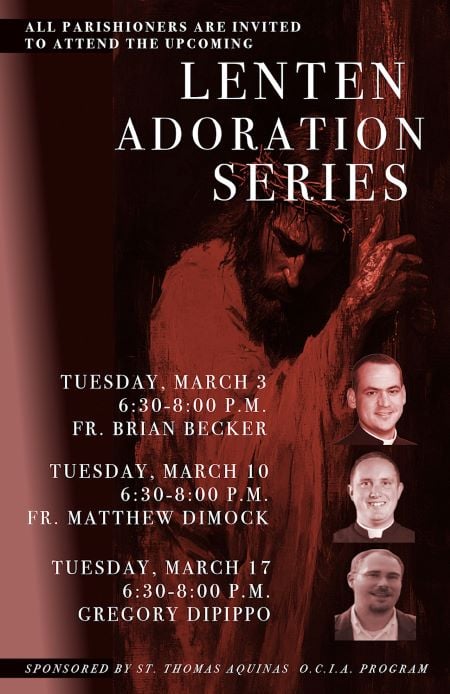
Lenten Adoration Series (Saint Thomas Aquinas) – The parish is holding a Lenten Adoration series on the following Tuesday evenings in March. Each evening will feature a reflection followed by Adoration of the Blessed Sacrament. The last Lenten Adoration event is:
- Tuesday March 17, 6:30-8:00 p.m. (Greg DiPippo - Editor, New Liturgical Movement)
Please see the flyer at the end of this update.
Support Saint Ann and Saint Thomas Parishes – Our parishes remain the anchor of our spiritual and community lives and continue to promote the sacred traditions, devotions, speakers and catechesis important for the spiritual growth of ourselves and our families. They also need our continued financial support (and occasional visits!). Both parishes would appreciate our continued generosity - especially in Lent.
Rosary for the Traditional Latin Mass – A Rosary is offered for the restoration of the Traditional Latin Mass in the church on Sundays after the 11:30 a.m. Novus Ordo Mass at Saint Thomas Aquinas Church.
Daily Holy Face Chaplet for Sacred Liturgy (perpetual novena) – For the preservation of the Traditional Latin Mass, it has been recommended to all friends of the sacred liturgy in the diocese to consider continually praying the powerful Holy Face chaplet, under the banner of Our Lady of the Holy Name. To pray the chaplet, please see this link.
Cardinal Burke’s Prayer for Pope Leo XIV – His Eminence Cardinal Raymond Burke has released a prayer for Pope Leo XIV. Please see the prayer at the links below and consider praying this daily for the Holy Father as he leads the Church. PDF copies can be accessed at these links: [English] [Español] [Latin]
Holy Face Devotions
Prayers of Reparation to the Holy Face of Jesus are offered each week at the following churches on the indicated days:
- St. James (Concord) – Monday, 10-10:30 a.m. (in the cry room)
- St. Mark – Tuesday, 5:30 p.m.
- St. Thomas Aquinas – Tuesday, 6:00 a.m.
- St. Ann – Tuesday, 7:30 a.m. (following 7:00 a.m. Mass)
- St. Michael the Archangel (Gastonia) – Tuesday, 8:30 a.m. (following 8:00 a.m. Mass)
- St. Vincent de Paul – Tuesday, 8:40 a.m.
- Holy Spirit (Denver) – Tuesday, 10-11:00 a.m. (following the 9:15 a.m. Mass)
- Saint Elizabeth of the Hill Country (Boone) – Third Tuesday, at 6:45 p.m. after Mass in the Youth Room
- St. John the Baptist (Tryon) - First Saturday, 9:30 a.m. (after 8:30 a.m Mass)
Note: Days and times may be subject to change due to holidays.
“Jesus, Your ineffable image is the star which guides my steps. Ah, You know, Your sweet Face is for me Heaven on earth” (from Canticle to the Holy Face by Saint Thérèse de Lisieux, the 19th century Discalced Carmelite nun who took the name in religion, Thérèse of the Child Jesus and the Holy Face).
Traditional Latin Mass and Liturgical News
- The Station Churches of the Ember Days of Lent by Greg DiPippo, New Liturgical Movement (February 21, 2024). [Stational Churches of the Ember Days of Lent]
- The Feast of Longinus by Greg DiPippo, New Liturgical Movement (March 15, 2023). [Feast of Longinus]
- Forgotten Customs of St. Patrick’s Day by Matthew Plese, OnePeteFive (March 17, 2023). [Forgotten Customs of St. Patrick’s Day]
- Elisha and the Widow are Christ and the Church by Greg DiPippo, New Liturgical Movement (March 10, 2026). [Elisa and the Widow]
- Church's unity comes from faith in Christ and from love, pope says, by Josephine Peterson (OSV News) Catholic News Herald (March 11, 2026). [Church’s Unity]
- On the Loss of Early Liturgical Documents by Greg DiPippo, New Liturgical Movement (March 10, 2026). [Loss of Early Liturgical Documents]
- The 40 Days of Lent by Fr. William Rock, FSSP, The Missive (February 18, 2024). [The 40 Days of Lent]
- Ave Regina Caelorum by Greg DiPippo, New Liturgical Movement (February 3, 2025). [Ave Regina Caelorum]
Saints and Special Observances
Saint Joseph, Spouse of the Blessed Virgin Mary - As Thursday (March 19th) will be the Feast of Saint Joseph, Spouse of the Blessed Virgin Mary, we take this opportunity to pay homage to the foster father of Our Lord by providing the following excerpts from the commentary of Dom Prosper Guéranger for the saint’s feast day taken from the abbot’s The Liturgical Year.
Who can imagine or worthily describe the sentiments which filled the heart of this man, whom the Gospel describes to us in one word, when it calls him the just man (St. Matth. i. 19.)? Let us try to picture him to ourselves amidst the principal events of his life: his being chosen as the Spouse of Mary, the most holy and perfect of God’s creatures; the Angel’s appearing to him, and making him the one single human confidant of the mystery of the Incarnation, by telling him that his Virgin Spouse bore within her the fruit of the world’s salvation; the joys of Bethlehem, when he assisted at the Birth of the Divine Babe, honoured the Virgin Mother, and heard the Angels singing; his seeing, first the humble and simple Shepherds, and then the rich Eastern Magi, coming to the stable to adore the new-born Child; the sudden fears which came on him, when he was told to arise, and, midnight as it was, to flee into Egypt with the Child and the Mother; the hardships of that exile, the poverty and the privations which were endured by the hidden God, Whose foster-father he was, and by the Virgin Spouse, whose sublime dignity was now so evident to him; the return to Nazareth, and the humble and laborious life led in that village, where he so often witnessed the world’s Creator sharing in the work of a Carpenter; the happiness of such a life, in that cottage where his companions were the Queen of the Angels and the Eternal Son of God, both of whom honoured, and tenderly loved him as the head of the family: yes, Joseph was beloved and honoured by the uncreated Word, the Wisdom of the Father, and by the Virgin, the master-piece of God’s power and holiness.
We ask, what mortal can justly appreciate the glories of St. Joseph? To do so, he would have to understand the whole of that Mystery, of which God made him the necessary instrument. What wonder, then, if this Foster-Father of the Son of God was prefigured in the Old Testament, and that by one of the most glorious of the Patriarchs? Let us listen to St. Bernard, who thus compares the two Josephs: “The first was sold by his brethren, out of envy, and was led into Egypt, thus prefiguring our Saviour’s being sold; the second Joseph, that he might avoid Herod’s envy, led Jesus into Egypt. The first was faithful to his master, and treated his wife with honour; the second, too, was the most chaste guardian of his Spouse, the Virgin Mother of his Lord. To the first was given the understanding and interpretation of dreams; to the second, the knowledge of, and participation in, the heavenly Mysteries. The first laid up stores of corn, not for himself, but for all the people; the second received the Living Bread that came down from heaven, and kept it both for himself and for the whole world. (Homily 2nd. On the Missus est.)”
Such a life could not close save by a death that was worthy of so great a Saint. The time came for Jesus to quit the obscurity of Nazareth, and show himself to the world. His own works were henceforth to bear testimony to his divine origin; the ministry of Joseph, therefore, was no longer needed. It was time for him to leave this world, and wait, in Abraham’s bosom, the arrival of that day, when heaven’s gates were to be opened to the just. As Joseph lay on his bed of death, there was watching by his side He that is the master of life, and that had often called this his humble creature, Father. His last breath was received by the glorious Virgin Mother, whom he had, by a just right, called his Spouse. It was thus, with Jesus and Mary by his side, caring and caressing him, that Joseph sweetly slept in peace. The Spouse of Mary, the Foster-Father of Jesus, now reigns in heaven with a glory which, though inferior to that of Mary, is marked with certain prerogatives which no other inhabitant of heaven can have.
From heaven, he exercises a powerful protection over those that invoke him. In a few weeks from this time, the Church will show us the whole magnificence of this protection; we shall be having a special Feast in honour of the Patronage of St. Joseph. What the Liturgy proposes to us today, are his glories and privileges. Let us unite with the Faithful throughout the world, and offer the Spouse of Mary the Hymns, which are this day sung in his praise. [Saint Joseph - March 19]
Closing Commentary
On this Fourth Sunday of Lent, we offer the following excerpts from the commentary by Dom Prospér Guéranger on Laetare Sunday followed by a link to the full text.
The Fourth Sunday of Lent
This Sunday, called, from the first word of the Introit, Lætare Sunday, is one of the most solemn of the year. The Church interrupts her Lenten mournfulness; the chants of the Mass speak of nothing but joy and consolation; the Organ, which has been silent during the preceding three Sundays, now gives forth its melodious voice; the Deacon resumes his Dalmatic, and the Subdeacon his Tunic; and instead of purple, Rose-colored Vestments are allowed to be used. These same rites were practiced in Advent, on the third Sunday, called Gaudete. The Church’s motive for introducing this expression of joy in today’s Liturgy is to encourage her Children to persevere fervently to the end of this holy Season. The real Mid-Lent was last Thursday, as we have already observed; but the Church, fearing lest the joy might lead to some infringement on the spirit of penance, has deferred her own notice of it to this Sunday, when she not only permits, but even bids, her children to rejoice!
The blessing of the Golden Rose is one of the ceremonies peculiar to the Fourth Sunday of Lent, which is called, on this account, Rose Sunday. The thoughts suggested by this flower harmonize with the sentiments wherewith the Church would now inspire her Children. The joyous time of Easter is soon to give them a spiritual Spring, of which that of Nature is but a feeble image. Hence, we cannot be surprised that the institution of this ceremony is of a very ancient date. We find it observed under the Pontificate of St. Leo IX (eleventh century); and we have a Sermon on the Golden Rose, preached by the glorious Pope Innocent III, on this Sunday, and in the Basilica of the Holy Cross in Jerusalem. In the Middle Ages, when the Pope resided in the Lateran Palace, having first blessed the Rose, he went on horseback to the Church of the Station. He wore the mitre, was accompanied by all the Cardinals, and held the blessed Flower in his hand. Having reached the Basilica, he made a discourse on the mysteries symbolized by the beauty, the color, and the fragrance of the Rose. Mass was then celebrated. After the Mass, the Pope returned to the Lateran Palace. Surrounded by the sacred College, he rode across the immense plain which separates the two Basilicas, with the mystic Flower still in his hand. We may imagine the joy of the people as they gazed upon the holy symbol. When the procession had got to the Palace gates, if there were a Prince present, it was his privilege to hold the stirrup, and assist the Pontiff to dismount; for which filial courtesy he received the Rose, which had received so much honor and caused such joy. [Fourth Sunday in Lent]