First Sunday of Lent
Friends in Christ,
Welcome to our weekly Sunday update. In the Gospel for the First Sunday in Lent we are told that after Jesus had fasted forty days in the desert, the devil confronted Him with three temptations. When Our Lord rejected the first two, the tempter (whom Jesus would later call “the prince of this world”) offered Him nothing less than all the kingdoms of the world if He would but fall down and worship him. “Then Jesus saith to him: Begone, Satan: for it is written, The Lord thy God shalt thou adore, and him only shalt thou serve” (Matthew 4:10).
There is a powerful echo of the vade Satanas (“Begone, Satan”), spoken by Christ in this Sunday’s Gospel reading, to be found in the sixteenth chapter of the same Gospel. When Simon Bar-Jona acknowledges Jesus to be the Christ, Our Lord responds by naming him Peter, calling him the rock upon which He will build his church, and giving him the keys of the kingdom of heaven (Matthew 16:16-19). But when Jesus begins telling his disciples how He is to suffer at the hands of the Jewish authorities and be put to death when they reach Jerusalem, Peter takes him aside and rebukes Him. Turning to confront the apostle, Jesus tells Peter, “Go behind me, Satan (vade post me, Satana); thou art a scandal unto me, because thou savourest not the things that are of God, but the things that are of men” (Matthew 16:23).
We are only at the beginning of Lent, but as we approach the end of the season we will be reminded in the liturgical readings for Holy Week that Peter was tempted three times as he stood in the court of the high priest while Jesus was interrogated and convicted of blasphemy. As foretold by Our Lord, he succumbed to temptation each time, denying he knew the one who was the Truth three times before the night was over in a futile attempt to conceal his own identity (Matthew 26:69-75).
As we fast and pray in this season of penance, we are called to acknowledge our own failure to savor the things that are of God rather than the things that are of men. Jesus rejected the world in order to save men, while Peter clung to the world for a time, seeking to save himself. Now is the time to turn away from the temptations of the world, as the apostle did after that terrible night, in order to seek the forgiveness of sins by which we can be reconciled with God.
Calendar of Special Observances
Celebrations are those listed in the Roman Missal of 1962.
DAY, DATE – FEAST (CLASS)
Sunday, February 22 – First Sunday of Lent (I)
Monday, February 23 – Feria of Lent (III) – Commemoration of St. Peter Damian, Bishop, Confessor, and Doctor of the Church
Tuesday, February 24 – St. Matthias, Apostle (II) – Feria of Lent
Wednesday, February 25 – Ember Wednesday of Lent (II)
Thursday, February 26 – Feria of Lent (III)
Friday, February 27 – Ember Friday of Lent (II) – Commemoration of St. Gabriel of Our Lady of Sorrows, Confessor
Saturday, February 28 – Ember Saturday of Lent (II)
Ember Week: This week includes the Ember Days of Lent, according to the traditional liturgical calendar: three days of prayer and penance (now voluntary), anticipating the arrival of Spring, giving thanks to God for the gifts of creation and consecrating the season ahead. The Lenten or Spring Ember Days, like those designated for the other three natural seasons, are celebrated on Wednesday, Friday, and Saturday in Ember Week. To learn more about Ember Days we direct readers to Dom Prosper Guéranger’s Reflection for Wednesday in Lenten Ember Week.
First Sunday of Lent
The links provided below can be used to download printable copies of the Proper Prayers for the First Sunday of Lent with English or Spanish translation, followed by commentary by Dr. Michael P. Foley. We also provide a link to an article from Greg DiPippo on “The Station Churches of the Ember Days of Lent”.
Traditional Latin Mass Schedule
Diocese of Charlotte Sunday Masses
Chapel of the Little Flower (757 Oakridge Farm Road, Mooresville, NC)
- 10:00 a.m. (Low)
- 12:00 p.m. (Sung)
- Chaplain: Fr. Brandon Jones
- Chapel related questions? Email Father at: tlmchapel(at)rcdoc.org
- More details: https://carolinaliturgy.org/chapel
Note: Only Sunday Latin Masses and Holy Days are offered at the Chapel. This is the only Diocese of Charlotte location which offers the Traditional Latin Mass.
Saint Thérèse of the Child Jesus and the Holy Face, the Little Flower, pray for us!
Diocese of Raleigh Sunday Masses
- 1:00 p.m., Sacred Heart (Dunn, NC)
- 4:30 p.m. - First Sunday, Holy Name Cathedral (Raleigh, NC)
- For additional locations and Masses please see our Mass Times webpage
Diocese of Charleston Sunday Masses
- 12:00 p.m., Prince of Peace (Taylors SC)
- 1:00 p.m., Our Lady of the Lake (Chapin SC)
- 12:00 p.m., Sacred Heart (Charleston SC)
- 5:30 p.m., Stella Maris (Sullivans Island, SC)
Diocese of Charleston Daily Traditional Latin Masses
- Prince of Peace (Taylors SC) – Monday-Friday, 12:00 p.m.
- Prince of Peace (Taylors SC) – Saturday, 8:00 a.m.
- For additional locations and Masses please see our Mass Times webpage
As a reminder, travelers are urged to consult parish websites or offices for up-to-date information regarding possible changes in the schedule of Mass times.
Traditional Fasting and Abstinence Disciplines During Lent
For those looking to practice the traditional Lenten disciplines in place in 1962, we share a helpful 2010 document from Mater Ecclesiae Latin Mass Chapel in Berlin, New Jersey, which explains the differences between the traditional Lenten rules for fasting and abstinence (now voluntary) that accompanied the Traditional Latin Mass and the current rules. [Discipline of 1962 for Fast during Lent]
Chapel of the Little Flower Announcements
Mass Intentions for Sunday
Sunday February 22 - David Ernest Cochrane By Jeannie and John Grant
Mass intentions for the Chapel of the Little Flower Available
The Mass book for the Chapel of the Little Flower will be open again on Sunday, February 22 at 11:30 to allow attendees of both Masses the opportunity to request Mass intentions (for the remaining dates). One Mass each Sunday will be available and the requestor will be able to specify which Mass one would like to request (10 a.m. or 12 noon). If you have already had a Mass offered, please allow others the opportunity to request a Mass. The minimum stipend is $15 and checks must be made out to "St. Ann Catholic Church" with "Chapel Mass Stipend" in the memo line or cash will also be accepted. Please be prepared to choose which Mass you are requesting.
Lost and Found
The Chapel has a growing collection of items left behind after Mass. If one is missing a missal, book, or other item, please see the new table in the cry room.
Father Jones’ Contact Info
If one has questions about the Chapel of the Little Flower, that are not related to one’s parish, please email Father Jones directly at: tlmchapel(at)rcdoc.org
Visiting the Chapel of the Little Flower
If you haven’t attended Mass at the Chapel of the Little Flower yet, you are welcome to join us during Lent. Seating is adequate at both Masses, and there is plenty of parking; a cry room; open space outside for the kids after Mass. Bulletins from Saint Ann or Saint Thomas Aquinas parishes are usually available.
General Announcements
New Book on Litany of Humility – In previous weeks we shared a book, Meditations on the Litany of Humility, according to the Saints published by Sensus Fidelium Press. This month we share a complimentary book by Patrick O’Hearn, entitled Humility of the Saints: The Litany of Humility Made Flesh, which “Includes prayers, spiritual insights and the saints’ most profound insights on the virtue that made Heaven possible for them”. It is published by Sophia Institute Press and can be found at this link. An ideal book during Lent.
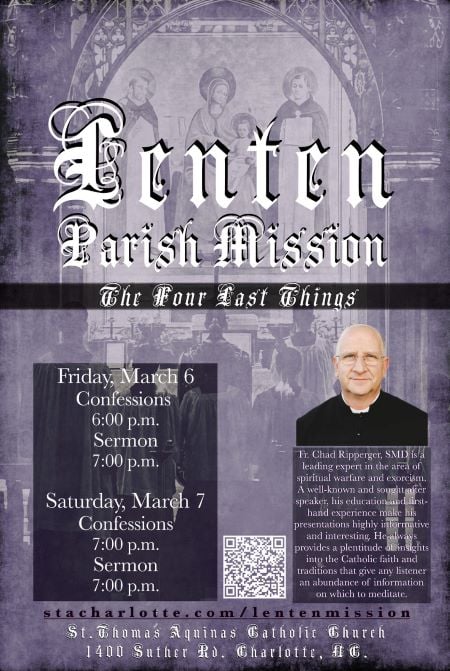
(TWO Weeks Away) Fr. Ripperger to Offer Lenten Mission at Saint Thomas Aquinas (March 6-7) – Saint Thomas Aquinas parish is blessed to welcome back Fr. Chad Ripperger, SMD, a priest and exorcist with the Society of the Most Sorrowful Mother (the Doloran Fathers), to offer a Lenten Parish Mission in March. Father will offer the mission on Friday March 6 at 7:00 p.m. and Saturday March 7 at 7:00 p.m. Please note: As noted last year, the conference is geared toward adults, and would not be appropriate for younger children. Registration is required. To register click here.
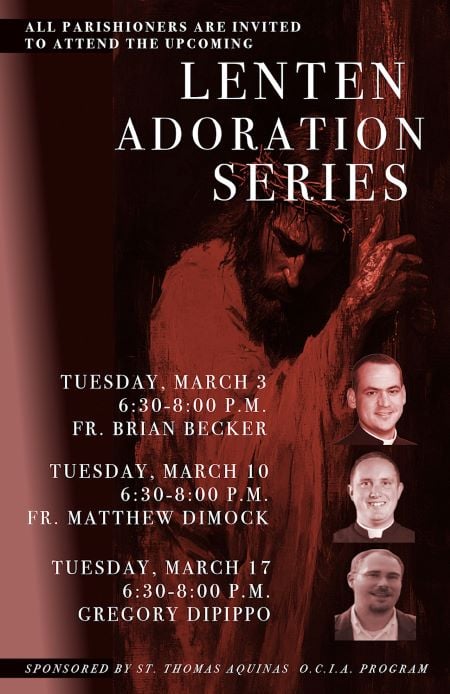
Lenten Adoration Series (Saint Thomas Aquinas) – The parish will hold a Lenten Adoration series on the first three Tuesday evenings in March. Each evening will feature a reflection followed by Adoration of the Blessed Sacrament. This is a stellar lineup of speakers:
- Tuesday March 3, 6:30-8:00 p.m. (Fr. Brian Becker, St. Joseph Seminary)
- Tuesday March 10, 6:30-8:00 p.m. (Fr. Matthew Dimock, Sacred Heart parish)
- Tuesday March 17, 6:30-8:00 p.m. (Greg DiPippo - Editor, New Liturgical Movement)
Please see the flyer at the end of this update.
Support Saint Ann and Saint Thomas Parishes – Our parishes remain the anchor of our spiritual and community lives and continue to promote the sacred traditions, devotions, speakers and catechesis important for the spiritual growth of ourselves and our families. They also need our continued financial support (and occasional visits!). Both parishes would appreciate our continued generosity - especially in Lent.
Rosary for the Traditional Latin Mass – A Rosary is offered for the restoration of the Traditional Latin Mass in the church on Sundays after the 11:30 a.m. Novus Ordo Mass at Saint Thomas Aquinas Church.
Daily Holy Face Chaplet for Sacred Liturgy (perpetual novena) – For the preservation of the Traditional Latin Mass, it has been recommended to all friends of the sacred liturgy in the diocese to consider continually praying the powerful Holy Face chaplet, under the banner of Our Lady of the Holy Name. To pray the chaplet, please see this link.
Cardinal Burke’s Prayer for Pope Leo XIV – His Eminence Cardinal Raymond Burke has released a prayer for Pope Leo XIV. Please see the prayer at the links below and consider praying this daily for the Holy Father as he leads the Church. PDF copies can be accessed at these links: [English] [Español] [Latin]
Holy Face Devotions
Prayers of Reparation to the Holy Face of Jesus are offered each week at the following churches on the indicated days:
- St. James (Concord) – Monday, 10-10:30 a.m. (in the cry room)
- St. Mark – Tuesday, 5:30 p.m.
- St. Thomas Aquinas – Tuesday, 6:00 a.m.
- St. Ann – Tuesday, 7:30 a.m. (following 7:00 a.m. Mass)
- St. Michael the Archangel (Gastonia) – Tuesday, 8:30 a.m. (following 8:00 a.m. Mass)
- St. Vincent de Paul – Tuesday, 8:40 a.m.
- Holy Spirit (Denver) – Tuesday, 10-11:00 a.m. (following the 9:15 a.m. Mass)
- Saint Elizabeth of the Hill Country (Boone) – Third Tuesday, at 6:45 p.m. after Mass in the Youth Room
- St. John the Baptist (Tryon) - First Saturday, 9:30 a.m. (after 8:30 a.m Mass)
Note: Days and times may be subject to change due to holidays.
“Jesus, Your ineffable image is the star which guides my steps. Ah, You know, Your sweet Face is for me Heaven on earth” (from Canticle to the Holy Face by Saint Thérèse de Lisieux, the 19th century Discalced Carmelite nun who took the name in religion, Thérèse of the Child Jesus and the Holy Face).
Traditional Latin Mass and Liturgical News
- Liturgical Notes on Ash Wednesday by Greg DiPippo, New Liturgical Movement (February 18, 2026). [Liturgical Notes on Ash Wednesday]
- The Per ipsum by Dr. Michael P. Foley, New Liturgical Movement (February 13, 2026). [The Per ipsum]
- Georgia martyrs killed for defending marriage to be beatified in U.S. this October by Kate Quiñones, EWTN News, (February 19, 2026). [Georgia Martyrs]
- ‘Sacred Wine’: How Monks Built Europe’s Wine Culture by Solène Tadié, National Catholic Register (February 15, 2026). [Europe’s Wine Culture]
- An American Diocese Institutes Lenten Stational Churches by Greg DiPippo, New Liturgical Movement (February 10, 2026). [Stational Churches]
- What Motivated 70,000 Young Mexicans to Make a Pilgrimage to Christ the King? by Diego López Colín, National Catholic Register (February 10, 2026). [Christ the King Pilgrimage]
- Ave Regina Caelorum by Greg DiPippo, New Liturgical Movement (February 3, 2025). [Ave Regina Caelorum]
Saints and Special Observances
Saint Anne Line is one of the Forty Martyrs of England and Wales condemned for their Catholic faith and executed by the government of England between 1535 and 1679. Canonized by Pope Paul VI in 1970, the Forty Martyrs are memorialized as a group on October 25th, the date of their canonization, in the revised (post-1962) liturgical calendar. Convicted of harboring a missionary priest who celebrated the outlawed Latin Mass in her house, Anne Line was hanged in 1601. She was the third of three laywomen among the Forty Martyrs, following Margaret Clitherow who was executed in 1586 and Margaret Ward who met the same fate in 1588.
Born Alice Higham around 1563, she was the daughter of a well-to-do Puritan, William Higham of Dunmow in Essex. She took the name Anne when she converted to Catholicism along with her brother, William, and Roger Line, whom she married in February of 1583. Both men were disowned by their fathers, and Anne was deprived of her dowry, for renouncing Protestantism. Roger Line was subsequently arrested while attending a traditional Mass and forced into exile in Flanders where he died in 1594.
Following her husband’s death, Anne was recruited by Fr. John Gerard, S.J., a priest on the Jesuit mission to England and Wales, to maintain a house he had acquired in London to serve as a refuge for covert missionaries. Fr. Gerard would later escape from imprisonment in the Tower and live to write an autobiographical account of his service on the mission. “In charge of this house,” he wrote of Anne Line, “I put a very good and prudent widowed lady, who was later to receive the honor of martyrdom.”
When I decided to establish the house . . . I could think of no better person than her to put in charge of it. She was able to manage the finances, do all the housekeeping, look after the guests, and deal with the inquiries of strangers. She was full of kindness, very discreet, and possessed her soul in great peace. She was, however, a chronic invalid – she was always suffering from one ailment or another.
Anne often expressed to Fr. Gerard her desire to win a martyr’s crown but said she thought it unlikely she would do so because, as a woman, she believed there was little chance she would have the opportunity. “However, she told her confessor some years before her death,” Bishop Challoner wrote in his Memoirs of Missionary Priests, “that . . . a former confessor of hers, who ended his days by martyrdom in 1586, had promised her that if God should make him worthy of that glorious end, he would pray for her that she might obtain the like happiness.” She also described to the same confessor a vision in which the Lord appeared to her, carrying his cross and beckoning her to follow Him. She interpreted the vision to mean that martyrdom awaited her.
When Fr. Gerard escaped from prison, Anne gave up the house he had established and leased another where she provided apartments for priests who had returned to England as undercover missionaries. The way in which her martyrdom came about is described by Bishop Challoner:
On Candlemas day, 1601, the pursuivants having some intelligence, or suspecting that Mrs. Line entertained a priest, beset her house at the very time that mass was actually beginning. However, as the door was strongly barred and fastened, they were forced to wait some time before they could come in: and, in the meantime, the priest, a Mr. Page, “had leisure to unvest himself and make his escape” [here quoting “Dr. Champney’s manuscript history,” according to a footnote].
The priest-hunters failed to capture their man or to find any real evidence that a Latin Mass had been celebrated in the house. Nevertheless, they took Anne Line into custody and brought her to trial before Lord Chief Justice Popham, “a bitter enemy of the Catholics.” As directed by the judge, the jury delivered a verdict of guilty on the charge of having harbored a seminary priest. The judge sentenced her to die and sent her to Newgate to await execution on the next day, an event described by Bishop Challoner:
When the keeper acquainted her with the dead-warrant being signed, and when afterwards she was carried out to execution, she showed not the least commotion or change in her countenance. At Tyburn, when she was just ready to die, she declared to the standers by, with a loud voice — I am sentenced to die for harbouring a catholic priest; and so far I am from repenting for having so done, that I wish with all my soul that where I have entertained one I could have entertained a thousand. She suffered before the two priests; and Mr. Barkworth, whose combat came on the next, embraced her body whilst it was yet hanging, saying, — O ! blessed Mrs. Line, who hast now happily received thy reward. Thou art gone before us; but we shall quickly follow thee to bliss, if it please the Almighty.
Anne Line was executed, along with Fr. Mark Barkworth, O.S.B., and Fr. Roger Filcock, S.J., on February 27, 1601. In the Catholic dioceses of England, she is memorialized together with Saint Margaret Clitherow and Saint Margaret Ward on August 30th, but the date of her personal feast is that of her martyrdom, February 27th.
Sources: Challoner, Bishop Richard, Memoirs of Missionary Priests (Manchester: Mark Wardle, 1803); Gerard, John, S.J., The Autobiography of a Hunted Priest, translated from the Latin by Philip Caraman, S.J. (San Francisco: Ignatius Press, 2012).
Closing Commentary
Finally, as we move into the penitential season of Lent, we offer a commentary by Dom Prospér Guéranger for the First Sunday of Lent, which is technically the official beginning of the season.
First Sunday of Lent
Lent solemnly opens today. We have already noticed that the four preceding days were added since the time of St. Gregory the Great, in order to make up Forty days of fasting. Neither can we look upon Ash Wednesday as the solemn opening of the Season, for the Faithful are not bound to hear Mass on that day. The Holy Church, seeing her children now assembled together, speaks to them, in her Office of Matins, these eloquent and noble words of St. Leo the Great: “Having to announce to you, dearly beloved, the most sacred and chief Fast, how can I more appropriately begin, than with the words of the Apostle, (in whom Christ himself spoke,) and by saying to you what has just been read: Behold! now is the acceptable time; behold! now is the day of salvation. For although there be no time, which is not replete with divine gifts, and we may always, by God’s grace, have access to his mercy, - yet ought we all to redouble our efforts to make spiritual progress and be animated with unusual confidence, now that the anniversary of the day of our Redemption is approaching, inviting us to devote ourselves to every good work, that so we may celebrate, with purity of body and mind, the incomparable Mystery of our Lord’s Passion.
“It is true, that our devotion and reverence towards so great a Mystery should be kept up during the whole year, and we ourselves be, at all times, in the eyes of God, the same as we are bound to be at the Easter Solemnity. But this is an effort which only few among us have the courage to sustain. The weakness of the flesh induces us to relent our austerities; the various occupations of every-day life take up our thoughts; and thus, even the virtuous find their hearts clogged by this world’s dust. Hence it is, that our Lord has most providentially given us these Forty Days, whose holy exercises should be to us a remedy, whereby to regain our purity of soul. The good works and the holy fastings of this Season were instituted as an atonement and obliteration of the sins we commit during the rest of the Year. [First Sunday of Lent]