Easter Sunday
Friends in Christ,
Christus Resurréxit! Resurréxit Vere! Welcome to our weekly Sunday update. This Sunday is Easter Sunday, but the season of Eastertide actually begins with celebration of the Easter Vigil on Saturday night. As the vigil will not be celebrated according to the traditional rite this year, those who regularly attend the Latin Mass may choose to wait until Sunday to celebrate what is, after all, the holiest day on the Christian calendar.
Now, leaving Lent behind us, we move into a season dedicated to the joyful celebration of those world-historical events ensuing from the Incarnation of Our Lord: His conquest of sin and death in the Resurrection; His Ascension into Heaven, returning to the Father after 40 days spent speaking and even eating with his disciples in his resurrected body; and the Descent of the Holy Ghost at Pentecost, ten days after the Ascension, establishing through the agency of the twelve Apostles the Holy Catholic Church proclaimed by Jesus Christ with Peter as its head.
This season of Eastertide, given over entirely to the joy that arises from knowing our salvation has been accomplished through the death and resurrection of Our Lord and Savior Jesus Christ, will continue until the Saturday following Pentecost Sunday.
The Gradual for Easter Sunday tells us: Haec dies, quam fecit Dóminus; exsultémus, et laetémur in ea. This is the day which the Lord hath made: let us rejoice and be glad in it (Psalm 117:24). As Dom Prosper Guéranger begins his commentary on Easter Sunday with these words, we begin by offering the following brief excerpt from The Liturgical Year followed by a link to the abbot’s full commentary.
Easter Morning
The night between Saturday and Sunday has well nigh run its course, and the day-dawn is appearing. The Mother of sorrows is waiting, in courageous hope and patience, for the blissful moment of her Jesus’ return. Magdalene and the other holy women have spent the night in watching, and are preparing to start for the sepulcher. In limbo, the Soul of our crucified Lord is about to give the glad word of departure to the myriads of the long-imprisoned holy souls, who cluster round Him in adoring love. Death is still holding his silent sway over the sepulcher, where rests the Body of Jesus. Since the day when he gained his first victim, Abel, he has swept off countless generations; but never has he held in his grasp a prey so noble as this that now lies in the tomb near Calvary. Never has the terrible sentence of God, pronounced against our first parents, received such a fulfillment as this; but never has death received such a defeat as the one that is now preparing. It is true, the power of God has, at times brought back the dead to life: the son of the widow of Naim, and Lazarus, were reclaimed from the bondage of this tyrant death; but he regained his sway over them all. But his Victim of Calvary is to conquer him forever, for this is He of whom it is written in the prophecy: “O death! I will be thy death!” Yet a few brief moments and the battle will be begun, and life shall vanquish death. [Easter Sunday Morning]
Calendar of Special Observances
Celebrations are those listed in the Roman Missal of 1962.
DAY, DATE – FEAST (CLASS)
Sunday, April 5 – Easter Sunday (I)
Monday, April 6 – Easter Monday (I)
Tuesday, April 7 – Easter Tuesday (I)
Wednesday, April 8 – Easter Wednesday (I)
Thursday, April 9 – Easter Thursday (I)
Friday, April 10 – Easter Friday (I)
Saturday, April 11 – Easter Saturday (I)
Easter Sunday
The links provided below can be used to download printable copies of the Proper Prayers for Easter Sunday with English or Spanish translation, followed by commentary by Dr. Michael P. Foley.
Traditional Latin Mass Schedule
Diocese of Charlotte Sunday Masses
Chapel of the Little Flower (757 Oakridge Farm Road, Mooresville, NC)
- 10:00 a.m. (Low)
- 12:00 p.m. (Sung)
- Chaplain: Fr. Brandon Jones
- Chapel related questions? Email Father at: tlmchapel(at)rcdoc.org
- DONATE: To donate to the Chapel of the Little Flower click here (via Saint Ann Parish, Charlotte)
- More details: https://carolinaliturgy.org/chapel
Note: Only Sunday Latin Masses and Holy Days are offered at the Chapel. This is the only Diocese of Charlotte location which offers the Traditional Latin Mass.
Saint Thérèse of the Child Jesus and the Holy Face, the Little Flower, pray for us!
Diocese of Raleigh Sunday Masses
- 1:00 p.m., Sacred Heart (Dunn, NC)
- 4:30 p.m. - First Sunday, Holy Name Cathedral (Raleigh, NC)
- 5:00 p.m. - Fourth Sunday, Basilica of Saint Mary (Wilmington, NC)
- For additional locations and Masses please see our Mass Times webpage
Diocese of Charleston Sunday Masses
- **12:30 p.m.**, Prince of Peace (Taylors SC) (**Special 12:30 p.m. start for Easter Sunday Mass April 5 - see announcement below)
- 1:00 p.m., Our Lady of the Lake (Chapin SC)
- 12:00 p.m., Sacred Heart (Charleston SC)
- 5:30 p.m., Stella Maris (Sullivans Island, SC)
Diocese of Charleston Daily Traditional Latin Masses
- Prince of Peace (Taylors SC) – Monday-Friday, 12:00 p.m. (see note below)
- Prince of Peace (Taylors SC) – Saturday, 8:00 a.m.(see note below)
- For additional locations and Masses please see our Mass Times webpage
Easter Sunday note: The Latin Mass at Prince of Peace (Taylors SC) for Easter Sunday will begin 30 minutes late, at 12:30 p.m.
Easter Week cancellation note: According to the bulletin, the daily Latin Masses are canceled at Prince of Peace (Taylors SC) this coming Easter week from Monday April 6 thru Saturday April 11.
As a reminder, travelers are urged to consult parish websites or offices for up-to-date information regarding possible changes in the schedule of Mass times.
Upcoming Special Latin Masses and Liturgies (as announced)
Sunday April 5: Easter Sunday (Special Mass Times only)
- 12:30 p.m. - Prince of Peace (Taylors SC)
- All other Sunday Latin Masses at other locations are on a normal schedule
For additional Lenten Masses and events please see our Lenten Masses webpage.
Chapel of the Little Flower Announcements
Mass Intentions for Sunday
Sunday April 5, 12:00 p.m. - Intentions of Bishop Michael Martin OFM Conv., by the Carolina Traditional Liturgy Society
Donations for the Chapel of the Little Flower
There is a new procedure for making donations to the Chapel of the Little Flower. Please make out a check to “St. Ann Catholic Church” and carefully earmark it for “Latin Mass” or “Chapel of the Little Flower”. It can be mailed to the parish (3635 Park Road, Charlotte, NC 28209). To donate online, please visit the parish’s “Chapel of the Little Flower” online donation portal at this link.
Update on Mass intentions
Mass intentions have now been filled through the spring and new Masses are currently unavailable. The Mass intentions book will be opened sometime later this spring for the next quarter of Masses.
Lost and Found
The Chapel has a growing collection of items left behind after Mass. If one is missing a missal, book, or other item, please see the new table in the cry room.
Father Jones’ Contact Info
If one has questions about the Chapel of the Little Flower, that are not related to one’s parish, please email Father Jones directly at: tlmchapel(at)rcdoc.org
Visiting the Chapel of the Little Flower
If you haven’t attended Mass at the Chapel of the Little Flower yet, you are welcome to join us in Eastertide. Seating is adequate at both Masses, and there is plenty of parking; a cry room; open space outside for the kids after Mass. Bulletins from Saint Ann and Saint Thomas Aquinas parishes are usually available.
General Announcements
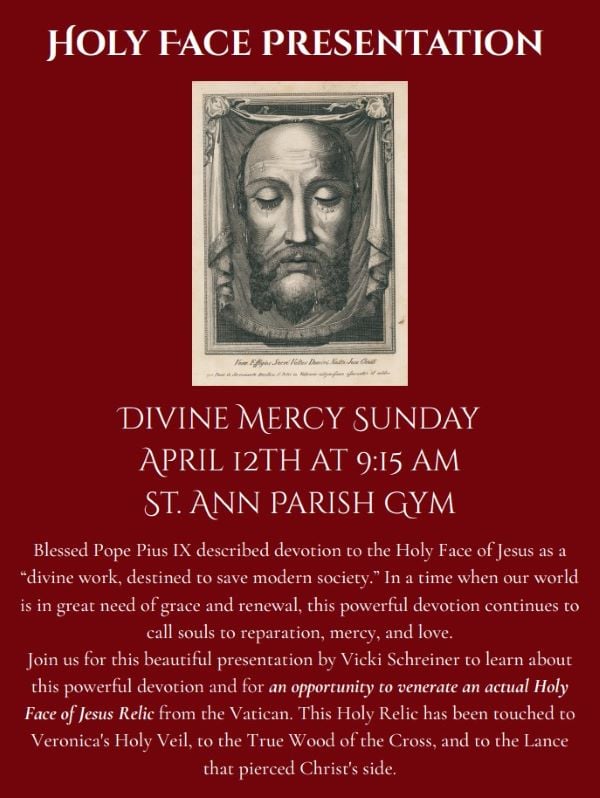
Special Talk on the Holy Face of Jesus – Next Sunday April 12 at 9:15 a.m. Saint Ann parish will host a special talk on the Holy Face devotion by Vicki Schreiner to allow the faithful to learn about this powerful devotion. There will also be an opportunity to venerate an actual Holy Face of Jesus relic, which has been touched to Veronica’s Holy Veil, the True Cross, and to the Lance that pierced Christ’s side. The talk will be in the gym. See flyer at the end of this update.
First Sunday Food & Fellowship Potluck at Saint Thomas Aquinas – Next Sunday (April 12) will be the monthly Sunday Food and Fellowship at Saint Thomas Aquinas from 1:30 p.m. – 3:00 p.m. If you attend Mass at the Chapel, you can always drop by after Mass. Please consider bringing something to share at this sign-up sheet.
LiveMass.net – Want to watch a Latin Mass online? The Priestly Fraternity of Saint Peter (FSSP) has a broadcast apostolate which streams its Latin Masses across the world at various times of the day. To view visit: https://www.livemass.net/
(New) Reprinted Book on The Holy Face – Sensus Fidelium Press has just released a reprint of Father J.B. Fourault’s 19th century book, The Month of the Holy Face. According to the description, April is the month of the Holy Face and the book offers meditations for each day in honor of the Holy Face of Jesus. It seems a perfect opportunity to continue to practice the Holy Face of Jesus devotion to pray for the Traditional Latin Mass. To learn more or to order, click here.
Support Saint Ann and Saint Thomas Parishes – Our parishes remain the anchor of our spiritual and community lives and continue to promote the sacred traditions, devotions, speakers and catechesis important for the spiritual growth of ourselves and our families. They also need our continued financial support (and occasional visits!). Both parishes would appreciate our continued generosity - especially in Lent.
Rosary for the Traditional Latin Mass – A Rosary is offered for the restoration of the Traditional Latin Mass in the church on Sundays after the 11:30 a.m. Novus Ordo Mass at Saint Thomas Aquinas Church.
Daily Holy Face Chaplet for Sacred Liturgy (perpetual novena) – For the preservation of the Traditional Latin Mass, it has been recommended to all friends of the sacred liturgy in the diocese to consider continually praying the powerful Holy Face chaplet, under the banner of Our Lady of the Holy Name. To pray the chaplet, please see this link.
Cardinal Burke’s Prayer for Pope Leo XIV – His Eminence Cardinal Raymond Burke has released a prayer for Pope Leo XIV. Please see the prayer at the links below and consider praying this daily for the Holy Father as he leads the Church. PDF copies can be accessed at these links: [English] [Español] [Latin]
Holy Face Devotions
(See Holy Face event on April 12 at the conclusion of this email update)
Prayers of Reparation to the Holy Face of Jesus are offered each week at the following churches on the indicated days:
- St. James (Concord) – Monday, 10-10:30 a.m. (in the cry room)
- St. Mark – Tuesday, 5:30 p.m.
- St. Thomas Aquinas – Tuesday, 6:00 a.m.
- St. Ann – Tuesday, 7:30 a.m. (following 7:00 a.m. Mass)
- St. Michael the Archangel (Gastonia) – Tuesday, 8:30 a.m. (following 8:00 a.m. Mass)
- St. Vincent de Paul – Tuesday, 8:40 a.m.
- Holy Spirit (Denver) – Tuesday, 10-11:00 a.m. (following the 9:15 a.m. Mass)
- Saint Elizabeth of the Hill Country (Boone) – Third Tuesday, at 6:45 p.m. after Mass in the Youth Room
- St. John the Baptist (Tryon) - First Saturday, 9:30 a.m. (after 8:30 a.m Mass)
Note: Days and times may be subject to change due to holidays.
“Jesus, Your ineffable image is the star which guides my steps. Ah, You know, Your sweet Face is for me Heaven on earth” (from Canticle to the Holy Face by Saint Thérèse de Lisieux, the 19th century Discalced Carmelite nun who took the name in religion, Thérèse of the Child Jesus and the Holy Face).
Traditional Latin Mass and Liturgical News
- Christ the Lamb by Fr. William Rock, FSSP, The Missive (April 19, 2024). [Christ the Lamb]
- Pope urges liturgical unity, inclusion of Traditional Latin Mass faithful, ACI Stampa (March 25, 2026). [Pope urges liturgical unity]
- Vatican Affirms Future of Anglican Ordinariates: ‘A Precious Gift and a Treasure to Be Shared’ by Amira Abuzeid, National Catholic Register (March 30, 2026). [Vatican Affirms Future of Anglican Ordinariates]
- Gregorian Chant Courses This Summer at Clear Creek Abbey by Greg DiPippo, New Liturgical Movement (March 31, 2026). [Gregorian Chant Courses]
- Pope Leo XIV: Toward a Liturgical Turning Point? by Andrea Gagliarducci, National Catholic Register (March 31, 2026). [Toward a Liturgical Turning Point?]
Saints and Special Observances
Saint Peter, after figuring prominently in the events that transpired on the night of the Last Supper, as described in the Gospel According to Saint Matthew, is entirely absent from the evangelist’s account of what happened after dawn on the day Our Lord was crucified. The last we hear of him is Matthew’s terse description of Peter’s response to the crowing of a cock immediately after his third denial of any association with Jesus: “And Peter remembered the word of Jesus which he had said: Before the cock crow, thou wilt deny me thrice. And going forth, he wept bitterly” (Matthew 26:75).
In the second Gospel, Mark records Peter’s response to the crowing of the cock in similar fashion (“And he began to weep”) but quotes Jesus as having said, “Before the cock crow twice, thou shalt thrice deny me” (Mark 14:72) [emphasis added]. Peter does not appear again in the Gospel, although his name is mentioned one time. When Mary Magdalen and her companions come on Easter morning to anoint with sweet spices the body of Jesus, they find the stone that had sealed the sepulchre rolled away. Upon entering the tomb, they encounter a young man wearing a white robe who tells them Jesus is risen: “But go, tell his disciples and Peter that he goeth before you into Galilee. There you shall see him, as he told you” (Mark 16:7). Note that he does not say, “But go, tell Peter and his other disciples. . . .” The implication is that Peter has, in effect, separated himself from the body of followers by his triple denial of both Jesus and his own identity.
It is left to Luke to rehabilitate Peter by bringing him back into the narrative after describing his response to the crowing of the cock in the same way as Matthew and Mark: “And Peter going out, wept bitterly” (Luke 22:62). Unlike the first two evangelists, Luke makes him an active participant in the events of Easter morning, although he mentions him only once. When Mary Magdalen and the other women return with news of the empty tomb, Luke tells us, “But Peter rising up, ran to the sepulchre and, stooping down, he saw the linen cloths laid by themselves: and went away wondering in himself at that which was come to pass” (Luke 24:12). We see, at least, the beginning of a return to faith in Jesus.
Only in the Gospel According to Saint John do we get the full picture of Peter’s involvement in the events of the Resurrection. There, we get what amounts to the eyewitness testimony of “the other disciple,” as John styles himself in demurring from use of his own name. He says nothing about Peter’s response when the cock crowed at dawn on the day Our Savior died, only noting with regard to the third denial, “Again therefore Peter denied: and immediately the cock crew” (John 18:27). But where the other evangelists essentially write Peter out of the script following his defection, John reveals him to be a major actor in the rest of the story sketched in the last two chapters of his Gospel.
It is “to Simon Peter and the other disciple whom Jesus loved” that Mary Magdalen runs with news of the discovery of the empty tomb (John 20:2). Peter and John then run together to see for themselves that the body of Jesus is no longer in the sepulchre. John outruns the older disciple but then steps aside to let Peter enter before him: “Then cometh Simon Peter, following him, and went into the sepulchre: and saw the linen cloths lying” (John 20:6).
In the last chapter of his Gospel, John tells the story of the dramatic encounter between Peter and the resurrected Christ on the shore of the Sea of Tiberias. Peter and James and John have seemingly gone back to their former lives as fishermen. When Peter announces his intention to go fishing, several of the disciples present join him. They fish all night but catch nothing. When the sun comes up, they see a man standing on the shore; he asks if they have any meat. The fishermen admit they have nothing, and the man tells them to cast their net to the right of the ship. When they do so, they are unable to lift the net into the boat because of the “multitude of fishes” it contains. Then John realizes the man on the shore is Jesus. “It is the Lord,” he tells Peter who promptly jumps into the water and swims ashore to greet Jesus.
When the boat bearing John and the other disciples reaches the shore, Jesus tells them to bring the fish they had caught. “Simon Peter went up and drew the net to land, full of great fishes, one hundred and fifty-three. And although there were so many, the net was not broken” (John 21:11).
Jesus, having prepared a fire, proceeds to cook for them. Then, turning to Peter, he says, “Simon, son of John, lovest thou me more than these?” and Peter replies, “Yea, Lord, thou knowest that I love thee.” “Feed my lambs,” Jesus tells him. This exchange is repeated not once but twice in essentially the same words, Jesus extracting a threefold confession from Peter to counter his triple denial in the dark hours before dawn on the day of Our Lord’s crucifixion. Each time, he addresses his wayward follower not by the name he had given him but by the name he bore before Christ called him to be the rock on which his Church was to be built.
After speaking of the martyrdom Peter was fated to endure, Jesus says to him, “Follow me.” As they walk along the shore, Peter turns and sees “that disciple whom Jesus loved” following them. Stung by the revelation of his own fate, he asks about the other disciple: “Lord, and what shall this man do?” (John 21:21). Then, rebuking Peter, “Jesus saith to him: So I will have him to remain till I come, what is it to thee? Follow thou me” (John 21:22).
And John, who clearly heard every word exchanged between Jesus and Peter that day as they walked along the shore, is unmasked at last in the penultimate verse of his Gospel: “This is that disciple who giveth testimony of these things and hath written these things: and we know that his testimony is true” (John 21:24).
Closing Commentary
We began this update with an excerpt from Dom Prosper Guéranger’s commentary on Easter Sunday focusing on the morning of that momentous day. We close now with a brief excerpt from that same source, focusing on the evening of Easter Sunday, followed by a link to the full commentary.
Easter Evening: The Road to Emmaus
The Day of Jesus’ Resurrection is fast drawing to its close. It is the day honoured by God with the greatest of all miracles: it is the most important day that has ever dawned upon the world since Light was first created: but the night will soon be upon us, shadowing the brightness of the great day. Four times has our Redeemer appeared. He would now manifest Himself to the whole of His Apostles, and thus enable them to know by their own experience what they have, a few hours since, learned from Peter’s testimony. But, leaving, for a few moments longer, these men, whom He honours with the name of Brethren, and who now believe in His Resurrection, He would first console two hearts that are grieving on His account, though their grief comes from their want of faith.
Two men are traversing the road from Jerusalem to Emmaus, slowly and sadly. They are evidently suffering from some cruel disappointment; nay, they give one the idea that a motive of fear impels them to leave the city. They had been Disciples of Jesus; but the ignominious and violent death of this Master, in whom they had had such confidence, has filled their hearts with bitter despondency. They were ashamed of having joined themselves with one who is not what they took Him to be. They had hid themselves after His execution; but the report having been spread of His sepulcher having been broken into, and the Body taken away, they resolve to seek a safer refuge. Jesus’ enemies have great power, and are doubtless busy taking proceedings against those who have dared to break the seal of the sepulcher. Perhaps all that have had any connection with this Jesus will be arraigned before the public tribunal.
Whilst thus conferring with each other on the sad events of the last few days, a stranger overtakes them and walks with them. It is Jesus. So absorbed are they in their own sorrow, that they do not recognize Him. The same happens to us, when we give way to feelings of human grief, we lose sight of that God who comes to cheer us by His presence along the path of our exile. Jesus asks these two men the cause of their sadness. They tell Him with all simplicity, and this King of glory, who has, this very day, triumphed over Death, deigns to enter into a long conversation with them, and explain to them, as they walk along, the scriptural prophecies concerning the humiliations, the death, and the glory of the Messias. The two wayfarers are delighted with His words. As they afterwards said to each other, their hearts burned within them as this stranger went on telling them the grand truths He did. Jesus feigns to bid them farewell, but they will not hear of it: “Stay with us,” they say to Him, “for the evening cometh on, and the day is far spent!” (Luke 24:29) They take Him into their house at Emmaus, constrain Him to sit down to table with them, and yet, strange to say, they have not an idea who this Heavenly Instructor is, who has solved all their doubts with such persuasive wisdom and eloquence! — Do not we resemble these two disciples, when we allow ourselves to be influenced by human thoughts and feelings? Jesus is near us, He speaks to us, He instructs us, He consoles us; and yet, oftentimes, we are long before we recognize Him! [Easter Sunday]
~
We wish our readers a blessed Eastertide. Christus Resurréxit! Resurréxit Vere!