Sunday within the Octave of Christmas
Friends in Christ,
Welcome to our weekly Sunday update. This Sunday is celebrated as Sunday in the Octave of Christmas. The Gospel reading for this Sunday offers a glimpse of the Infant Jesus in a remarkable setting: Mary and Joseph have taken Him to Jerusalem for presentation to the Lord in the Temple. There they encounter Simeon and the prophetess Anna. In the reading from the Gospel of Saint Luke, we hear the ominous words spoken to the Mother of Our Lord by Simeon, a man of who had spent his life awaiting the arrival of the Redeemer: “Behold, this child is set for the fall, and for the resurrection of many in Israel: and for a sign which shall be contradicted; and thine own soul a sword shall pierce, that out of many hearts thoughts may be revealed.” The messianic identity of the Child is confirmed by Anna, an 84-year-old widow continually at prayer and service in the Temple: “Now she, at the same hour, coming in, confessed to the Lord: and spoke of Him to all that looked for the redemption of Israel.” Afterwards, Mary and Joseph simply returned to Nazareth of Galilee to raise their remarkable Child.
Calendar of Special Observances
Celebrations are those listed in the Roman Missal of 1962.
DAY, DATE – FEAST (CLASS)
Sunday, December 28 – Sunday in the Octave of Christmas (II) – Commemoration of the Holy Innocents, Martyrs
Monday, December 29 – Fifth Day in the Octave of Christmas (II) – Commemoration of St. Thomas Becket
Tuesday, December 30 – Sixth Day in the Octave of Christmas (II)
Wednesday, December 31 – Seventh Day in the Octave of Christmas (II) – Commemoration of St. Sylvester I, Pope
Thursday, January 1 – Eighth Day in the Octave of Christmas (II)
Friday, January 2 – Sacred Heart of Jesus (III)
Saturday, January 3 – Immaculate Heart of Mary (III) – Our Lady on Saturday (IV)
Sunday in the Octave of Christmas
The links provided below can be used to download printable copies of the Proper Prayers for the Sunday in the Octave of Christmas. A link to Dr. Michael P. Foley’s New Liturgical Movement commentary is also provided. The propers for Christmas are provided with the Christmas schedule below.
Traditional Latin Mass Schedule
Diocese of Charlotte Sunday Masses
Chapel of the Little Flower (757 Oakridge Farm Road, Mooresville, NC)
- 10:00 a.m. (Low)
- 12:00 p.m. (Sung)
- Chaplain: Fr. Brandon Jones
- Chapel related questions? Email Father at: tlmchapel(at)rcdoc.org
- More details: https://carolinaliturgy.org/chapel
Note: Only Sunday Latin Masses and Holy Days are offered at the Chapel. This is the only Diocese of Charlotte location which offers the Traditional Latin Mass.
Saint Thérèse of the Child Jesus and the Holy Face, the Little Flower, pray for us!
Diocese of Raleigh Sunday Masses
- 1:00 p.m., Sacred Heart (Dunn, NC)
- 4:30 p.m. - First Sunday, Holy Name Cathedral (Raleigh, NC)
- For additional locations and Masses please see our Mass Times webpage
Diocese of Charleston Sunday Masses
- 12:00 p.m., Prince of Peace (Taylors SC)
- 1:00 p.m., Our Lady of the Lake (Chapin SC)
- 12:00 p.m., Sacred Heart (Charleston SC)
- 5:30 p.m., Stella Maris (Sullivans Island, SC)
Diocese of Charleston Daily Traditional Latin Masses
- Prince of Peace (Taylors SC) – Monday-Friday, 12:00 p.m.
- Prince of Peace (Taylors SC) – Saturday, 8:00 a.m.
- For additional locations and Masses please see our Mass Times webpage
Cancellation Note: Per the parish bulletin, no Latin Masses will be offered at Prince of Peace Church from Monday December 29 thru Wednesday December 31 and Friday January 2- Saturday January 3.
Feast of the Circumcision Traditional Latin Masses (January 1)
The following are announced Traditional Latin Masses for the Octave of Christmas/Feast of the Circumcision on Thursday January 1, a Holy Day of Obligation. If additional Masses are announced we will share them in our email updates and post them on our website.
Diocese of Charlotte
- 12:00 p.m., Chapel of the Little Flower (Low Mass)
Diocese of Charleston
- 10:30 a.m., Stella Maris (Sullivan’s Island SC)
- 12:00 p.m., Prince of Peace (Taylors SC)
- 2:00 p.m., Our Lady of the Lake (Chapin SC)
Diocese of Raleigh
- 11:00 a.m., Sacred Heart (Dunn)
As a reminder, travelers are urged to consult parish websites or offices for up-to-date information regarding possible changes in the schedule of Mass times.
Propers for the Octave of Christmas January 1
Chapel of the Little Flower Announcements
Mass Intentions for Sunday
Sunday December 28, 10:00 a.m. - Stephanie Farawell-Young
In Thanksgiving: Christmas Flowers and Decorations
Thank
you to all who contributed toward the Christmas flowers
for beautifying the sanctuary and Chapel for its first Christmas
liturgy. Additionally, thanks is also due to the Saint Ann’s Men’s Club
for generously donating the Christmas trees for the Chapel.
Father Jones’ Contact Info
If one has questions about the Chapel of the Little Flower, that are not related to one’s parish, please email Father Jones directly at: tlmchapel(at)rcdoc.org
Bulletin Volunteer for Saint Thomas Aquinas Parish
To help Chapel attendees/visitors stay connected with their parishes, the Chapel is providing Sunday bulletins, specifically Saint Ann Parish. Father Jones is looking for a volunteer(s) who could bring a stack of current bulletins from Saint Thomas Aquinas parish to the Chapel on Sundays. If one can assist, please contact Fr. Jones at: tlmchapel(at)rcdoc.org
New Fund for the Chapel of the Little Flower
There will soon be a fund established to which one may contribute to the Chapel of the Little Flower. The procedure will work as follows: Please make out the check to the “Roman Catholic Diocese of Charlotte” and earmark it very specifically (in the check memo) as to how one would like the funds to be used. For instance “Artwork - Chapel of the Little Flower” or “Hymnals - Chapel of the Little Flower” (which Father hopes to acquire soon). More details will be forthcoming on how to contribute. For questions please contact Father Jones at: tlmchapel(at)rcdoc.org
Upcoming Holy Day Masses
Father Jones has announced a Traditional Mass for the Holy Day of the Feast of the Circumcision (January 1). Mass times are listed above.
Mass intentions for the Chapel of the Little Flower
Mass intentions have now been filled through February and new Masses are currently unavailable. The Mass intentions book will be reopened sometime in February for the Spring Masses.
Visiting the Chapel of the Little Flower
If you haven’t attended Mass at the Chapel of the Little Flower yet, you are welcome to join us during Christmastide. Seating is adequate at both Masses, and there is plenty of parking; a cry room; open space outside for the kids after Mass.
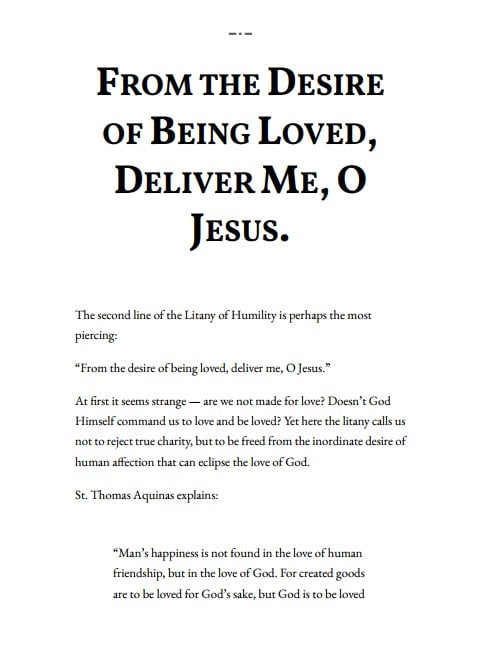
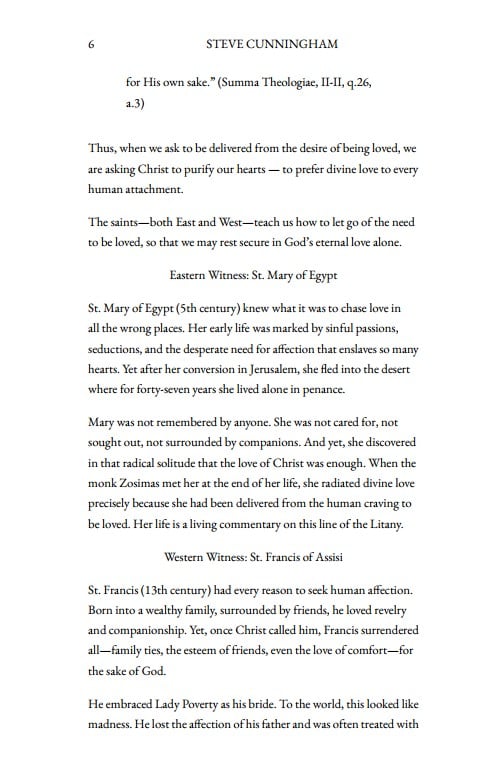
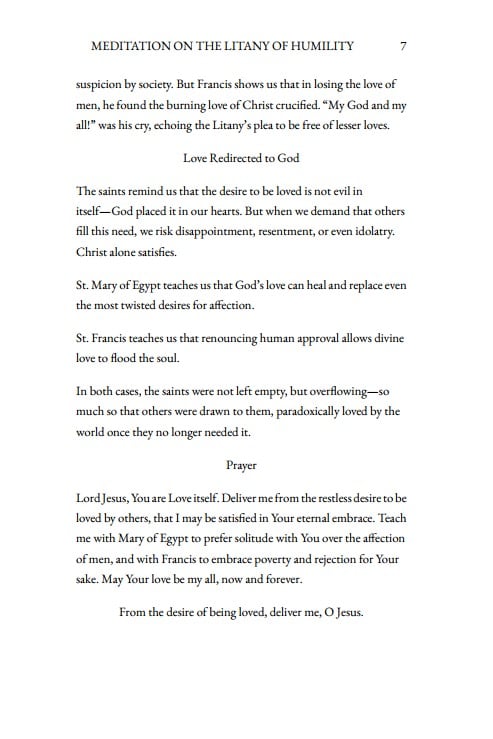
New Book Announcement: Meditations on the Litany of Humility
Local publisher Sensus Fidelium Press has released an enriching new book on the Litany of Humility according to the writings of the saints. Meditations on the Litany of Humility: From the Examples of the Saints unpacks this important litany through the examples and words of the saints themselves who practiced this foundational virtue. This book is a spiritual guide to understanding and embracing the powerful Litany of Humility and can help one grow in humility to bring one closer to Christ’s heart.
Sensus Fidelium Press and Sensus Fidelium, are run by local parishioner, Steve Cunningham.
To order your copy, click here.
Sample book images are provided at the conclusion of this update.
~
Traditional Calendar: For those seeking a 1962 Traditional Latin Mass wall calendar, Sensus Fidelium Press offers them at this link.
General Announcements
December 31 & January 1: Plenary Indulgences Available – For the last and first day of the calendar year there is a plenary indulgence granted (under usual conditions) for the faithful who pray the Te Deum hymn on December 31 and the Veni Creator on January 1, in a parish church or oratory. The Te Deum is offered in thanksgiving for the graces received over the past year, while the Veni Creator is prayed to ask for God’s assistance in the New Year.
- To pray the Te Deum prayer on December 31 click here.
- To pray the Veni Creator prayer on January 1 click here.
Help Thy Neighbor – For those looking to help those struggling financially this time of year, Fr. Reid announced a link to the parish’s Help Thy Neighbor program, which helps families in need. To give, one can either write a check to St. Ann with "Help Thy Neighbor" in the memo line, or donate at the parish’s online link.
Support Our Parishes – Father Reid noted that Saint Ann parish will bear much of the financial costs of keeping the Chapel of the Little Flower open and encourages our continued generosity (and our occasional visits!). Parishioners from other parishes should continue to support their own parish.
Prayer Request – In your charity, please continue to pray for the healing of Tony Reitz from a rapidly progressing Lymphoma. He is the brother-in-law of Amanda Banville who attends Our Lady of Grace parish. Pray also for Tony’s wife and young children.
Rosary for the Traditional Latin Mass – A Rosary is offered for the restoration of the Traditional Latin Mass in the church on Sundays after the 11:30 a.m. Novus Ordo Mass at Saint Thomas Aquinas Church.
Daily Holy Face Chaplet for Sacred Liturgy (perpetual novena) – For the preservation of the Traditional Latin Mass, it has been recommended to all friends of the sacred liturgy in the diocese to consider continually praying the powerful Holy Face chaplet, under the banner of Our Lady of the Holy Name. To pray the chaplet, please see this link.
Cardinal Burke’s Prayer for Pope Leo XIV – His Eminence Cardinal Raymond Burke has released a prayer for Pope Leo XIV. Please see the prayer at the links below and consider praying this daily for the Holy Father as he leads the Church. PDF copies can be accessed at these links: [English] [Español] [Latin]
Holy Face Devotions
Prayers of Reparation to the Holy Face of Jesus are offered each week at the following churches on the indicated days:
- St. James (Concord) – Monday, 10-10:30 a.m. (in the cry room)
- St. Mark – Tuesday, 5:30 p.m.
- St. Thomas Aquinas – Tuesday, 6:00 a.m.
- St. Ann – Tuesday, 7:30 a.m. (following 7:00 a.m. Mass)
- St. Michael the Archangel (Gastonia) – Tuesday, 8:30 a.m. (following 8:00 a.m. Mass)
- St. Vincent de Paul – Tuesday, 8:40 a.m.
- Holy Spirit (Denver) – Tuesday, 10-11:00 a.m. (following the 9:15 a.m. Mass)
- Saint Elizabeth of the Hill Country (Boone) – Third Tuesday, at 6:45 p.m. after Mass in the Youth Room
- St. John the Baptist (Tryon) - First Saturday, 9:30 a.m. (after 8:30 a.m Mass)
Note: Days and times may be subject to change due to holidays.
“Jesus, Your ineffable image is the star which guides my steps. Ah, You know, Your sweet Face is for me Heaven on earth” (from Canticle to the Holy Face by Saint Thérèse de Lisieux, the 19th century Discalced Carmelite nun who took the name in religion, Thérèse of the Child Jesus and the Holy Face).
Traditional Latin Mass and Liturgical News
- The 40 Days of Christmas by Dom Prosper Guéranger, The Liturgical Year. [A History of Christmas]
- Midnight Mass in Rome: Let us be unafraid of the night by Pope Leo XIV, Rorate Caeli (December 25, 2025). [Midnight Mass in Rome]
- Childermas Customs by Dr. Michael P. Foley, New Liturgical Movement (December 28, 2023). [Childermas Customs]
- Durandus on the Three Masses of Christmas by Greg DiPippo, New Liturgical Movement (December 25, 2025). [Three Masses of Christmas]
- Forgotten Customs of Christmastide by Matthew Plese, OnePeterFive (December 24, 2025). [Forgotten Customs of Christmastide]
- Carving Christmas: The Story Behind the South Carolina Life-Size Nativity by Gigi Duncan, National Catholic Register (December 24, 2025). [Carving Christmas]
- New York: Land of St. Nicholas by Charles Coulombe, OnePeterFive (December 24, 2025). [New York Land of St. Nicholas]
- The Apostle Saint Thomas on the American Continent by Fr. Peter De Roo, American Ecclesiastical Review (January 1899). [The Apostle Saint Thomas on the American Continent]
Saints and Special Observances
The Holy Innocents, Martyrs are celebrated two days after St. Stephen on December 28th (the feast day of St. John the Evangelist, a martyr of another sort, falling between the two on December 27th). The story of the Holy Innocents is told in the second chapter of the Gospel According to St. Matthew:
When Jesus therefore was born in Bethlehem of Juda, in the days of king Herod, behold, there came wise men from the east to Jerusalem. Saying, Where is he that is born king of the Jews? For we have seen his star in the east, and are come to adore him.
King Herod, hearing the report of wise men from the east seeking the newborn king of the Jews, felt threatened. Troubled, he summoned the chief priests and scribes to ask them where the prophet had said the Christ was to be born. “In Bethlehem of Juda,” they told him. Then Herod sent for the wise men to consult with him in private, determined to learn exactly when they had first seen the star they followed from the east all the way to Jerusalem.
And sending them into Bethlehem, said: Go and diligently inquire after the child, and when you have found him, bring me word again, that I also may come to adore him.
Resuming their journey, the wise men followed the star until it came to rest above the place where “they found the child with Mary his mother, and falling down they adored him; and opening their treasures, they offered him gifts; gold, frankincense, and myrrh.” Returning to their own country, they avoided Jerusalem and did not inform Herod that they had found the child.
Warned by an angel in a dream that Herod would seek the child to destroy him, Joseph arose and took the child and his mother and escaped into Egypt where they remained until the death of Herod. But Herod, perceiving that the wise men had slipped away without delivering the intelligence he sought, was exceedingly angry and sent soldiers to kill all the male children in and around Bethlehem who were two years of age or younger.
Then was fulfilled that which was spoken by Jeremias the prophet, saying: A voice in Rama was heard, lamentation and great mourning; Rachel bewailing her children, and would not be comforted, because they are not.
The Holy Innocents massacred by Herod’s henchmen did not willingly offer up their lives for a Church that did not yet exist, but their sacrifice served to preserve the life of the Holy Infant. In time they rightfully came to be acclaimed martyrs. Thus, Stephen, stoned more than 30 years after the Massacre of the Innocents, was not the first martyr per se but the first Christian martyr, although he lived and died long before the term Christian gained currency.
~
St. Sylvester, Pope and Confessor, was head of the Church for exactly 22 years in the first half of the fourth century, from January 31, 314 until December 31, 335. Born in Asculam in 285, he died in Rome 50 years later. While little is known about Sylvester himself, the period of his pontificate was a momentous time in the history of the Church.
Sylvester may have been brought up by a priest and trained for service in the Church. As a young man he was noted for his charitable works. When Timothy of Antioch, a famous exponent of the faith, came to Rome, Sylvester opened his home to him and provided him shelter for a year. Timothy was finally apprehended and executed during the Great Persecution of Diocletian. Sylvester managed to secure his remains in order to provide for the proper burial of the martyr, but he was accused by the governor of having exploited the opportunity to steal the treasure left behind by Timothy. Imprisoned for a time, he was released when the governor choked on a fishbone and died.
Impressed by the courage and resourcefulness of the young man, Pope Melchiades (311-314) made him a deacon. When Melchiades died, Sylvester succeeded him. During his tenure of more than two decades, there were several major events of lasting historical significance; but they are overshadowed by what happened in the year before Sylvester became Bishop of Rome. In February of 313, Constantine issued the Edict of Milan, bringing an end to the suppression of Christianity in the West. The emperor subsequently made public his own conversion to the faith. Some accounts credit Sylvester with having brought about the emperor’s conversion. If there is any truth to the legend that Sylvester cured Constantine of leprosy and then converted him to Christianity, it would certainly help to explain his meteoric rise from newly ordained deacon (fresh out of prison) to head of the newly liberated Church in just under three years.
The papacy of Sylvester coincided with the transformation of Rome into a Christian city, its place as the capital of Christianity made manifest by the construction of several major basilicas. Foremost among these was the Basilica of St. Peter built on Vatican Hill where the first Bishop of Rome had been interred following his martyrdom. Other impressive churches built during Sylvester’s reign included the Lateran Basilica and Baptistry and the Basilica of St. Paul Outside the Walls, as well as the Basilica of the Holy Cross in Jerusalem.
The Council of Nicaea (325) was convened in the middle of Sylvester’s papacy, but it is uncertain what part he played in bringing about the momentous decisions made by the council. It is known that he made a personal contribution to the liturgy by overseeing composition of the first Roman Martyrology. He has also been credited with the establishment of the Roman school of sacred song.
The traditional liturgical calendar established December 31st, the date on which he died, as the day on which the life of St. Sylvester is to be commemorated.
Liturgist Dom Prosper Guéranger also observed how fitting it is to place the Feast of the Pope of Peace (Saint Sylvester - who presided over the first peace for the Church) in the Octave of the Nativity of the Prince of Peace.
Closing Commentary
As we move into this joyous season of Christmas, we share two commentaries extracted from The Liturgical Year of Dom Prosper Guéranger for both “Sunday within the Octave of Christmas.” and the “History of Christmas”, the latter which explains why the Christmas season extends for 40 days. A link to the full texts of the great liturgist’s commentaries is included below.
Sunday within the Octave of Christmas
This is the only day within the Christmas Octave which is not a Saint’s Feast. During the Octaves of the Epiphany, Easter, and Pentecost, the Church is so absorbed in the respective mysteries that she puts off everything that could share her attention; whereas during this of Christmas, there is only one day which does not celebrate the memory of some glorious Saint, and our Infant Jesus is surrounded by a choir of heroes who loved and served him. Thus, the Church—or, more correctly, God, for God is the first author of the Cycle of the Year—shows us how the Incarnate Word, who came to save mankind, desires to give mankind confidence by this his adorable familiarity.
We have already shown that the Birth of our Lord took place on a Sunday, the Day on which, in the beginning of the world, God created Light. We shall find, later on, that his Resurrection also was on a Sunday. This the first day of creation and the first day of the week was consecrated, by the old Pagans, to the Sun: with us Christians, it is most sacred and holy, on account of the two risings of our divine Sun of Justice—his Birth and his Resurrection. While the solemnity of Easter is always kept on a Sunday, that of Christmas falls, by turns, on each of the days of the week—we have already had this difference explained to us by the Holy Fathers: but the mystery of Jesus’ Birth is more aptly and strongly expressed when its anniversary falls on a Sunday. Other years, when the coincidence does not happen, the Faithful will at least be led by their Christian instincts to give especial honor to the Day within the Octave, which falls on the Sunday. The Church has honored it with a proper Mass and Office, and we of course insert them. [Sunday within the Octave of Christmas]
~
The 40 Days of Christmas: A History of Christmas
We apply the name of Christmas to the forty days which begin with the Nativity of our Lord, December 25, and end with the Purification of the Blessed Virgin, February 2. It is a period which forms a distinct portion of the Liturgical Year, as distinct, by its own special spirit, from every other, as are Advent, Lent, Easter, or Pentecost. One same Mystery is celebrated and kept in view during the whole forty days Neither the Feasts of the Saints, which so abound during this Season; nor the time of Septuagesima, with its mournful Purple, which often begins before Christmastide is over, seem able to distract our Holy Mother the Church from the immense joy of which she received the good tidings from the Angels [St Luke ii 10] on that glorious Night for which the world had been longing four thousand years. The Faithful will remember that the Liturgy commemorates this long expectation by the four penitential weeks of Advent.
The custom of celebrating the Solemnity of our Saviour’s Nativity by a feast or commemoration of forty days’ duration is founded on the holy Gospel itself; for it tells us that the Blessed Virgin Mary, after spending forty days in the contemplation of the Divine Fruit of her glorious Maternity, went to the Temple, there to fulfil, in most perfect humility, the ceremonies which the Law demanded of the daughters of Israel, when they became mothers.
The Feast of Mary’s Purification is, therefore, part of that of Jesus’ Birth; and the custom of keeping this holy and glorious period of forty days as one continued Festival has every appearance of being a very ancient one, at least in the Roman Church. And firstly, with regard to our Saviour’s Birth on December 25, we have St John Chrysostom telling us, in his Homily for this Feast, that the Western Churches had, from the very commencement of Christianity, kept it on this day. He is not satisfied with merely mentioning the tradition; he undertakes to show that it is well founded, inasmuch as the Church of Rome had every means of knowing the true day of our Saviour’s Birth, since the acts of the Enrolment, taken in Judea by command of Augustus, were kept in the public archives of Rome.
The holy Doctor adduces a second argument, which he founds upon the Gospel of St Luke, and he reasons thus: we know from the sacred Scriptures that it must have been in the fast of the seventh month [Lev. xxiii 24 and following verses. The seventh month (or Tisri) corresponded to the end of our September and beginning of our October. -Tr] that the Priest Zachary had the vision in the Temple; after which Elizabeth, his wife, conceived St John the Baptist: hence it follows that the Blessed Virgin Mary having, as the Evangelist St Luke relates, received the Angel Gabriel’s visit, and conceived the Saviour of the world in the sixth month of Elizabeth’s pregnancy, that is to say, in March, the Birth of Jesus must have taken place in the month of December. [The History of Christmas]
~
To Our Readers and All Friends of the Latin Mass: May you be abundantly blessed by God in this upcoming joyous season of Christmas.