Twenty-first Sunday after Pentecost
Friends in Christ,
Welcome to our weekly Sunday update. This Sunday is the Twenty-first Sunday after Pentecost. In the Gospel reading for Sunday, Jesus offers a parable illustrating the importance of a key passage in the prayer He taught his disciples: Et dimitte nobis debita nostra sicut et nos dimittimus debitoribus nostris. A literal translation of this passage into contemporary English might read, “And dismiss our debt as we dismiss those of our debtors.” This is not what happens in the parable: Having had his own large debt dismissed, the wicked servant proceeds to throttle a fellow servant in an attempt to extract from the man the rather insignificant amount owed by him. In the end the wicked servant gets his comeuppance because the king in the parable, like the King of Heaven, rules with justice for all.
Calendar of Special Observances
Celebrations are those listed in the Roman Missal of 1962.
DAY, DATE – FEAST (CLASS)
Sunday, October 18 – Twenty-first Sunday after Pentecost (II) – Commemoration of St. Luke the Evangelist
Monday, October 19 – St. Peter of Alcantara, Confessor (III)
Tuesday, October 20 – St. John Cantius, Confessor (III)
Wednesday, October 21 – Feria (IV) – Commemoration of St. Ursula and Companions, Virgins and Martyrs – Commemoration of St. Hilarion, Abbot
Thursday, October 22 – Feria (IV)
Friday, October 23 – St. Anthony Mary Claret, Bishop and Confessor (III)
Saturday, October 24 – St. Raphael the Archangel (III)
Twenty-First Sunday after Pentecost
The links provided below can be used to download printable copies of the Proper Prayers for the Twenty-First Sunday after Pentecost with English or Spanish translations, followed by commentary by Dr. Michael P. Foley.
Traditional Latin Mass Schedule
Diocese of Charlotte Sunday Masses
Chapel of the Little Flower (757 Oakridge Farm Road, Mooresville, NC)
- 10:00 a.m. (Low)
- 12:00 p.m. (Sung)
- Chaplain: Fr. Brandon Jones
- Chapel related questions? Email Father at: tlmchapel(at)rcdoc.org
- DONATE: To donate to the Chapel of the Little Flower click here (via Saint Ann Parish, Charlotte)
- More details: https://carolinaliturgy.org/chapel
Note: Only Sunday Latin Masses and Holy Days are offered at the Chapel. This is the only Diocese of Charlotte location which offers the Traditional Latin Mass.
Saint Thérèse of the Child Jesus and the Holy Face, the Little Flower, pray for us!
Diocese of Raleigh Sunday Masses
- 1:00 p.m., Sacred Heart (Dunn, NC)
- 4:30 p.m., - First Sunday, Holy Name Cathedral (Raleigh, NC)
- 5:00 p.m., - Fourth Sunday, Basilica of Saint Mary (Wilmington, NC)
- For additional locations and Masses please see our Mass Times webpage
Diocese of Charleston Sunday Masses
- 12:00 p.m., Prince of Peace (Taylors SC)
- 1:00 p.m., Our Lady of the Lake (Chapin SC)
- 12:00 p.m., Sacred Heart (Charleston SC)
- 5:30 p.m., Stella Maris (Sullivans Island, SC)
Diocese of Charleston Daily Traditional Latin Masses
- Prince of Peace (Taylors SC) – Monday - Friday, 12 noon
- Prince of Peace (Taylors SC) – Saturday, 8:00 a.m.
- For additional locations and Masses please see our Mass Times webpage
As a reminder, travelers are urged to consult parish websites or offices for up-to-date information regarding possible changes in the schedule of Mass times.
Chapel of the Little Flower Announcements
Mass Intentions for Sunday
Sunday October 18, 10:00 a.m. – Margaret F. and Collin Whetstone by Holt and Deborah Foushee
Eucharistic Procession for the Feast of Christ the King
On Sunday October 25, the Feast of Christ the King, a Eucharistic Procession will occur after the 12 noon Mass at the Chapel of the Little Flower.
Support Sacred Music at the Chapel by Joining the Schola and Choir
The Church teaches us that singing is praying twice. Please consider lending your musical talents to the beautifying of the sacred liturgy here at the Chapel of the Little Flower. If one would like more information about joining the schola and choir, please contact the Chapel music director whose contact information is at the bottom of the hymn sheets found on the table in the narthex. Thank you for your generosity.
Music Sheets Available in the Narthex
A reminder that music sheets are available in the narthex so that one may join in or follow along with the singing at the sung Mass.
Saint Ann Parishioner Catholic School Check In
If one is a parishioner at St. Ann parish and has children enrolled in the Catholic schools, please scan the QR code found on the table/wall in the narthex of the Chapel. This is the new attendance check in system.
Donations for the Chapel of the Little Flower
To donate to the Chapel of the Little Flower, please make out a check to “St. Ann Catholic Church” and carefully earmark it for “Latin Mass” or “Chapel of the Little Flower”. It can be mailed to the parish (3635 Park Road, Charlotte, NC 28209). To donate online, please visit the parish’s “Chapel of the Little Flower” online donation portal at this link.
Lost and Found
If one is missing a missal, book, or other item, please see the Lost and Found table in the cry room.
Father Jones’ Contact Info
If one has questions about the Chapel of the Little Flower, that are not related to one’s parish, please email Father Jones directly at: tlmchapel(at)rcdoc.org
Join Us at the Chapel of the Little Flower
If you haven’t attended Mass at the Chapel of the Little Flower yet, you are welcome to join us. Seating is adequate at both Masses, and there is plenty of parking; a cry room; open space outside for the kids after Mass. Bulletins from Saint Ann and Saint Thomas Aquinas parishes are usually available.
General Announcements
Annual Priests' Retreat This Week – This coming week (19-23) is the annual priests’ retreat for the Diocese of Charlotte. Please keep Bishop Martin and the priests in prayer this week as they spend time in prayer, recollection, and rest.
Plenary Indulgence for the Feast of Christ the King (Sunday October 25) – A plenary indulgence may be obtained on the Feast of Christ the King under the usual conditions (Mass attendance, confession, the avoidance of serious sin, and recitation of prayers for the intentions of the Pope) when praying An Act of Consecration of the Human Race to the Sacred Heart of Jesus in a church. The Act of Consecration may be found in this article from The Missive.
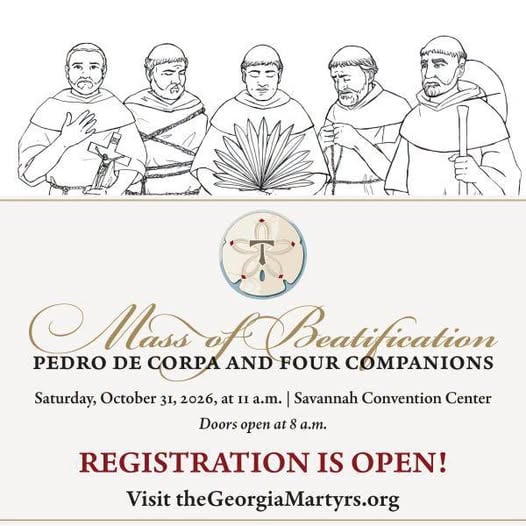
The Georgia Martyrs: The First Beatification in the American South - Saturday October 31 – A historic event is occurring just a few hours from Charlotte on Saturday October 31 in Savannah Georgia. The Church is beatifying Friar Pedro de Corpa and his four companions, who were martyred at their Spanish missions along the Georgia coast in September 1597. If you've never been to a beatification before (and missed Bl. Fulton Sheen's event last month), why not drive down to Savannah to witness this historic Catholic event? To register (free) for the event and learn more, click here.
Prayers at the Cemetery for the Souls of the Faithful Departed – Saint Ann Homeschool Ministry is organizing their annual prayers at the cemetery for the faithful departed on Sunday November 1st, 3:00 p.m. (All Saints Day) at Belmont Abbey Cemetery. Prayers will be led by Fr. Reid.
Enroll the Souls of the Faithful Departed – The Traditional Carmelite Hermits of Our Lady of Mt. Carmel (Colorado and Pennsylvania) are offering an All Souls Enrollment during the month of November. Throughout November, the community will dedicate 30 Holy Masses (Traditional Carmelite Rite), along with the daily prayers and sacrifices of the Hermits, for the souls of the faithful departed who are enrolled. To learn more or enroll, click here.
Support Saint Ann and Saint Thomas Parishes – Our parishes remain the anchor of our spiritual and community lives and continue to promote the sacred traditions, devotions, speakers and catechesis important for the spiritual growth of ourselves and our families. They also need our continued financial support (and occasional visits!). Both parishes would appreciate our continued generosity.
Bishop Martin issues Pastoral Letter to the Faithful Associated with the Society of Saint Pius X
LiveMass.net – Want to watch a Latin Mass online? The Priestly Fraternity of Saint Peter (FSSP) has a broadcast apostolate which streams its Latin Masses across the world at various times of the day. To view visit: https://www.livemass.net/
Rosary for the Traditional Latin Mass – A Rosary is offered for the restoration of the Traditional Latin Mass in the church on Sundays after the 11:30 a.m. Novus Ordo Mass at Saint Thomas Aquinas Church.
Daily Holy Face Chaplet for Sacred Liturgy (perpetual novena) – For the preservation of the Traditional Latin Mass, it has been recommended to all friends of the sacred liturgy in the diocese to consider continually praying the powerful Holy Face chaplet, under the banner of Our Lady of the Holy Name. To pray the chaplet, please see this link.
Cardinal Burke’s Prayer for Pope Leo XIV – His Eminence Cardinal Raymond Burke has released a prayer for Pope Leo XIV. Please see the prayer at the links below and consider praying this daily for the Holy Father as he leads the Church. PDF copies can be accessed at these links: [English] [Español] [Latin]
Holy Face Devotions
Prayers of Reparation to the Holy Face of Jesus are offered each week at the following churches on the indicated days:
- St. James (Concord) – Monday, 10-10:30 a.m. (in the cry room)
- St. Mark – Tuesday, 5:30 p.m.
- St. Thomas Aquinas – Tuesday, 6:00 a.m.
- St. Ann – Tuesday, 7:30 a.m. (following 7:00 a.m. Mass)
- St. Michael the Archangel (Gastonia) – Tuesday, 8:30 a.m. (following 8:00 a.m. Mass)
- St. Vincent de Paul – Tuesday, 8:40 a.m.
- Holy Spirit (Denver) – Tuesday, 10-11:00 a.m. (following the 9:15 a.m. Mass)
- Saint Elizabeth of the Hill Country (Boone) – Third Tuesday, at 6:45 p.m. after Mass in the Youth Room (League of St. Martin chapter)
- St. John the Baptist (Tryon) - First Saturday, 9:30 a.m. (after 8:30 a.m Mass)
Note: Days and times may be subject to change due to holidays.
“Jesus, Your ineffable image is the star which guides my steps. Ah, You know, Your sweet Face is for me Heaven on earth” (from Canticle to the Holy Face by Saint Thérèse de Lisieux, the 19th century Discalced Carmelite nun who took the name in religion, Thérèse of the Child Jesus and the Holy Face).
Traditional Latin Mass and Liturgical News
- US bishops, lawmakers offer prayers for Pope Leo after cancer diagnosis, Catholic News Herald/OSV News (October 13, 2026). [Prayers for Pope Leo]
- Prayers for Pope Leo by Greg DiPippo, New Liturgical Movement (October 12, 2026). [Prayers for Pope Leo]
- The Feast of St Luke the Evangelist by Gregory DiPippo, New Liturgical Movement (October 18, 2025). [Feast of St. Luke]
- The Priest’s Final Prayers before Holy Communion, Part 3 by Dr. Michael P. Foley, New Liturgical Movement (October 9, 2026). [Priest’s Final Prayers Part 3]
- The Marriage of Blessed Karl and Princess Zita by Charles Coulombe, OnePeterFive (October 21, 2024). [Marriage of Blessed Karl]
- The Maternity of the Virgin Mary by Greg DiPippo, New Liturgical Movement (October 11, 2025). [Maternity of the Virgin Mary]
- Why Columbus Day Matters to the Blessed Virgin Mary by Mary Hansen, OnePeterFive (October 12, 2026). [Why Columbus Day Matters to the Blessed Virgin Mary]
- Who Is St. Peregrine, the ‘Cancer Saint’ Catholics Are Invoking for Pope Leo XIV? by EWTN News Staff, EWTN News (October 13, 2026). [Who Is St. Peregrine]
- Venue Selected for Beatification of Georgia Martyrs by Kathleen Murphy, National Catholic Register (September 28, 2026). [Venue Selected for Beatification of Georgia Martyrs]
Saints and Special Observances
Blessed Emperor Charles (Karl) of Austria – This Wednesday October 21 is the 115th anniversary of the marriage between Blessed Emperor Charles von Habsburg of Austria and Servant of God Empress Zita de Bourbon Parma. It is also the feast day (locally, new calendar) for Blessed Karl. As such, we reshare our post from last April (anniversary of his death) that includes excerpts (with some minor adaptations) of his life from the Emperor Karl League of Prayer website which promotes the cause of his canonization here in the United States.
Karl of the House of Austria was born on August 17, 1887, at Schloss Persenbeug in Lower Austria. His parents were Archduke Otto and Princess Maria Josepha of Saxony, daughter of the last king of Saxony. Emperor Franz Joseph I was Karl's great uncle. From an early age, Karl fostered a great devotion to the Blessed Sacrament and the Sacred Heart of Jesus. He used prayer to guide him in making all important decisions.
On October 21, 1911, he married Princess Zita of Bourbon-Parma. During the ten good years of their happy and exemplary marriage, the pair were given eight children.
On June 28, 1914, because of the assassination of Archduke Franz Ferdinand, Karl became the heir apparent of the throne of Austria-Hungary. In the middle of the First World War, the death of Emperor Franz Joseph on November 21, 1916, made Karl the Emperor of Austria. On December 20, 1916, he was crowned Apostolic King of Hungary. Karl became the last Emperor of the Austro-Hungarian Empire in 1916, during the First World War.
His Faith
Blessed Karl loved to pray throughout his life. He received Holy Communion daily, and at the end of mass prayed "Veni Creator." He prayed Morning Prayer, Evening Prayer, and the rosary daily. He frequently prayed the Litanies of the Sacred Heart, the Blessed Virgin Mary, and Saint Joseph; he was a member of Our Lady's Confraternity and wore the scapular. Karl was devoted to adoring the Blessed Sacrament, and could happily spend hours in adoration.
Karl of Austria was obedient to the Holy Father, acknowledging him to be the Vicar of Christ; and he treated bishops and priests with respect. From the testimony of those who knew him well, it is clear that Blessed Karl took his faith seriously and fostered his relationship with God, devoutly following the teachings of the Roman Catholic Church.
The Peacemaker
The most sacred obligation of a king—to provide peace—became the primary focus of Karl's efforts during this horrific war. The only world leader to do so, he supported the peace proposals of Pope Benedict XV.
From the very beginning of his reign, Karl worked to create peace for his empire. He had been against the declaration of war, and now he was in a position to put an end to the needless killing and fighting. In his accession speech he proclaimed: "I will do all within my power to banish the horrors and sacrifices of war at the earliest possible date and to win back for my peoples the sorely missed blessings of peace . . ."
During a most difficult time domestically, he offered extensive assistance to his people and gave example to them by passing social legislation in conformity with Catholic social teachings. His stance prevented civil war from occurring during the post-war transition of government. Yet still he was banished from his homeland.
His Death
At the request of the pope, who feared that communism would overtake Central Europe, Karl attempted to restore his government and return to the throne of Hungary. Two attempts failed because he wanted to avoid civil war at all costs. Karl was then sent into exile on Madeira. He saw his abandonment there as a commission from God, a duty he could not put aside.
In exile on the island of Madeira, he lived with his family in poverty, in a damp house. There, Karl contracted a fatal illness, which he accepted as a sacrifice to make for the peace and unity of his people.
His wife stayed with him throughout most of his final ordeal. He forgave those who betrayed him, and prayed for his subjects. On the evening before he died, he uttered: "I must suffer like this so that my peoples can come together again." But his most frequent pray was: "Thy Will be done!"
He later requested Holy Communion, which a priest, Father Zsambóki, administered to him, and anointed him a final time. The Eucharist was exposed in his room, and he prayed in the Lord's presence. About ten minutes before he died, he prayed: "Thy Holy Will be done. Jesus, Jesus, come! Yes-yes. My Jesus, as You will it-Jesus."
Then he whispered "Jesus" softly, and died. It was shortly after noon on Saturday, April 1, 1922. He was only 34 years old.
Canonization Process
In 1949, Karl was given the title, Servant of God. In 1972, on the fiftieth anniversary of his death, the tomb of Karl was opened and his remains were found remarkably well preserved. In April 2003 he was declared Venerable and in December the first miracle necessary for beatification was approved: a nun in Brazil with a debilitating illness was miraculously cured after praying for Karl’s intercession.
On October 3, 2004, Pope Saint John Paul II beatified Emperor and King Karl (whom the late pontiff, Karol Wojtiya, was named after as his father fondly served in Blessed Karl’s army). Blessed Karl's feast day is October 21, the date of his marriage to Empress Zita. In 2023, a miracle for his canonization began to be investigated.
The cause for Empress Zita’s canonization is also open and Clear Creek Abbey in Oklahoma is promoting her cause in the United States.
Source: Emperor Charles League of Prayer
Closing Commentary
We offer, in closing, that portion of Dom Prosper Guéranger’s commentary on the “Twenty-First Sunday after Pentecost” having to do with the Gospel reading for the day. A link to the full text from The Liturgical Year follows.
Twenty-First Sunday after Pentecost
“O thou just Judge of vengeance (on man), grant us the gift of forgiveness, before the Day of reckoning cometh!” Such is the petition that comes from the heart of holy Mother Church as she thinks on what may have befallen those countless children of hers, who have been victims of death during this as every other year; it is, moreover, the supplication that should be made by every living soul, after hearing the Gospel just read to us. The Sequence, Dies iræ, from which these words are taken, is not only a sublime prayer for the Dead; it is, likewise, and especially at this close of the Ecclesiastical Year, an appropriate expression for all of us who are still living. Our thoughts and our expectations are naturally turned towards our own deaths. We almost seem forgotten and overlooked in this evening of the world’s existence, but it not so, for we know from sacred Scripture that we shall join those who have already slept the last sleep, and shall be taken, together with them, to meet our divine Judge.
Let us hearken to some more of our Mother’s words, in that same magnificent Sequence; this is their meaning: “How great will be our fear when the Judge is about to come and rigorously examine all our works!—The trumpet’s wondrous sound will pierce the graves of every land and summon us all before the throne!”—Death will stand amazed, and nature too, when the “creature shall rise again, to go and answer Him that is to judge!—The written Book shall be brought forth, wherein all is contained for which the world is to be tried. —So when the Judge shall sit on his throne, every hidden secret shall be revealed, nothing shall remain unpunished!—What shall I, poor wretch, then say? Who ask to be my patron, when the just man himself shall scarce be safe?—O King of dreaded majesty! who savest gratuitously them that are, save me, O fount of love!—Do thou remember, loving Jesu! that I was cause of thy life on earth! Lose me not, on that Day!”
Undoubtedly, such a prayer as this has every best chance of being graciously heard, addressed as it is to Him, who has nothing so much at heart as our salvation, and who, for procuring it, gave himself up to fatigue and suffering and death on the Cross: but we should be inexcusable, and deserve condemnation twice over, were we to neglect to profit of the advice he himself gives us, whereby to avert from us the perils of “that day of tears, when guilty man shall rise from the dust and go to be judged!” Let us, then, meditate on the parable of our Gospel, whose sole object is to teach us a sure way of settling, at once, our accounts with the divine King.
We are all of us, in fact, that negligent servant, that insolvent debtor, whose master might, in all justice, sell him, with all he has, and hand him over to the torturers. The debt contracted with God, by the sins we have committed, is of that nature as to deserve endless tortures; it supposes an eternal hell, in which the guilty one will ever be paying, without ever cancelling his debt. Infinite praise, then, and thanks to the divine Creditor who, being moved to pity by the entreaties of the unhappy man, who asks for time and he will pay all—yes, this good God grants him far beyond what he prays for—he, there and then, forgives him the debt. He puts but this condition on the pardon, as is evident from the sequel—he insists, and most justly, that he should go and do, in like manner, towards his fellow-servans, who may perhaps owe something to him. After being so generously forgiven by his Lord and King, after having his infinite debt so gratuitously cancelled, how can he possibly turn a deaf ear to the very same prayer which won pardon for himself, now that a fellow-servant makes it to him? is it to be believed that he will refuse all pity towards one whose only offense is that he asks him for time, and he will pay all?
“It is quite true,” says St. Augustine, “that every man has his fellow-man a debtor—for who is the man, that he has had no one to offend him? but at the same time, who is the man that is not debtor to God, for all of us have sinned? Man, therefore, is both debtor to God, and creditor to his fellow-man. It is for this reason that God has laid down this rule for thy conduct—that thou must treat thy debtor as He treats his … We pray every day; every day, we send up the same petition to the divine throne; every day, we prostrate ourseles before God and say to him: Forgive us our debts, as we forgive them that are debtors to us. Of what debts speakest thou? Is it, of all thy debts? or of one or two only? Thou wilt say: Of all. Do thou, therefore, forgive thy debtor, for it is the rule laid upon thee, it is the condition accepted by thee.” [Twenty-First Sunday after Pentecost]