Twentieth Sunday after Pentecost
Friends in Christ,
Welcome to our weekly Sunday update. This Sunday is the Twentieth Sunday after Pentecost. In the Gospel reading for the day (John 4:46-53), we encounter a certain ruler traveling to see Jesus and beseeching Him to heal his son who was “at the point of death.” Jesus, hearing his prayer, then replied to him “Go thy way, thy son liveth.” The father believed what he was told by Jesus, and as he returned home his servants informed the ruler that his son was healed – at the very hour that Jesus said “thy son liveth.” At that moment “the father, therefore, knew that it was at the same hour that Jesus said to him: Thy son liveth: and himself believed, and his whole house.” (John 4:53) The Saint Andrew Daily Missal (1945) commentary for this Sunday draws a connection between this Gospel passage and the traditional breviary (Divine Office) lessons for the month of October, which are taken from the Book of Maccabees. In these lessons, “the Maccabees, who were soldiers, approached almighty God successfully to make sure that their race should not perish, but that it should keep its religion and faith in the Messias unimpaired, so in the Gospel, an officer of the imperial army comes to Christ to save his son’s life, and when the miracle for which he asked takes place, he believes in our Lord with his whole house.” Therefore, as the commentary concludes, let us “in the name of our Lord Jesus Christ, let us sing psalms in our churches to the glory of God who has freed us from the bondage of death and who, in the evil days at the end of the world, will deliver all those who have faith in him.” A fitting reflection as we approach the end of the liturgical year - which focuses on the end times.
Calendar of Special Observances
Celebrations are those listed in the Roman Missal of 1962.
DAY, DATE – FEAST (CLASS)
Sunday, October 11 – Twentieth Sunday after Pentecost (II) – Commemoration of the Motherhood of the Blessed Virgin Mary
Monday, October 12 – Feria (IV)
Tuesday, October 13 – St. Edward the Confessor, King (III)
Wednesday, October 14 – St. Callistus I, Pope and Martyr (III)
Thursday, October 15 – St. Teresa of Avila, Virgin (III)
Friday, October 16 – St. Hedwig, Widow (III)
Saturday, October 17 – St. Margaret Mary Alocoque, Virgin (III)
Twentieth Sunday after Pentecost
The links provided below can be used to download printable copies of the Proper Prayers for the Twentieth Sunday after Pentecost with English or Spanish translations, followed by commentary by Dr. Michael P. Foley.
Traditional Latin Mass Schedule
Diocese of Charlotte Sunday Masses
Chapel of the Little Flower (757 Oakridge Farm Road, Mooresville, NC)
- 10:00 a.m. (Low)
- 12:00 p.m. (Sung)
- Chaplain: Fr. Brandon Jones
- Chapel related questions? Email Father at: tlmchapel(at)rcdoc.org
- DONATE: To donate to the Chapel of the Little Flower click here (via Saint Ann Parish, Charlotte)
- More details: https://carolinaliturgy.org/chapel
Note: Only Sunday Latin Masses and Holy Days are offered at the Chapel. This is the only Diocese of Charlotte location which offers the Traditional Latin Mass.
Saint Thérèse of the Child Jesus and the Holy Face, the Little Flower, pray for us!
Diocese of Raleigh Sunday Masses
- 1:00 p.m., Sacred Heart (Dunn, NC)
- 4:30 p.m., - First Sunday, Holy Name Cathedral (Raleigh, NC)
- 5:00 p.m., - Fourth Sunday, Basilica of Saint Mary (Wilmington, NC)
- For additional locations and Masses please see our Mass Times webpage
Diocese of Charleston Sunday Masses
- 12:00 p.m., Prince of Peace (Taylors SC)
- 1:00 p.m., Our Lady of the Lake (Chapin SC)
- 12:00 p.m., Sacred Heart (Charleston SC)
- 5:30 p.m., Stella Maris (Sullivans Island, SC)
Diocese of Charleston Daily Traditional Latin Masses
- Prince of Peace (Taylors SC) – Monday - Friday, 12 noon
- Prince of Peace (Taylors SC) – Saturday, 8:00 a.m.
- For additional locations and Masses please see our Mass Times webpage
As a reminder, travelers are urged to consult parish websites or offices for up-to-date information regarding possible changes in the schedule of Mass times.
Chapel of the Little Flower Announcements
Mass Intentions for Sunday
Sunday October 11, 10:00 a.m. – The Schaper Family by Agnes Schaper
Support Sacred Music at the Chapel by Joining the Schola and Choir
The Church teaches us that singing is praying twice. Please consider lending your musical talents to the beautifying of the sacred liturgy here at the Chapel of the Little Flower. If one would like more information about joining the schola and choir, please contact the Chapel music director whose contact information is at the bottom of the hymn sheets found on the table in the narthex. Thank you for your generosity.
Music Sheets Available in the Narthex
A reminder that music sheets are available in the narthex so that one may join in or follow along with the singing at the sung Mass.
Saint Ann Parishioner Catholic School Check In
If one is a parishioner at St. Ann parish and has children enrolled in the Catholic schools, please scan the QR code found on the table/wall in the narthex of the Chapel. This is the new attendance check in system.
Donations for the Chapel of the Little Flower
To donate to the Chapel of the Little Flower, please make out a check to “St. Ann Catholic Church” and carefully earmark it for “Latin Mass” or “Chapel of the Little Flower”. It can be mailed to the parish (3635 Park Road, Charlotte, NC 28209). To donate online, please visit the parish’s “Chapel of the Little Flower” online donation portal at this link.
Lost and Found
If one is missing a missal, book, or other item, please see the Lost and Found table in the cry room.
Father Jones’ Contact Info
If one has questions about the Chapel of the Little Flower, that are not related to one’s parish, please email Father Jones directly at: tlmchapel(at)rcdoc.org
Join Us at the Chapel of the Little Flower
If you haven’t attended Mass at the Chapel of the Little Flower yet, you are welcome to join us. Seating is adequate at both Masses, and there is plenty of parking; a cry room; open space outside for the kids after Mass. Bulletins from Saint Ann and Saint Thomas Aquinas parishes are usually available.
General Announcements
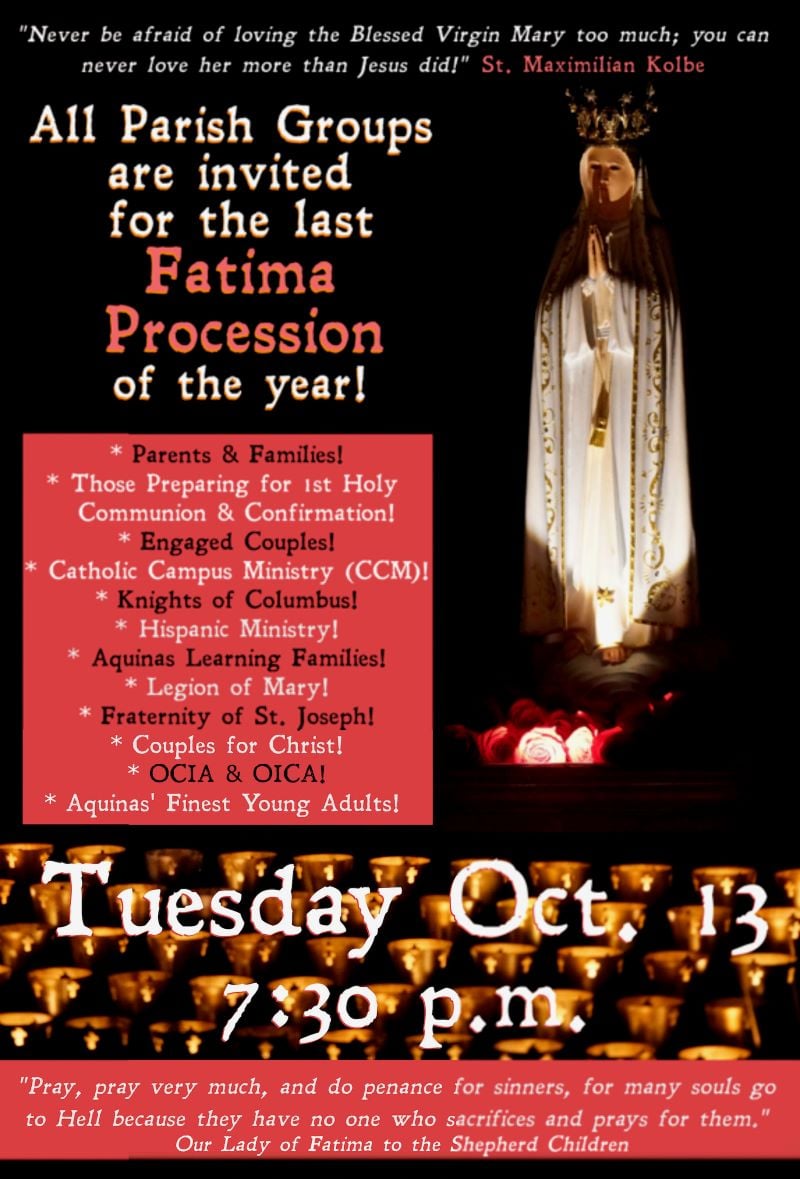
Fatima Procession at Saint Thomas Aquinas Parish – The final Fatima Procession of 2026 will be held this Tuesday October 13 at 7:30 p.m. All the faithful are invited to commemorate the 109th anniversary of the Miracle of the Sun. Please see the flyer at the end of this newsletter.
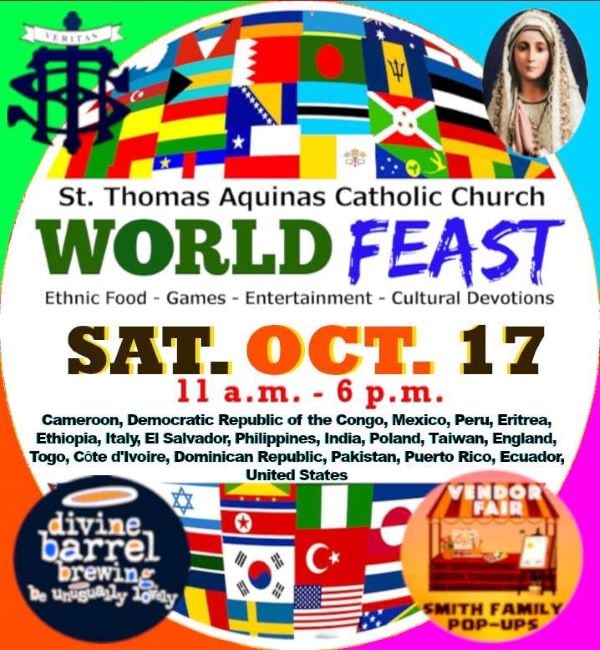
Saint Thomas Aquinas World Feast Day - Saturday October 17 – World Feast Day, Saint Thomas Aquinas’ annual carnival will be held on Saturday October 17 from 11 a.m. - 6:00 p.m. The event features ethnic dishes from over 15 countries, along with games, entertainment and cultural devotions. Please see the flyer at the end of this newsletter.
534th Anniversary of Columbus’ Discovery of the New World – Monday October 12 is the 534th anniversary of Christopher Columbus’ discovery of the New World and the bringing of the Gospel to the Western Hemisphere. To celebrate, we share an excerpt of Pope Leo XIII’s 1892 encyclical, Quarto Abeunte Saeculo, commemorating the 400th anniversary of the discovery:
For Columbus is ours; since if a little consideration be given to the particular reason of his design in exploring the mare tenebrosum*, and also the manner in which he endeavoured to execute the design, it is indubitable that the Catholic faith was the strongest motive for the inception and prosecution of the design; so that for this reason also the whole human race owes not a little to the Church.
To read the entire encyclical click here. (* Mare tenebrosum is Latin for the Sea of Darkness, e.g. Atlantic Ocean)
Support Saint Ann and Saint Thomas Parishes – Our parishes remain the anchor of our spiritual and community lives and continue to promote the sacred traditions, devotions, speakers and catechesis important for the spiritual growth of ourselves and our families. They also need our continued financial support (and occasional visits!). Both parishes would appreciate our continued generosity.
Bishop Martin issues Pastoral Letter to the Faithful Associated with the Society of Saint Pius X
LiveMass.net – Want to watch a Latin Mass online? The Priestly Fraternity of Saint Peter (FSSP) has a broadcast apostolate which streams its Latin Masses across the world at various times of the day. To view visit: https://www.livemass.net/
Rosary for the Traditional Latin Mass – A Rosary is offered for the restoration of the Traditional Latin Mass in the church on Sundays after the 11:30 a.m. Novus Ordo Mass at Saint Thomas Aquinas Church.
Daily Holy Face Chaplet for Sacred Liturgy (perpetual novena) – For the preservation of the Traditional Latin Mass, it has been recommended to all friends of the sacred liturgy in the diocese to consider continually praying the powerful Holy Face chaplet, under the banner of Our Lady of the Holy Name. To pray the chaplet, please see this link.
Cardinal Burke’s Prayer for Pope Leo XIV – His Eminence Cardinal Raymond Burke has released a prayer for Pope Leo XIV. Please see the prayer at the links below and consider praying this daily for the Holy Father as he leads the Church. PDF copies can be accessed at these links: [English] [Español] [Latin]
Holy Face Devotions
Prayers of Reparation to the Holy Face of Jesus are offered each week at the following churches on the indicated days:
- St. James (Concord) – Monday, 10-10:30 a.m. (in the cry room)
- St. Mark – Tuesday, 5:30 p.m.
- St. Thomas Aquinas – Tuesday, 6:00 a.m.
- St. Ann – Tuesday, 7:30 a.m. (following 7:00 a.m. Mass)
- St. Michael the Archangel (Gastonia) – Tuesday, 8:30 a.m. (following 8:00 a.m. Mass)
- St. Vincent de Paul – Tuesday, 8:40 a.m.
- Holy Spirit (Denver) – Tuesday, 10-11:00 a.m. (following the 9:15 a.m. Mass)
- Saint Elizabeth of the Hill Country (Boone) – Third Tuesday, at 6:45 p.m. after Mass in the Youth Room (League of St. Martin chapter)
- St. John the Baptist (Tryon) - First Saturday, 9:30 a.m. (after 8:30 a.m Mass)
Note: Days and times may be subject to change due to holidays.
“Jesus, Your ineffable image is the star which guides my steps. Ah, You know, Your sweet Face is for me Heaven on earth” (from Canticle to the Holy Face by Saint Thérèse de Lisieux, the 19th century Discalced Carmelite nun who took the name in religion, Thérèse of the Child Jesus and the Holy Face).
Traditional Latin Mass and Liturgical News
- Pope Pius XI on the Holy Rosary by Greg DiPippo, New Liturgical Movement (October 7, 2026). [Pope Pius XI on the Holy Rosary]
- The Priest’s Second Prayer for Holy Communion by Dr. Michael P. Foley, New Liturgical Movement (October 2, 2026). [Priest’s Second Prayer]
- Bishop Martin announces two pastor appointments, Catholic News Herald (September 30, 2026). [Two Pastor Appointments]
- Seven Defenders of Christendom: St. Anthony, Defender of Italy by Charles Coulombe, OnePeterFive (October 6, 2026). [St. Anthony, Defender of Italy]
- It’s Remarkable How the Children Respond: Why Catholic Culture Is Thriving in Nigeria, Mission Tradition (FSSP) (October 7, 2026). [Catholic Culture in Nigeria]
- Martyrs or Rebels? Rome Conference Debates 100-Year Legacy of Cristero Movement by Ishmael Adibuah, EWTN News (October 8, 2026). [100-Year Legacy]
- Meet the soon-to-be-Blessed Georgia Martyrs by Michelle De La Rosa, The Pillar (October 8, 2026). [Meet the Georgia Martyrs]
- Venue Selected for Beatification of Georgia Martyrs by Kathleen Murphy, NC Register (September 28, 2026). [Venue Selected for Beatification of Georgia Martyrs]
- Blessing of Roses by Fr. William Rock, FSSP, The Missive (October 3, 2026). [Blessing of Roses]
- Pope Leo XIV to contemplative nuns: In a world of speed, silence is precious by Ishmael Adibuah, EWTN News (September 30, 2026). [Silence is Precious]
- Faithful invited to witness historic beatification of Georgia Martyrs, Catholic News Herald (July 31, 2026). [Georgia Martyrs]
Saints and Special Observances
St. Teresa of Ávila was born on March 28, 1515, at Ávila in the Kingdom of Castile. Baptized Teresa Sánchez de Cepeda Dávila y Ahumada, she was the third of nine children born to her parents and ultimately one of twelve children in the family as her father also had three from a previous marriage. Her mother died when she was about fourteen, and Teresa sought solace in devotion to the Blessed Mother and distraction in reading the popular fiction of her day.
Having initially resisted the idea of a religious vocation, Teresa entered the Carmelite Convent of the Incarnation at the age of twenty. It was an institution not known for strict observance of the order’s rule. However, her reading of works on ascetical mysticism, such as the Tractatus de oratione et meditatione of St. Peter of Alcantara, led her down the more demanding path of self-mortification. The rigorous program of self-denial she pursued seriously impaired her health and nearly took her life, necessitating her removal from the convent. Confined to bed for almost a year before making a miraculous recovery she attributed to the intercession of Saint Joseph, she was absent from the convent for three years. When she returned, transformed by the mystical insights she had received during her illness, regarding the “prayer of quiet” and the “prayer of union,” she began to experience periods of spiritual ecstasy while engaged in prayer.
After reading a Spanish translation of St. Augustine’s Confessions, Teresa became convinced of the possibility of overcoming the effects of original sin in order to achieve a state of holiness. Nevertheless, the pleasure arising from social interaction with those around her impeded her spiritual progress for some time. It was only after she renounced such distractions and renewed her commitment to the life of prayer that she began to receive visions and hear voices that she believed came from God. Some around her came to believe she was the victim of hallucinations or even diabolically inspired delusions, but her Jesuit confessor, Fr. Francis Borgia, sought to reassure her that the things she saw and heard could only have a divine origin. When deeply immersed in a state of rapture, she was sometimes known to levitate; and she found it necessary to enjoin the other sisters in the convent not to hold her down on such occasions.
A visit by Peter of Alcantara in 1557 convinced the great mystic that Teresa was in the grip of the Holy Spirit. Commiserating with her over the slanders directed at her by those who doubted her visionary experiences, he urged her not to be diverted from the path of holiness. Teresa’s personal visions of Our Lord culminated in a mystical marriage to Christ in a ceremony that involved the repeated piercing of her heart by a fiery dart wielded by an angel so bright she took it to be a seraph.
Growing discontent with the laxity of conditions in the Convent of the Incarnation led Teresa to envision the establishment of a reformed Carmelite institution. In 1562 she opened a new convent dedicated to St. Joseph and was met with immediate opposition from both the prioress of the Incarnation and local authorities in the town. However, having obtained authorization for the new convent from the pope, as well as the concurrence of the local bishop, she was able to overcome efforts to stifle the reform movement before it got started. The nuns of St. Joseph embraced a rule of poverty and almost complete silence and, dressing in coarse habits with only sandals on their feet, came to be known as Discalced (or “shoeless”) Carmelites.
In 1567 Teresa founded a second convent at Medina del Campo. There followed, in quick succession, a third at Malagon, a fourth at Valladolid and a fifth at Toledo. At Medina del Campo she encountered two friars who, having heard of her reform, desired to adopt it: Antony de Heredia and John of the Cross. With their collaboration, and the permission of the prior general, she established a reformed Carmelite house for men at Durelo in 1569 and then a second at Pastrana. Her collaboration with John of the Cross, who was still in his twenties when they met, led to a lasting friendship. In time they became co-founders of the new Order of Discalced Carmelites.
Fr. Antony de Heredia was present to administer Extreme Unction just before Teresa died while on a visit to Alva de Tormez on the evening of October 4th in 1582. As it happened the new Gregorian calendar came into use the following day; and, as it required skipping ten days to get the seasons back into proper alignment, the date of her death was recorded as October 15th. That date eventually was proclaimed her feast day. She was buried in the place where she had died, according to her own expressed wish; but three years later the Reformed Carmelites secretly transferred her remains to Ávila. However, the Duke of Alva appealed to Rome and succeeded in securing the return of St. Teresa’s body to Alva de Tormez, where it has since remained.
While lacking the university training of her friend, John of the Cross, and writing only in the ordinary Castilian dialect of her native speech, St. Teresa produced numerous spiritual works of enduring value that are still essential elements of the Catholic literary canon after more than four hundred years. They include The Book of Life, The Way of Perfection, Interior Castle and The Book of Foundations. Her autobiography, The Life of Teresa of Jesus, stands with St. Augustine’s Confessions at the very summit of that genre. Her legacy also includes 31 poems and 458 extant letters. St. Teresa was beatified by Pope Paul V on April 24, 1614. She was canonized by Pope Gregory XV on March 12, 1622. On September 27, 1970, Pope Paul VI conferred the title, Doctor of the Church, on both St. Teresa and St. Catherine of Siena, the first women to be so honored.
Closing Commentary
We offer, in closing, excerpts from the commentary of Dom Prosper Guéranger, OSB, on the “Twentieth Sunday after Pentecost” followed by a link to the full text from The Liturgical Year.
Twentieth Sunday after Pentecost
The Gospel of last Sunday spoke to us of the nuptials of the Son of God with the human race. The realization of those sacred nuptials is the object which God had in view by the creation of the visible world; it is the only one he intends in his government of society. This being the case, we cannot be surprised that the parable of the Gospel, while revealing to us this divine plan, has also brought before us the great fact of the rejection of the Jews, and the vocation of the Gentiles, which is not only the most important fact of the world’s history, but is also the one which is the most intimately connected with the consummation of the mystery of the divine Union.
And yet, as we have already said, the exclusion of Juda is, one day, to cease. His obstinate refusal of the grace has been the occasion of us Gentiles having it brought to us by the messengers of God’s loving mercy. But now that the fullness of the Gentiles has heard and followed the heavenly invitation, the time is advancing when the accession of Israel will complete the Church in her members and give the Bride the signal of the final call, which will put an end to the long labor of ages, by making the Bridegroom appear. The holy jealousy, which the Apostle was so desirous to rouse, in the people of his race, by turning towards the Gentiles, will make itself, at last, be felt by the descendants of Jacob. What joy will there not be in heaven when they, repentant and humble, shall unite before God in the song of gladness sung by the Gentiles, in celebration of the entrance of his countless jewish people into the house of the divine banquet! That union of the two people will truly be a prelude to the great day mentioned by St. Paul when, speaking in his patriotic enthusiasm of the Jews, he said: If their offense (if their fall) hath been the riches of the world, and their diminution be the riches of the Gentiles—how much more the fullness of them!
Now, the Mass of this twentieth Sunday after Pentecost gives us a foretaste of that happy day, when the gratitude of the new people is not to be the only one to sing hymns of praise for the divine favors bestowed on our earth. The ancient Liturgists tell us that our Mass consists partly of the words of the Prophets, giving to Jacob an expression of his repentance, whereby he is to merit a return of God’s favors, and partly of inspired formulas, wherein the Gentiles, who are already within the hall of the marriage-feast, are singing their canticles of love. The Gentile-Choir takes the Gradual and Communion-Anthem; the Choir of the Jews, the Introit and Offertory.
The Introit is from the book of Daniel. Exiled to Babylon with his people, the Prophet—in that captivity whose years of bitterness were a figure of the still longer and intenser sufferings of the present dispersion—laments, with Juda, in that strange land, and at the same time instructs his people how they may be readmitted into God’s favor. It is a secret which Israel had lost ever since his commission of the crime on Calvary; though, in the previous ages of his history, he knew the happy secret, and had continually experienced its efficacy. What it was, it still is, and ever will be: it consists in the humble avowal of the sinner’s falls, in the suppliant regret of the culprit, and in the sure confidence that God’s mercy is infinitely above the sins of men, how grievous soever those may have been. [Twentieth Sunday after Pentecost]