Sixth Sunday after Epiphany (Resumed)
Friends in Christ,
Welcome to our weekly Sunday update. This Sunday is the Sixth Sunday after Epiphany (Resumed). In the parable reprised in the Gospel reading for this Sunday, Jesus compares the kingdom of heaven to a single grain of mustard seed that grows into a tree substantial enough for the birds of the air to “dwell in the branches thereof.” Dom Prosper Guéranger says in The Liturgical Year that the mustard seed is “the Word of God, at first hidden in Judea” and the tree is the Church that sprang from it, “reaching rapidly to every part of the world.” The birds that come and dwell in it are “the souls of men aspiring to the eternal goods of the better world.” This is just one of a series of parables presented in the thirteenth chapter of the Gospel According to Saint Matthew. The Gospel reading for this Sunday concludes with one of the more intriguing passages in the New Testament. Echoing an earlier passage in the same chapter of St. Matthew, Our Lord explains to His disciples the rationale for His parabolic approach to preaching. (For more on this subject, see “Three Parables” in Saints and Special Observances below.)
Calendar of Special Observances
Celebrations are those listed in the Roman Missal of 1962.
DAY, DATE – FEAST (CLASS)
Sunday, November 15 – Resumed Sixth Sunday after Epiphany (II)
Monday, November 16 – St. Gertrude the Great, Virgin (III)
Tuesday, November 17 – St. Gregory the Wonder Worker, Bishop and Confessor (III)
Wednesday, November 18 – The Dedication of the Basilicas of Ss. Peter and Paul (III)
Thursday, November 19 – St. Elizabeth, Widow (III) – Commemoration of St. Pontian, Pope and Martyr
Friday, November 20 – St. Felix of Valois, Confessor (III)
Saturday, November 21 – The Presentation of the Blessed Virgin Mary (III)
Sixth Sunday after Epiphany (Resumed)
The links provided below can be used to download printable copies of the Proper Prayers for the Sixth Sunday after Epiphany with English or Spanish translations, followed by commentary by Dr. Michael P. Foley.
Traditional Latin Mass Schedule
Diocese of Charlotte Sunday Masses
Chapel of the Little Flower (757 Oakridge Farm Road, Mooresville, NC)
- 10:00 a.m. (Low)
- 12:00 p.m. (Sung)
- Chaplain: Fr. Brandon Jones
- Chapel related questions? Email Father at: tlmchapel(at)rcdoc.org
- DONATE: To donate to the Chapel of the Little Flower click here (via Saint Ann Parish, Charlotte)
- More details: https://carolinaliturgy.org/chapel
Note: Only Sunday Latin Masses and Holy Days are offered at the Chapel. This is the only Diocese of Charlotte location which offers the Traditional Latin Mass.
Saint Thérèse of the Child Jesus and the Holy Face, the Little Flower, pray for us!
Diocese of Raleigh Sunday Masses
- 1:00 p.m., Sacred Heart (Dunn, NC)
- 4:30 p.m., - First Sunday, Holy Name Cathedral (Raleigh, NC)
- 5:00 p.m., - Fourth Sunday, Basilica of Saint Mary (Wilmington, NC)
- For additional locations and Masses please see our Mass Times webpage
Diocese of Charleston Sunday Masses
- 12:00 p.m., Prince of Peace (Taylors SC)
- 1:00 p.m., Our Lady of the Lake (Chapin SC)
- 12:00 p.m., Sacred Heart (Charleston SC)
- 5:30 p.m., Stella Maris (Sullivans Island, SC)
Diocese of Charleston Daily Traditional Latin Masses
- Prince of Peace (Taylors SC) – Monday - Friday, 12 noon
- Prince of Peace (Taylors SC) – Saturday, 8:00 a.m.
- For additional locations and Masses please see our Mass Times webpage
As a reminder, travelers are urged to consult parish websites or offices for up-to-date information regarding possible changes in the schedule of Mass times.
Chapel of the Little Flower Announcements
Mass Intentions for Sunday
Sunday November 15, 12:00 p.m. – Repose of the soul of Charles Steiger Wald (+) by the family
Support Sacred Music at the Chapel by Joining the Schola and Choir
Saint Paul exhorts us "Be filled with the Spirit...singing and making melody to the Lord with all your heart" (Ephesians 5:18-19) and St. Augustine teaches us that “singing belongs to those who love.” Please consider lending your musical talents toward beautifying the sacred liturgy here at the Chapel of the Little Flower. If one would like more information about joining the schola and choir, please contact the Chapel music director whose contact information is at the bottom of the hymn sheets found on the table in the narthex. Thank you for your generosity.
Music Sheets Available in the Narthex
A reminder that music sheets are available in the narthex so that one may join in or follow along with the singing at the sung Mass.
Saint Ann Parishioner Catholic School Check In
If one is a parishioner at St. Ann parish and has children enrolled in the Catholic schools, please scan the QR code found on the table/wall in the narthex of the Chapel. This is the new attendance check in system.
Donations for the Chapel of the Little Flower
To donate to the Chapel of the Little Flower, please make out a check to “St. Ann Catholic Church” and carefully earmark it for “Latin Mass” or “Chapel of the Little Flower”. It can be mailed to the parish (3635 Park Road, Charlotte, NC 28209). To donate online, please visit the parish’s “Chapel of the Little Flower” online donation portal at this link.
Lost and Found
If one is missing a missal, book, or other item, please see the Lost and Found table in the cry room.
Father Jones’ Contact Info
If one has questions about the Chapel of the Little Flower, that are not related to one’s parish, please email Father Jones directly at: tlmchapel(at)rcdoc.org
Join Us at the Chapel of the Little Flower
If you haven’t attended Mass at the Chapel of the Little Flower yet, you are welcome to join us. Seating is adequate at both Masses, and there is plenty of parking; a cry room; open space outside for the kids after Mass. Bulletins from Saint Ann and Saint Thomas Aquinas parishes are usually available.
General Announcements
Enroll the Souls of the Faithful Departed – The Traditional Carmelite Hermits of Our Lady of Mt. Carmel (Colorado and Pennsylvania) are offering an All Souls Enrollment during the month of November. Throughout November, the community will dedicate 30 Holy Masses (Traditional Carmelite Rite), along with the daily prayers and sacrifices of the Hermits, for the souls of the faithful departed who are enrolled. To learn more or enroll, click here.
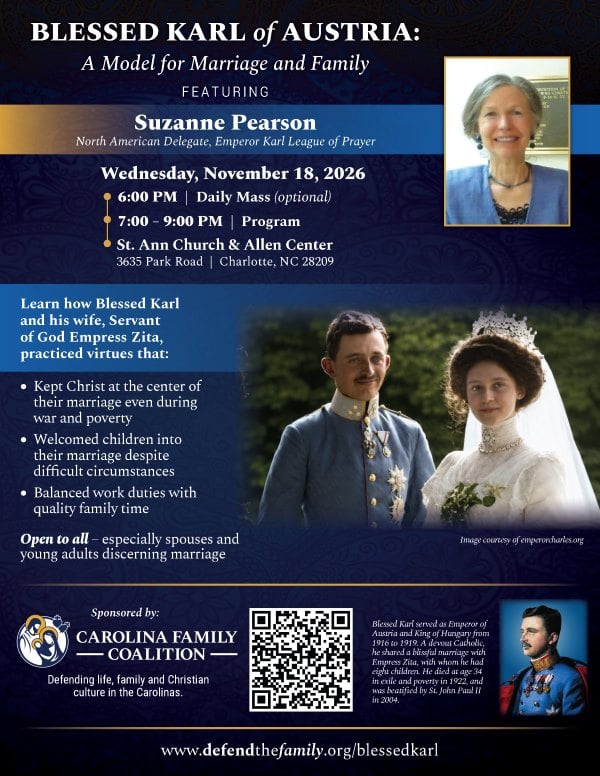
Talk on Blessed Karl of Austria – A talk on Blessed Karl of Austria (1887-1922) will be held at Saint Ann parish on Wednesday November 18 at 7 PM entitled, Blessed Karl of Austria: A Model for Marriage and Family. This presentation will explore his virtues as a husband and father, and how they serve as a model for marriage and family life today. See the flyer at the end of this email or learn more at this link.
Support Saint Ann and Saint Thomas Parishes – Our parishes remain the anchor of our spiritual and community lives and continue to promote the sacred traditions, devotions, speakers and catechesis important for the spiritual growth of ourselves and our families. They also need our continued financial support (and occasional visits!). Both parishes would appreciate our continued generosity.
Bishop Martin issues Pastoral Letter to the Faithful Associated with the Society of Saint Pius X
LiveMass.net – Want to watch a Latin Mass online? The Priestly Fraternity of Saint Peter (FSSP) has a broadcast apostolate which streams its Latin Masses across the world at various times of the day. To view visit: https://www.livemass.net/
Rosary for the Traditional Latin Mass – A Rosary is offered for the restoration of the Traditional Latin Mass in the church on Sundays after the 11:30 a.m. Novus Ordo Mass at Saint Thomas Aquinas Church.
Daily Holy Face Chaplet for Sacred Liturgy (perpetual novena) – For the preservation of the Traditional Latin Mass, it has been recommended to all friends of the sacred liturgy in the diocese to consider continually praying the powerful Holy Face chaplet, under the banner of Our Lady of the Holy Name. To pray the chaplet, please see this link.
Cardinal Burke’s Prayer for Pope Leo XIV – His Eminence Cardinal Raymond Burke has released a prayer for Pope Leo XIV. Please see the prayer at the links below and consider praying this daily for the Holy Father as he leads the Church. PDF copies can be accessed at these links: [English] [Español] [Latin]
Holy Face Devotions
Prayers of Reparation to the Holy Face of Jesus are offered each week at the following churches on the indicated days:
- St. James (Concord) – Monday, 10-10:30 a.m. (in the cry room)
- St. Mark – Tuesday, 5:30 p.m.
- St. Thomas Aquinas – Tuesday, 6:00 a.m.
- St. Ann – Tuesday, 7:30 a.m. (following 7:00 a.m. Mass)
- St. Michael the Archangel (Gastonia) – Tuesday, 8:30 a.m. (following 8:00 a.m. Mass)
- St. Vincent de Paul – Tuesday, 8:40 a.m.
- Holy Spirit (Denver) – Tuesday, 10-11:00 a.m. (following the 9:15 a.m. Mass)
- Saint Elizabeth of the Hill Country (Boone) – Third Tuesday, at 6:45 p.m. after Mass in the Youth Room (League of St. Martin chapter)
- St. John the Baptist (Tryon) - First Saturday, 9:30 a.m. (after 8:30 a.m Mass)
Note: Days and times may be subject to change due to holidays.
“Jesus, Your ineffable image is the star which guides my steps. Ah, You know, Your sweet Face is for me Heaven on earth” (from Canticle to the Holy Face by Saint Thérèse de Lisieux, the 19th century Discalced Carmelite nun who took the name in religion, Thérèse of the Child Jesus and the Holy Face).
Traditional Latin Mass and Liturgical News
- Blessed are the meek: Reflections on the Georgia Martyrs by Deacon Matthew Newsome, Catholic News Herald (November 11, 2026). [Blessed are the meek]
- Researchers explore misconceptions about Latin Mass community by McKenna Snow, Zeale (November 5, 2026). [Misconceptions about Latin Mass community]
- Blessing of Bird Meat by Fr. William Rock, FSSP, The Missive (November 9, 2026). [Blessing of Bird Meat]
- Forgotten Customs of Martinmas and St. Martin’s Lent by Matthew Plese, OnePeterFive (November 11, 2026). [Forgotten Customs of Martinmas]
- Introducing Archbishop Salvatore Cordileone’s Reverent Liturgy Project, Liturgical Arts Journal (November 6, 2026). [Reverent Liturgy Project]
- The Feast of St Martin of Tours 2026 by Greg DiPippo, New Liturgical Movement (November 11, 2026). [Feast of St Martin of Tours]
- The Feast of St Brice, St Martin’s Bad Disciple by Greg DiPippo, New Liturgical Movement (November 13, 2024). [Feast of St Brice]
- Saint Didacus by Dr. Michael P. Foley, New Liturgical Movement (November 13, 2026). [Saint Didacus]
- Forgotten Customs of All Saints Days for Religious Orders & Nations by Matthew Plese, OnePeterFive (November 5, 2026). [Forgotten Customs of All Saints Days]
- Pope Leo XIV: Let Us Not Allow the Memory of the Deceased to Be Reduced to Mere Nostalgia by Angela Ambrogetti, EWTN News (November 5, 2026). [Pope Leo XIV Homily]
Saints and Special Observances
Three Parables – The Gospel readings for this Sunday (Matthew 13:31-35) and the preceding Sunday (Matthew 13:24-30) include three parables in which Jesus speaks explicitly about the nature of the kingdom of heaven. To say He speaks explicitly is not to suggest directly, because His approach in two of the three exemplifies the parabolic approach from which the term parable is derived. Rather than making a straight-line connection between the point at which He begins and the end of the message He seeks to convey, His thought pursues an indirect route, curving its way to His intended conclusion. In the case of the third parable, the end is implicit and is left unexpressed by Our Lord.
The first parable begins, “The kingdom of heaven is likened to a man that sowed good seed in his field.” The straight-line projection of how the story should end would call for a good harvest when the time came to gather the crop. But the path taken by the story is diverted by an enemy who oversows the field with bad seed. Only the patience and forbearance of the one who owns the field prevents that which is good from being uprooted along with the bad. When the time for the harvest arrives, he will have the cockle bound into bundles to be burned; but the wheat he will gather into his barn.
The second parable begins, like the first, with the metaphor of sowing: “The kingdom of heaven is like to a grain of mustard seed, which a man took and sowed in his field. . . .” The “least indeed of all seeds,” little or nothing ought to be expected to come of it; and yet, when fully grown, “it is greater than all herbs, and becometh a tree, so that the birds of the air come and dwell in the branches thereof.” Once again, the indirect approach to the subject arrives at an end one would be unlikely to anticipate at the beginning of the parable.
The third parable begins and ends in a single sentence: “The kingdom of heaven is like to leaven, which a woman took and hid in three measures of meal, until the whole was leavened.” The parabolic element here is to be found in the word hid. We know how the story will end; the woman will take a loaf of bread from her oven once it has been baked. But she has only succeeded in producing the loaf by an act of intervention, overcoming the ordinary inertness of the meal by hiding leaven within it.
What, then, is Jesus telling us about the kingdom of heaven in these three parables? First, it is not meant in the end for everyone without distinction. Some among us, products of the bad seed introduced by the enemy, will be weeded out and consigned to the fire when human affairs are brought to their conclusion. For now, good and bad coexist, living and growing side-by-side in the same field.
The second revelation is that the kingdom of heaven emerges from an almost invisible beginning. Its seed, overlooked and nearly undetectable at first, holds within itself the potential for unlimited growth. Ultimately it will expand into something capable of accommodating all who flock to it.
The third is like unto the second: The kingdom of heaven emerges from something that is essentially hidden, unseen until the time when its capacity for expansion makes its presence known.
The kingdom of heaven is, in fact, the Body of Christ – in this world the Church established by Jesus Himself. The Church is open and accessible to all in this life, even if some among its ranks have been corrupted to a degree that renders them unworthy of a place in the next. This is no doubt an uncongenial thought to many in an era when inclusivity and tolerance seem to trump all other values. But this is what Our Lord taught.
Jesus Himself was the grain from which grew the Church he founded. He has been called an obscure itinerant preacher whose ministry was limited to a distant corner of the Roman Empire, a man born in poverty who died the ignominious death of a convicted criminal. But the seed He planted grew with astonishing rapidity, branching out as His apostles spread out across the world to convey the message that was Jesus Christ Himself. The kingdom of heaven exists, in this world, wherever He is to be found; and that is in the Church that He established.
He is the leaven hid in the bread that sustains the Body of Christ. Born in Bethlehem (“House of Bread”) and laid in a feeding-trough (a manger, from the Latin mangere, to eat), He offered His body and blood as a final sacrifice in atonement for the sin of man and as sustenance for all who seek to ascend with Him to the heaven above.
Where He is, there is the kingdom of heaven.
Closing Commentary
We offer, in closing, Dom Prosper Guéranger’s commentary on the Gospel for “The Sixth Sunday after the Epiphany” from The Liturgical Year. A link to the full text of the commentary on the liturgy for the day follows.
The Sixth Sunday after the Epiphany: Gospel
Our Lord here teaches us, under the symbolism of two parables, what we are to believe concerning his Church, which is his Kingdom, - a Kingdom that rises indeed here on the earth, but is to be perfected in Heaven. What is this grain of mustard-seed, which is hid under ground, is unseen by man's eye, then appears as the least of herbs, but, finally, becomes a tree? It is the Word of God, at first hidden in Judea, trampled on by man's malice even so as to be buried in a tomb, but, at length, rising triumphantly and reaching rapidly to every part of the world. Scarcely had a hundred years elapsed since Jesus was put to death, and his Church was vigorous even far beyond the limits of the Roman Empire. During the past nineteen centuries, every possible effort has been made to up-root the Tree of God; persecution, diplomacy, human wisdom, - all have tried, and all have but wasted their time. True, - they succeeded, from time to time, in severing a branch; but another grew in its place, for the sap of the Tree is vigorous beyond measure. The birds that come and dwell upon it, are, as the Holy Fathers interpret it, the souls of men aspiring to the eternal goods of the better world. If we are worthy of our name of "Christians," we shall love this Tree, and find our rest and safety no where but beneath its shade. - The Woman, of whom the second parable speaks, is the Church, our Mother. It was she that, from the commencement of Christianity, took the teaching of her Divine Master, and hid it in the very heart of men, making it the leaven of their salvation. The three measures of meal which she leavened into bread, are the three great families of mankind, the three that came from the children of Noah, who are the three fathers of the whole human race. Let us love this Mother of ours; and let us bless that heavenly leaven, which made us become children of God, by making us children of the Church. [Sixth Sunday after the Epiphany]