Fourteenth Sunday after Pentecost
Friends in Christ,
Welcome to our weekly Sunday update. This Sunday is the Fourteenth Sunday after Pentecost. In the Gospel reading for this Sunday, Jesus reminds His disciples of the importance in trusting in God’s providence and not in material things: “No man can serve two masters; for either he will hate the one and love the other, or he will sustain the one and despise the other” (Matthew 6:24-33). He then continues and exhorts them to not be “solicitous for your life, what you shall eat, nor for your body, what you shall put on.” St. Augustine comments on this passage noting “The Lord…wants us to remember that in creating us and making us consist of soul and body, almighty God has given us much more than food and clothing. He does not want us to be divided by these cares…He who by His power made your body grow to its present height can equally well clothe you by His providence.”
The Saint Andrew Missal concludes by warning that a “lack of trust in Divine Providence, that anxiety about material things, which stands so much in the way of true freedom of spirit, and keeps us from being generous in the Lord’s service.” It serves as an important lesson in this age of materialism and atheism.
Calendar of Special Observances
Celebrations are those listed in the Roman Missal of 1962.
DAY, DATE – FEAST (CLASS)
Sunday, August 30 – Fourteenth Sunday after Pentecost (II)
Monday, August 31 – St. Raymond Nonnatus, Confessor (III)
Tuesday, September 1 – Feria (IV) – Commemoration of The Holy Twelve Brothers, Martyrs – Commemoration of St. Giles, Confessor
Wednesday, September 2 – St. Stephen of Hungary, King and Confessor (III)
Thursday, Sept. 3 – St. Pius X, Pope and Confessor (III) – Jesus Christ the High Priest (III)
Friday, September 4 – Sacred Heart of Jesus (III) – Feria (IV)
Saturday, September 5 – St. Lawrence Justinian, Bishop and Confessor (III) – Immaculate Heart of Mary (III)
Fourteenth Sunday after Pentecost
The links provided below can be used to download printable copies of the Proper Prayers for the Fourteenth Sunday after Pentecost with English or Spanish translation, followed by commentary by Dr. Michael P. Foley.
Traditional Latin Mass Schedule
Diocese of Charlotte Sunday Masses
Chapel of the Little Flower (757 Oakridge Farm Road, Mooresville, NC)
- 10:00 a.m. (Low)
- 12:00 p.m. (Sung)
- Chaplain: Fr. Brandon Jones
- Chapel related questions? Email Father at: tlmchapel(at)rcdoc.org
- DONATE: To donate to the Chapel of the Little Flower click here (via Saint Ann Parish, Charlotte)
- More details: https://carolinaliturgy.org/chapel
Note: Only Sunday Latin Masses and Holy Days are offered at the Chapel. This is the only Diocese of Charlotte location which offers the Traditional Latin Mass.
Saint Thérèse of the Child Jesus and the Holy Face, the Little Flower, pray for us!
Diocese of Raleigh Sunday Masses
- 1:00 p.m., Sacred Heart (Dunn, NC)
- 4:30 p.m., - First Sunday, Holy Name Cathedral (Raleigh, NC)
- 5:00 p.m., - Fourth Sunday, Basilica of Saint Mary (Wilmington, NC)
- For additional locations and Masses please see our Mass Times webpage
Diocese of Charleston Sunday Masses
- 12:00 p.m., Prince of Peace (Taylors SC)
- 1:00 p.m., Our Lady of the Lake (Chapin SC)
- 12:00 p.m., Sacred Heart (Charleston SC)
- 5:30 p.m., Stella Maris (Sullivans Island, SC)
Diocese of Charleston Daily Traditional Latin Masses
- Prince of Peace (Taylors SC) – No daily Latin Mass this summer unless otherwise noted in the bulletin (see note below)
- For additional locations and Masses please see our Mass Times webpage
Note: The summer Mass schedule for Prince of Peace parish is in effect and according to the bulletin there will be no daily Latin Masses at Prince of Peace Monday-Saturday this summer.
As a reminder, travelers are urged to consult parish websites or offices for up-to-date information regarding possible changes in the schedule of Mass times.
Chapel of the Little Flower Announcements
Mass Intentions for Sunday
Sunday August 23, 12:00 p.m. – +Deceased Stribl and Farawell Families by Rosina Farawell
Fall/Winter Mass Intentions
The Mass Book will be open for October, November, December, and January Mass intentions on Sunday September 20th between the 10:00 and 12:00 Masses. Mass stipends, either cash or check, will be collected that day for the Mass intentions.
If one is available to help on the 20th with the collection of the Mass intentions, please sign up on the signup sheet on the table in the narthex.
Support Sacred Music at the Chapel by Joining the Schola and Choir
The Church teaches us that singing is praying twice. Please consider lending your musical talents to the beautifying of the sacred liturgy here at the Chapel of the Little Flower. If one would like more information about joining the schola and choir, please contact the Chapel music director whose contact information is at the bottom of the hymn sheets found on the table in the narthex. Thank you for your generosity.
Saint Ann Parishioner Catholic School Check In
If one is a parishioner at St. Ann parish and has children enrolled in the Catholic schools, please scan the QR code found on the table in the narthex of the Chapel. This is the new attendance check in system.
Donations for the Chapel of the Little Flower
To donate to the Chapel of the Little Flower, please make out a check to “St. Ann Catholic Church” and carefully earmark it for “Latin Mass” or “Chapel of the Little Flower”. It can be mailed to the parish (3635 Park Road, Charlotte, NC 28209). To donate online, please visit the parish’s “Chapel of the Little Flower” online donation portal at this link.
Lost and Found
If one is missing a missal, book, or other item, please see the Lost and Found table in the cry room.
Father Jones’ Contact Info
If one has questions about the Chapel of the Little Flower, that are not related to one’s parish, please email Father Jones directly at: tlmchapel(at)rcdoc.org
Visiting the Chapel of the Little Flower
If you haven’t attended Mass at the Chapel of the Little Flower yet, you are welcome to join us. Seating is adequate at both Masses, and there is plenty of parking; a cry room; open space outside for the kids after Mass. Bulletins from Saint Ann and Saint Thomas Aquinas parishes are usually available.
General Announcements
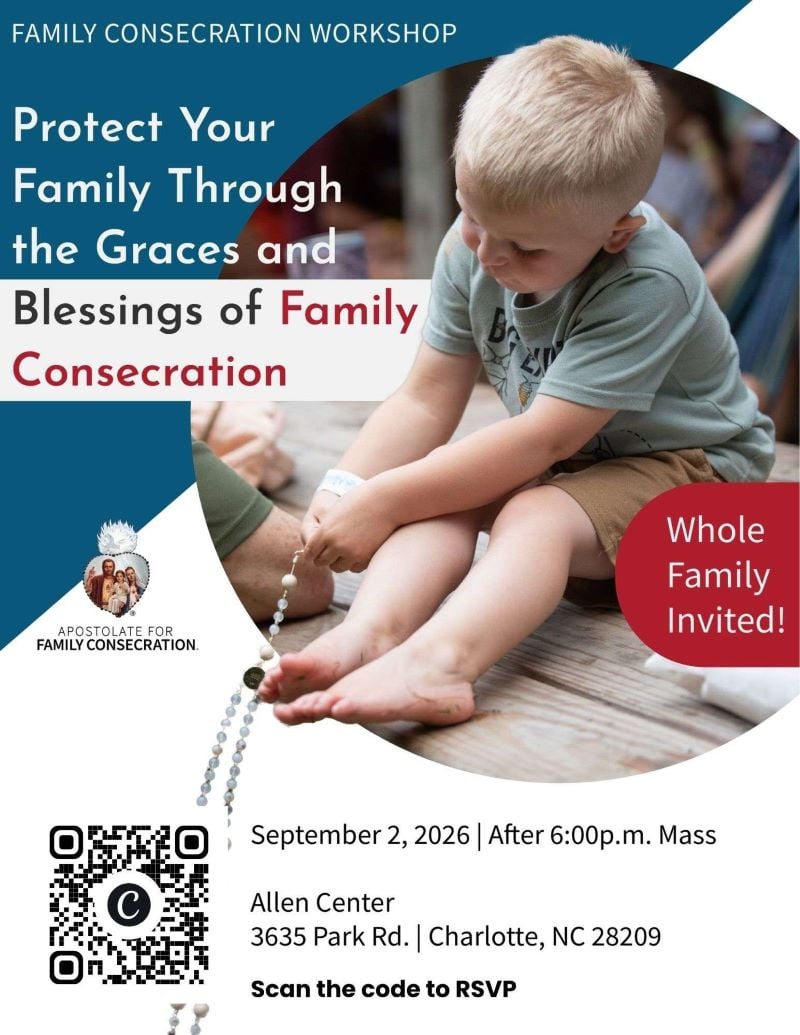
September 2nd: Family Consecration Workshop – Protecting Your Family Through the Graces and Blessings of Family Consecration – Saint Ann parish is hosting a special Family Consecration Workshop on Wednesday September 2nd after the 6:00 p.m. Mass in the Allen Center. The Workshop will help families deepen their Catholic faith within the home as well as protecting them in the battle against evil.
The Workshop explores what consecration is and how to consecrate one’s family to Jesus, through Mary, in union with Saint Joseph. It’s a great opportunity to walk alongside like-minded families in the faith. All family members are encouraged to attend the workshop. To RSVP click here or see the flyer at the end of this update.
First Sunday Food & Fellowship Potluck at Saint Thomas Aquinas – Sunday September 6 will be the monthly Sunday Food and Fellowship at Saint Thomas Aquinas from 1:30 p.m. – 3:00 p.m. If you attend Mass at the Chapel, you can always drop by after Mass. Please consider bringing something to share.
Support Saint Ann and Saint Thomas Parishes – Our parishes remain the anchor of our spiritual and community lives and continue to promote the sacred traditions, devotions, speakers and catechesis important for the spiritual growth of ourselves and our families. They also need our continued financial support (and occasional visits!). Both parishes would appreciate our continued generosity.
Bishop Martin issues Pastoral Letter to the Faithful Associated with the Society of Saint Pius X
LiveMass.net – Want to watch a Latin Mass online? The Priestly Fraternity of Saint Peter (FSSP) has a broadcast apostolate which streams its Latin Masses across the world at various times of the day. To view visit: https://www.livemass.net/
Prayer Request: Healing of Tony Reitz
Rosary for the Traditional Latin Mass – A Rosary is offered for the restoration of the Traditional Latin Mass in the church on Sundays after the 11:30 a.m. Novus Ordo Mass at Saint Thomas Aquinas Church.
Daily Holy Face Chaplet for Sacred Liturgy (perpetual novena) – For the preservation of the Traditional Latin Mass, it has been recommended to all friends of the sacred liturgy in the diocese to consider continually praying the powerful Holy Face chaplet, under the banner of Our Lady of the Holy Name. To pray the chaplet, please see this link.
Cardinal Burke’s Prayer for Pope Leo XIV – His Eminence Cardinal Raymond Burke has released a prayer for Pope Leo XIV. Please see the prayer at the links below and consider praying this daily for the Holy Father as he leads the Church. PDF copies can be accessed at these links: [English] [Español] [Latin]
Holy Face Devotions
Prayers of Reparation to the Holy Face of Jesus are offered each week at the following churches on the indicated days:
- St. James (Concord) – Monday, 10-10:30 a.m. (in the cry room)
- St. Mark – Tuesday, 5:30 p.m.
- St. Thomas Aquinas – Tuesday, 6:00 a.m.
- St. Ann – Tuesday, 7:30 a.m. (following 7:00 a.m. Mass)
- St. Michael the Archangel (Gastonia) – Tuesday, 8:30 a.m. (following 8:00 a.m. Mass)
- St. Vincent de Paul – Tuesday, 8:40 a.m.
- Holy Spirit (Denver) – Tuesday, 10-11:00 a.m. (following the 9:15 a.m. Mass)
- Saint Elizabeth of the Hill Country (Boone) – Third Tuesday, at 6:45 p.m. after Mass in the Youth Room
- St. John the Baptist (Tryon) - First Saturday, 9:30 a.m. (after 8:30 a.m Mass)
Note: Days and times may be subject to change due to holidays.
“Jesus, Your ineffable image is the star which guides my steps. Ah, You know, Your sweet Face is for me Heaven on earth” (from Canticle to the Holy Face by Saint Thérèse de Lisieux, the 19th century Discalced Carmelite nun who took the name in religion, Thérèse of the Child Jesus and the Holy Face).
Traditional Latin Mass and Liturgical News
- The Feast of St Augustine, According to the Order Formerly Known as the Hermits of St Augustine by Dr. Michael P. Foley, New Liturgical Movement (August 27, 2025). [The Feast of St Augustine]
- Groundbreaking at Our Lady of Clear Creek Abbey, Our Lady of Clear Creek Abbey (August 22, 2026). [Groundbreaking at Our Lady of Clear Creek]
- The Seven Joys of the Virgin Mary by Greg DiPippo, New Liturgical Movement (August 27, 2026). [Seven Joys of Mary]
- St. James the Great, Patron of Spain by Charles A. Coulombe, OnePeterFive (August 21, 2026). [Saint James the Great]
- From Ecuador: Fr. Heenan Reports on the New FSSP Apostolate’s First Days of Ministry, FSSP Mission Tradition Newsletter (August 26, 2026). [New FSSP Apostolate’s First Days]
- Second collection to support Belmont Abbey College, Catholic News Herald (August 16, 2026). [Second Collection]
- Faithful invited to witness historic beatification of Georgia Martyrs, Catholic News Herald (July 31, 2026). [Georgia Martyrs]
Saints and Special Observances
St. Pius X, Pope and Confessor, occupied the Chair of St. Peter for 11 years from August 4, 1903, until his death on August 20, 1914. Born Giuseppe Melchiorre Sarto on June 2, 1835, the future pope was a native of Riese in the Kingdom of Lombardy-Venetia, then a part of the Austrian Empire. He was the second of 10 children born to Giovanni Battista Sarto, a cobbler by trade who was also the village postman, and his wife, Margherita Sanson, who worked as a seamstress. The parents were poor but understood the value of a good education. With the help of the local pastor, they were able to arrange for young Giuseppe to attend the high school at Castelfranco, a larger town two miles away from Riese.
By the time he completed his secondary studies at Castelfranco, Giuseppe had discerned a call to the priesthood. With the help once again of the local pastor in Riese, he was able to secure a scholarship to attend the seminary at Padua. After completing his studies for the priesthood, he was ordained in the cathedral at Castelfranco on September 18, 1858. Giuseppe spent the next eight years serving as the curate at Tombolo, where he dedicated himself to serving the poor and established a night school for adults. He also provided instruction for the people of the parish in Gregorian chant. The pastor at Tombolo, Fr. Constantini, predicted of his young curate, “Some day or other he will wear the mitre, of that I am sure. After that – who knows?”
Fr. Sarto was appointed pastor of the parish at Salzano in July of 1867. He spent nine years there, sharing his clothes and other belongings with the poor of the parish, while striving to instruct his parishioners in the meaning of Christian doctrine. Throughout his career, he demonstrated an abiding interest in helping those who were poor in material terms or lacking in understanding of the spiritual treasure of their Faith. When he was appointed canon of the cathedral at Treviso and named chancellor of the diocese, he was also made spiritual director of the diocesan seminary. He also organized catechetical classes on Sundays for children who attended public schools.
The see of Mantua falling vacant in 1884, Pope Leo XIII selected Canon Sarto to be the new bishop. Confronted by the hostility of the secular authorities in the region, the diocese had been undermined by indifference and accommodation within its own ranks. Bishop Sarto set about reinvigorating the local seminary and reviving the faith of the young men studying for the priesthood by teaching there himself. He also promoted the establishment of the Confraternity of Christian Doctrine (CCD) in every parish within the diocese as a means of providing religious instruction for children who attended public schools.
In 1893, Pope Leo XIII promoted Bishop Sarto again, making him a cardinal and appointing him Patriarch of Venice. Ten years later, the reigning Pontiff’s death on July 20, 1903, sparked the search for a worthy successor. During the conclave to elect a new Pope, the name of the Patriarch of Venice was hardly mentioned at first; but support for Sarto increased from ballot to ballot until he obtained the votes necessary to secure election. He is said to have responded by bowing his head, breaking into tears, and whispering, “Fiat voluntas tua!” Enthroned as head of the Vatican on August 19, 1903, the new pope took the name Pius X and set about “to restore all things in Christ” (Eph. 1:10).
Pope Pius began by pushing for reform of the seminaries, reasoning that good priests were needed to provide proper instruction for the laity. In an encyclical entitled Exhortation to the Catholic Clergy, he asserted that the restoration of “all things in Christ” could only be brought about by properly trained and well-disciplined priests. On the Teaching of Christian Doctrine conveyed his belief that the evils of the world were attributable to the prevailing lack of knowledge of God, ignorance that could only be overcome by priests conveying the truth of the Catholic faith in language that people could comprehend. A series of decrees on Holy Communion, issued in the years from 1905 to 1910, earned him the reputation of being the “Pope of the Eucharist.” One of the changes brought about by these decrees was the lowering of the age for first reception of the sacrament from twelve to seven. He also encouraged frequent reception of the Eucharist, reversing a long-standing policy of the Vatican.
Pope Pius X’s concern for the well-being of both the Church and society at large is made evident by the range of subjects he addressed in the documents he produced. On Catholic Social Action addressed the issue of workers’ rights, while the motu proprio “On the Restoration of Church Music” identified Gregorian Chant as the music most compatible with the beauty and sanctity of the Mass. At the same time, he welcomed new music of suitable quality and favored the adoption of what he considered long-overdue changes to the liturgy. Other achievements included the reform of the Breviary, establishment of the Biblical Institute for Scriptural Studies, and the development of the Code of Canon Law.
But it is not for all of these achievements that Pope Pius X is best known and most admired. He was greatly honored in his own time for rejecting pomp and embracing poverty and for the humility and charity with which he emulated Our Lord throughout his life. But the source of his lasting greatness is to be found in his unrelenting defense of orthodox Catholicism. He gave definition to the Modernist movement and pinpointed Modernism as the greatest threat to the Church in the 20th century. His thoughts on the subject found their fullest expression in Pascendi Domenici Gregis, an encyclical of more than 21,000 words in which he concluded that Modernism was the “synthesis of all heresies.” (A link to the official Vatican post of this invaluable papal document is provided below.)
With the coming of the Great War in 1914, the 79-year-old pontiff speculated that God might spare him the horror of watching the world go up in flames. On August 20, 1914, the day that Germany invaded Belgium, Pope Pius X passed away peacefully, leaving a last testament that read, in part, “I was born poor, I lived poor, I die poor.” He was entombed in St. Peter’s Basilica, and the following lines were inscribed on his tomb:
Born poor and humble of heart,
Undaunted champion of the Catholic faith,
Zealous to restore all things in Christ,
Crowned a holy life with a holy death.
A number of astonishing miracles had been credited to him during his life, although he always sought to deflect attention from himself when things that were unexplainable occurred in his presence. Additional miracles were attributed to his intercession following his death. The official inquiry into his life and virtues got underway after the First World War, and the Cause for Canonization was initiated by Pope Pius XII during the Second World War. On June 3, 1951, he was declared by the Pope to be blessed, and on May 29, 1954, he was added to the roster of saints. His feast is observed by the Church each year on September 3rd, according to the traditional Roman Calendar. [Pascendi Dominici Gregis (September 8, 1907) | PIUS X]
Closing Commentary
In closing, we offer commentary on the Fourteenth Sunday after Pentecost excerpted from The Liturgical Year of Dom Prosper Guéranger, OSB, followed by a link to the full text.
Fourteenth Sunday after Pentecost
The supernatural life can never be healthy in men’s souls unless it triumph over the three enemies, which St. John calls concupiscence of the flesh, concupiscence of the eyes, and the pride of life. As to the first of these, our Epistle has been instructing us upon the obstacle it raises against the action of the Holy Spirit, and on the means we are to adopt for surmounting it. Pride of life is overcome by Humility, on which the Church has several times spoken to us during the previous Sundays. The Gospel for today is the condemnation of the concupiscence of the eyes, that is, attachment to the goods of this world, which of themselves are but goods in name and appearance.
No man, says our Lord, can serve two masters; and these two Masters are God and Mammon; Mammon means riches. Riches are not, of their own nature, bad. When lawfully acquired and used agreeably to the designs of God, Riches help the possessor to gain true goods for his soul; he stores up for himself, in the kingdom of his eternal home, treasures which neither thieves nor rust can reach. Ever since the Incarnation, wherein the divine Word espoused Poverty to himself, it is the Poor that are heaven’s nobility; and yet the mission of the rich man is a grand one. He is permitted to be rich, in order that he may be God’s minister to make all the several portions of material creation turn to their Creator’s glory. He graciously vouchsafes to entrust into his hands the feeding and supporting the dearest of his children—that is, the Poor—that is, the indigent and suffering members of his Christ. He calls them to uphold the interests of his Church and be the promoter of works connected with the salvation of men. He confides to him the keeping up the beauty of his temples.
Happy that man, and worthy of all praise who thus directly brings back to the glory of their maker the fruits of the earth, and the precious metals she yields from her bosom! Let not such a man fear: it is not of him that Jesus speaks those anathemas uttered so frequently by him against the rich ones of this world. He has but one Master—the Father who is in heaven, whose steward he humbly and gladly acknowledges himself to be. Mammon does not domineer over him; on the contrary he makes her his servant, and obliges her to minister to his zeal in all good works. The solicitude he takes in spending his wealth in acts of justice and charity is not that which our Gospel here blames; for in all such solicitude, he is but following our Lord’s precept—of seeking first the kingdom of God; and the riches which pass through his hands in the furtherance of good works do not distract his thoughts from that heaven where his heart is, because his true treasure is there. [Fourteenth Sunday after Pentecost]