Fifth Sunday after Epiphany (Resumed)
Friends in Christ,
Welcome to our weekly Sunday update. This Sunday is designated the Fifth Sunday after Epiphany (Resumed) on the traditional liturgical calendar. The date of Easter being variable, the number of Sundays after Pentecost also varies from year to year. This year there are four which fall between Christ the King and the First Sunday of Advent. After the Feast of All Saints (falling on a Sunday this year) the liturgy of the next two Sundays reverts to that of the fifth and sixth Sundays after Epiphany respectively. In the parable pronounced by Jesus in the Gospel reading for this Sunday, the enemy who came and oversowed cockle among the wheat represents the devil. The servants of the property owner – who, discerning the evil deed, wish to pull up the bad weeds – are the angels ever anxious to do the will of God. But the goodman (who represents God Himself) tells them to let both wheat and cockle grow until the harvest lest in rooting out the weeds, wheat be uprooted too. At the time of the harvest (the Last Judgment) the cockle is to be collected first and bound in bundles to be burned (in hell). Then will the wheat be gathered into the goodman’s barn (which is Heaven).
Calendar of Special Observances
Celebrations are those listed in the Roman Missal of 1962.
DAY, DATE – FEAST (CLASS)
Sunday, November 8 – Resumed Fifth Sunday after Epiphany (II)
Monday, November 9 – The Dedication of the Archbasilica of the Most Holy Redeemer (II) – Commemoration of St. Theodore, Martyr
Tuesday, November 10 – St. Andrew Avellino, Confessor (III) – Commemoration of Ss. Tryphon, Respicius, and Nympha (Virgin), Martyrs
Wednesday, November 11 – St. Martin of Tours, Bishop and Confessor (III) – Commemoration of St. Mennas, Martyr
Thursday, November 12 – St. Martin I, Pope and Martyr (III)
Friday, November 13 – (USA) St. Frances Xavier Cabrini, Virgin (III) – Commemoration of St. Didacus, Confessor
Saturday, November 14 – St. Josephat, Bishop and Martyr (III)
Fifth Sunday after Epiphany (Resumed)
The links provided below can be used to download printable copies of the Proper Prayers for the Fifth Sunday after Epiphany with English or Spanish translations, followed by commentary by Dr. Michael P. Foley.
Traditional Latin Mass Schedule
Diocese of Charlotte Sunday Masses
Chapel of the Little Flower (757 Oakridge Farm Road, Mooresville, NC)
- 10:00 a.m. (Low)
- 12:00 p.m. (Sung)
- Chaplain: Fr. Brandon Jones
- Chapel related questions? Email Father at: tlmchapel(at)rcdoc.org
- DONATE: To donate to the Chapel of the Little Flower click here (via Saint Ann Parish, Charlotte)
- More details: https://carolinaliturgy.org/chapel
Note: Only Sunday Latin Masses and Holy Days are offered at the Chapel. This is the only Diocese of Charlotte location which offers the Traditional Latin Mass.
Saint Thérèse of the Child Jesus and the Holy Face, the Little Flower, pray for us!
Diocese of Raleigh Sunday Masses
- 1:00 p.m., Sacred Heart (Dunn, NC)
- 4:30 p.m., - First Sunday, Holy Name Cathedral (Raleigh, NC)
- 5:00 p.m., - Fourth Sunday, Basilica of Saint Mary (Wilmington, NC)
- For additional locations and Masses please see our Mass Times webpage
Diocese of Charleston Sunday Masses
- 12:00 p.m., Prince of Peace (Taylors SC)
- 1:00 p.m., Our Lady of the Lake (Chapin SC)
- 12:00 p.m., Sacred Heart (Charleston SC)
- 5:30 p.m., Stella Maris (Sullivans Island, SC)
Diocese of Charleston Daily Traditional Latin Masses
- Prince of Peace (Taylors SC) – Monday - Friday, 12 noon
- Prince of Peace (Taylors SC) – Saturday, 8:00 a.m.
- For additional locations and Masses please see our Mass Times webpage
As a reminder, travelers are urged to consult parish websites or offices for up-to-date information regarding possible changes in the schedule of Mass times.
Chapel of the Little Flower Announcements
Mass Intentions for Sunday
Sunday November 8, 12:00 p.m. – Chanda Adkins by Celeste Richards
Support Sacred Music at the Chapel by Joining the Schola and Choir
Saint Paul exhorts us "Be filled with the Spirit...singing and making melody to the Lord with all your heart" (Ephesians 5:18-19) and St. Augustine teaches us that “singing belongs to those who love.” Please consider lending your musical talents toward beautifying the sacred liturgy here at the Chapel of the Little Flower. If one would like more information about joining the schola and choir, please contact the Chapel music director whose contact information is at the bottom of the hymn sheets found on the table in the narthex. Thank you for your generosity.
Music Sheets Available in the Narthex
A reminder that music sheets are available in the narthex so that one may join in or follow along with the singing at the sung Mass.
Saint Ann Parishioner Catholic School Check In
If one is a parishioner at St. Ann parish and has children enrolled in the Catholic schools, please scan the QR code found on the table/wall in the narthex of the Chapel. This is the new attendance check in system.
Donations for the Chapel of the Little Flower
To donate to the Chapel of the Little Flower, please make out a check to “St. Ann Catholic Church” and carefully earmark it for “Latin Mass” or “Chapel of the Little Flower”. It can be mailed to the parish (3635 Park Road, Charlotte, NC 28209). To donate online, please visit the parish’s “Chapel of the Little Flower” online donation portal at this link.
Lost and Found
If one is missing a missal, book, or other item, please see the Lost and Found table in the cry room.
Father Jones’ Contact Info
If one has questions about the Chapel of the Little Flower, that are not related to one’s parish, please email Father Jones directly at: tlmchapel(at)rcdoc.org
Join Us at the Chapel of the Little Flower
If you haven’t attended Mass at the Chapel of the Little Flower yet, you are welcome to join us. Seating is adequate at both Masses, and there is plenty of parking; a cry room; open space outside for the kids after Mass. Bulletins from Saint Ann and Saint Thomas Aquinas parishes are usually available.
General Announcements
Enroll the Souls of the Faithful Departed – The Traditional Carmelite Hermits of Our Lady of Mt. Carmel (Colorado and Pennsylvania) are offering an All Souls Enrollment during the month of November. Throughout November, the community will dedicate 30 Holy Masses (Traditional Carmelite Rite), along with the daily prayers and sacrifices of the Hermits, for the souls of the faithful departed who are enrolled. To learn more or enroll, click here.
All Souls Indulgences (Nov 1 - 8) – A plenary indulgence is granted to the faithful - applicable only to the souls in purgatory - who devoutly visit a cemetery to pray for the dead during the first eight days of November (under the usual conditions each day noted below). To obtain the indulgence one must be baptized and in the state of grace; free from an attachment to sin; go to confession within 20 days; receive Holy Communion on the day of visitation; and offer prayers for the intentions of the Holy Father (the Our Father and Creed will suffice).
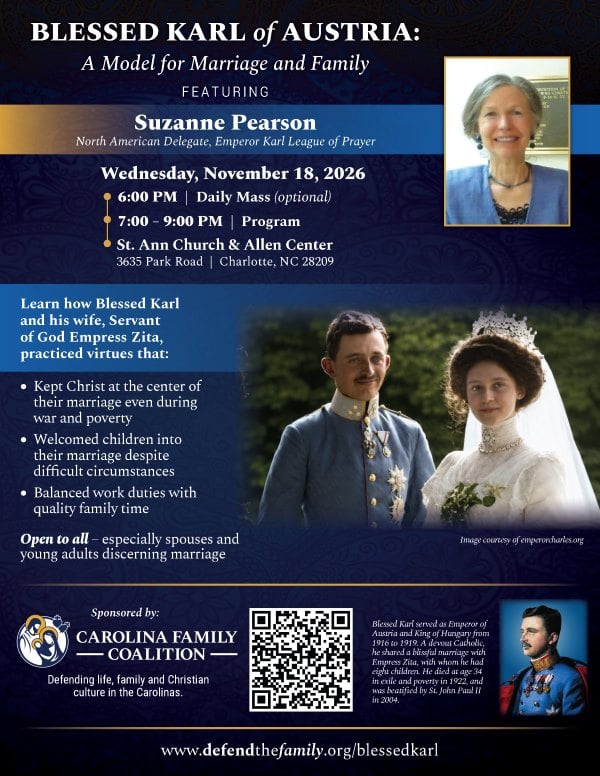
Talk on Blessed Karl of Austria – A talk on Blessed Karl of Austria (1887-1922) will be held at Saint Ann parish on Wednesday November 18 at 7 PM entitled, Blessed Karl of Austria: A Model for Marriage and Family. This presentation will explore his virtues as a husband and father, and how they serve as a model for marriage and family life today. See the flyer at the end of this email or learn more at this link.
Support Saint Ann and Saint Thomas Parishes – Our parishes remain the anchor of our spiritual and community lives and continue to promote the sacred traditions, devotions, speakers and catechesis important for the spiritual growth of ourselves and our families. They also need our continued financial support (and occasional visits!). Both parishes would appreciate our continued generosity.
Bishop Martin issues Pastoral Letter to the Faithful Associated with the Society of Saint Pius X
LiveMass.net – Want to watch a Latin Mass online? The Priestly Fraternity of Saint Peter (FSSP) has a broadcast apostolate which streams its Latin Masses across the world at various times of the day. To view visit: https://www.livemass.net/
Rosary for the Traditional Latin Mass – A Rosary is offered for the restoration of the Traditional Latin Mass in the church on Sundays after the 11:30 a.m. Novus Ordo Mass at Saint Thomas Aquinas Church.
Daily Holy Face Chaplet for Sacred Liturgy (perpetual novena) – For the preservation of the Traditional Latin Mass, it has been recommended to all friends of the sacred liturgy in the diocese to consider continually praying the powerful Holy Face chaplet, under the banner of Our Lady of the Holy Name. To pray the chaplet, please see this link.
Cardinal Burke’s Prayer for Pope Leo XIV – His Eminence Cardinal Raymond Burke has released a prayer for Pope Leo XIV. Please see the prayer at the links below and consider praying this daily for the Holy Father as he leads the Church. PDF copies can be accessed at these links: [English] [Español] [Latin]
Holy Face Devotions
Prayers of Reparation to the Holy Face of Jesus are offered each week at the following churches on the indicated days:
- St. James (Concord) – Monday, 10-10:30 a.m. (in the cry room)
- St. Mark – Tuesday, 5:30 p.m.
- St. Thomas Aquinas – Tuesday, 6:00 a.m.
- St. Ann – Tuesday, 7:30 a.m. (following 7:00 a.m. Mass)
- St. Michael the Archangel (Gastonia) – Tuesday, 8:30 a.m. (following 8:00 a.m. Mass)
- St. Vincent de Paul – Tuesday, 8:40 a.m.
- Holy Spirit (Denver) – Tuesday, 10-11:00 a.m. (following the 9:15 a.m. Mass)
- Saint Elizabeth of the Hill Country (Boone) – Third Tuesday, at 6:45 p.m. after Mass in the Youth Room (League of St. Martin chapter)
- St. John the Baptist (Tryon) - First Saturday, 9:30 a.m. (after 8:30 a.m Mass)
Note: Days and times may be subject to change due to holidays.
“Jesus, Your ineffable image is the star which guides my steps. Ah, You know, Your sweet Face is for me Heaven on earth” (from Canticle to the Holy Face by Saint Thérèse de Lisieux, the 19th century Discalced Carmelite nun who took the name in religion, Thérèse of the Child Jesus and the Holy Face).
Traditional Latin Mass and Liturgical News
- Savannah Gives Thanks for Newly Beatified Georgia Martyrs by Jeffrey Bruno, National Catholic Register/EWTN News (November 2, 2026). [Savannah Gives Thanks]
- America’s First Martyrs for Marriage: The Georgia Martyrs Declared ‘Blessed’ by Beverly Willett, EWTN News (October 31, 2026). [Georgia Martyrs Declared ‘Blessed’]
- Display of Relics at Trinità dei Pellegrini for All Saints’ Day by Greg DiPippo, New Liturgical Movement (November 5, 2026). [Display of Relics]
- Forgotten Customs of All Saints Days for Religious Orders & Nations by Matthew Plese, OnePeterFive (November 5, 2026). [Forgotten Customs of All Saints Days]
- Pope Leo XIV: Let Us Not Allow the Memory of the Deceased to Be Reduced to Mere Nostalgia by Angela Ambrogetti, EWTN News (November 5, 2026). [Pope Leo XIV Homily]
- Another Word on St. Jude by Dr. Michael P. Foley, New Liturgical Movement (October 30, 2026). [Another Word on St. Jude]
Saints and Special Observances
Saint Martin of Tours, Bishop and Confessor, was born in the eastern European region of Pannonia around the year 316. His father, a Roman army officer, was transferred to northern Italy when Martin was still a child; and it was there that the boy encountered Christianity and was first drawn to the Faith. As the son of a Roman officer, he was required to enter military service himself at the age of fifteen. Stationed at Amiens, he was approaching the town on horseback one winter day when he saw a poorly clad beggar shivering in the cold outside the city gate. Ignored by the crowd of people passing by, no one stopped to relieve the man’s suffering until Martin, drawing his sword, sliced his cloak down the middle and gave half to the beggar. According to Sulpicius Severus, a friend of the future saint who wrote an early biography, Martin saw Jesus in a dream the following night. Our Lord, surrounded by angels and wearing the half of Martin’s cloak he had given away, invited the young soldier to inspect the riven garment and say if he knew it. Upon doing so, Martin heard Jesus say to the angels, “Martin, as yet only a catechumen, has covered me with his cloak.” Inspired by this vision of Our Lord, Martin hurried to be baptized.
This single act of simple Christian charity is the one thing most people know about Saint Martin, although it came five years before he discerned his true vocation. When he was about twenty, Gaul was invaded by Teutonic tribes; and Martin was moved to address the Emperor Julian as the monarch was distributing bounties to the soldiers preparing to fight the invaders. “Up to now I have served you as a soldier,” Martin told the emperor. “Allow me henceforth to serve Christ.” He suggested his bounty be given to those going into battle, saying, “I am a soldier of Christ and it is not lawful for me to fight.” The emperor, unimpressed by this appeal, had Martin locked up and held in prison until a truce with the Teutonic invaders was negotiated.
Upon his release, Martin made his way to Poitiers, where he was received by the renowned bishop and defender of the Faith, Saint Hilary. The bishop promptly ordained Martin to the diaconate, launching his career in the Church. During a visit to his homeland, where he secured the conversion of his mother and others, Martin became embroiled in the battle against the Arian heresy. His zeal for the true Faith drew the ire of the Arians, who were ascendant in the area, and they had him scourged before driving him away. Returning to Gaul, he found the Aryans had seized control at Poitiers and banished his mentor, Bishop Hilary. When the bishop was restored to his see in 360, he granted Martin’s wish to pursue his religious calling in solitude and gave him a small tract in central France to which he could withdraw. Joined there by other men of like mind, Martin became the head of a community that has been called the fist monastery in France. It survived until 1607 and was reestablished in 1852 by the Benedictines of Solesmes under the leadership of Dom Prosper Guéranger.
Martin spent a decade in this monastic environment before a delegation of bishops arrived with the intention of consecrating him to replace the recently deceased bishop of Tours, Lidorius. He tried unsuccessfully to escape consecration, almost convincing the consecrators that he was unworthy by the poverty of his appearance. Once installed, he launched an aggressive campaign to suppress pagan practices in the vicinity of Tours. Severus reports that on one occasion a pagan mob fell on him in a fury. One man, armed with a sword, was about to strike when Martin turned on him and bared his breast. The pagan stopped in his tracks and fell back terrified, begging forgiveness.
The early biography of Martin by his friend, Severus, records numerous marvelous events which occurred during the period of his episcopacy. The bishop ardently went about the business of destroying pagan temples and felling trees considered sacred that stood near them. Once, after razing a temple, he was preparing to bring down a pine tree that stood nearby when the pagans offered to cut it down themselves on the condition that he would stand under it wherever they ordered. Placing his trust in God, Martin agreed and was bound where the pagans planned to have the tree fall; but when they chopped the tree down it fell in the opposite direction from which they had planned. Severus also included in the story of Martin’s life numerous revelations and visions experienced by the bishop of Tours.
Saint Martin died on November 8, 397 and was buried three days later. Two thousand monks and nuns attended his funeral. His successor as bishop of Tours erected a chapel over his grave, later replaced by a basilica. A still later church destroyed during the French Revolution was also replaced. Fr. Lawrence Daniel Carney III, author of The Secret of the Holy Face, credits Venerable Leo Dupont, the “Holy Man of Tours,” with having recovered the relics of Saint Martin following the revolution. Born in 1797 on Saint Martinique, the Caribbean island named for the saint, Dupont relocated to Tours later in life in order to honor his late wife’s wish that their daughter be educated by the Ursuline nuns in that city. Making his way from church to church, some of which were only ruins left by the revolution, he began seeking information that would lead him to the remains of Saint Martin. Eventually a woman who had been selling vegetables on the street for 25 years was able to identify the exact spot where the saint’s tomb had been before the church above it was torn down by the revolutionists.
Saint Martin was proclaimed the patron of France, and his restored tomb became a national shrine visited by pilgrims from across Europe and throughout the world. The Feast of Saint Martin is celebrated on November 11th, the date of his burial.
Closing Commentary
We offer, in closing, Dom Prosper Guéranger’s commentary on the Gospel for “The Fifth Sunday after the Epiphany” from The Liturgical Year. A link to the full text of the commentary on the liturgy for the day follows.
The Fifth Sunday after the Epiphany: Gospel
The Kingdom of Heaven, here spoken of by our Lord, is the Church Militant,- the society of them that believe in him. And yet, the field he has tilled with so much care is oversowed with cockle; heresies have crept in, scandals have abounded; are we, on that account, to have misgivings about the foresight of the Master, who knows all things, and without whose permission nothing happens? Far from us be such a thought! He himself tells us that these things must needs be. Man has been gifted with free-will; it is for him to choose between good and evil; but, God will turn all to his own greater glory. Heresies, then, like weeds in a field, may spring up in the Church; but the day must come when they will be uprooted; some of them will wither on the parent-stems, but the whole cockle shall be gathered into bundles to burn. Where are now the heresies that sprang up in the first ages of the Church? And in another hundred years, what will have become of the heresy, which, under the pretentious name of The Reformation, has caused incalculable evil? It is the same with the scandals which rise up within the pale of the Church; - they are a hard trial; but trials must come. The Divine Husbandman wills not that this cockle be torn up, lest the wheat should suffer injury. First of all, the mixture of good and bad is an advantage; it teaches the good not to put their hopes in man, but in God. Then too, the mercy of our Lord is so great, that at times the very cockle is converted, by Divine grace, into wheat. We must, therefore, have patience. But, whereas it is when the men are asleep that the enemy oversows the field with cockle, it behoves us to pray for Pastors, and ask their Divine Master to bless them with that Vigilance, which is the primary condition of the flock being safe, and is so essential a quality in every Bishop, that his very name is, - one who watches. [Fifth Sunday after the Epiphany]