Third Sunday of Lent
Friends in Christ,
Welcome to our weekly Sunday update. In the Gospel for the Third Sunday of Lent Jesus invokes the image of a kingdom divided against itself to refute those who accuse him of casting out devils “by Beelzebub, the prince of devils.” The metaphor recalls the fate of Babel, where men sought to build a city that would reach up to Heaven but were confounded by God who fragmented their speech and sent them off into different lands. There is no limit to the languages of men or the divisions that may arise among them, but the word of God remains indivisible. At the end of this week’s Gospel reading, a woman calls out to Jesus, “Blessed is the womb that bore thee.” But he said: Yea rather, blessed are they who hear the word of God, and keep it (Luke 11:28).
***Daylight Saving Time Begins Sunday*** – A friendly reminder that this Sunday (March 8th) is the day that man makes the sun rise (and set) an hour later than it did the day before, so be sure to rise at 2:00 a.m. in order to reset your clocks to 3:00 a.m.
Calendar of Special Observances
Celebrations are those listed in the Roman Missal of 1962.
DAY, DATE – FEAST (CLASS)
Sunday, March 8 – Third Sunday of Lent (I)
Monday, March 9 – Feria of Lent (III) – Commemoration of St. Frances of Rome, Widow
Tuesday, March 10 – Feria of Lent (III) – Commemoration of The Forty Holy Martyrs
Wednesday, March 11 – Feria of Lent (III)
Thursday, March 12 – Feria of Lent (III) – Commemoration of St. Gregory, Pope, Confessor and Doctor of the Church
Friday, March 13 – Feria of Lent (III)
Saturday, March 14 – Feria of Lent (III)
Third Sunday of Lent
The links provided below can be used to download printable copies of the Proper Prayers for the Third Sunday of Lent with English or Spanish translation, followed by commentary by Dr. Michael P. Foley.
Traditional Latin Mass Schedule
Diocese of Charlotte Sunday Masses
Chapel of the Little Flower (757 Oakridge Farm Road, Mooresville, NC)
- 10:00 a.m. (Low)
- 12:00 p.m. (Sung)
- Chaplain: Fr. Brandon Jones
- Chapel related questions? Email Father at: tlmchapel(at)rcdoc.org
- More details: https://carolinaliturgy.org/chapel
Note: Only Sunday Latin Masses and Holy Days are offered at the Chapel. This is the only Diocese of Charlotte location which offers the Traditional Latin Mass.
Saint Thérèse of the Child Jesus and the Holy Face, the Little Flower, pray for us!
Diocese of Raleigh Sunday Masses
- 1:00 p.m., Sacred Heart (Dunn, NC)
- 4:30 p.m. - First Sunday, Holy Name Cathedral (Raleigh, NC)
- For additional locations and Masses please see our Mass Times webpage
Diocese of Charleston Sunday Masses
- 12:00 p.m., Prince of Peace (Taylors SC)
- 1:00 p.m., Our Lady of the Lake (Chapin SC)
- 12:00 p.m., Sacred Heart (Charleston SC)
- 5:30 p.m., Stella Maris (Sullivans Island, SC)
Diocese of Charleston Daily Traditional Latin Masses
- Prince of Peace (Taylors SC) – Monday-Friday, 12:00 p.m.
- Prince of Peace (Taylors SC) – Saturday, 8:00 a.m.
- For additional locations and Masses please see our Mass Times webpage
As a reminder, travelers are urged to consult parish websites or offices for up-to-date information regarding possible changes in the schedule of Mass times.
Traditional Fasting and Abstinence Disciplines During Lent
For those looking to practice the traditional Lenten disciplines in place in 1962, we share a helpful 2010 document from Mater Ecclesiae Latin Mass Chapel in Berlin, New Jersey, which explains the differences between the traditional Lenten rules for fasting and abstinence (now voluntary) that accompanied the Traditional Latin Mass and the current rules. [Discipline of 1962 for Fast during Lent]
Chapel of the Little Flower Announcements
Mass Intentions for Sunday
Sunday March 8:
10:00 a.m. - Sharon Hoidas
12:00 p.m. - +Orestes Manuel Vilorio by his son Orestes Vilorio
Donations for Easter Flowers
The Chapel of the Little Flower will be accepting donations for Easter flowers. There will be envelopes available for you to use for your cash or check donation. You may donate in honor or in memory of a loved one. More details available in the narthex at The Chapel. Checks should be made payable to Saint Ann Catholic Church, and write in the memo “Chapel of the Little Flower Easter Flowers”
Donations for the Chapel of the Little Flower
There is a new procedure for making donations to the Chapel of the Little Flower. Please make out a check to “St. Ann Catholic Church” and carefully earmark it for “Latin Mass” or "Chapel of the Little Flower". It can be mailed to the parish (3635 Park Road, Charlotte, NC 28209). To donate online, please visit the parish’s “Chapel of the Little Flower” online donation portal at this link.
Update on Mass intentions
Mass intentions have now been filled through the spring and new Masses are currently unavailable. The Mass intentions book will be opened sometime later this spring for the next quarter of Masses.
Lost and Found
The Chapel has a growing collection of items left behind after Mass. If one is missing a missal, book, or other item, please see the new table in the cry room.
Father Jones’ Contact Info
If one has questions about the Chapel of the Little Flower, that are not related to one’s parish, please email Father Jones directly at: tlmchapel(at)rcdoc.org
Visiting the Chapel of the Little Flower
If you haven’t attended Mass at the Chapel of the Little Flower yet, you are welcome to join us in Lent. Seating is adequate at both Masses, and there is plenty of parking; a cry room; open space outside for the kids after Mass. Bulletins from Saint Ann and Saint Thomas Aquinas parishes are usually available.
Annual Novena to Saint Gregory the Great (Continues thru Wednesday March 11)
The feast of Pope Saint Gregory the Great is on Thursday March 12. To honor the Pope who codified the Latin Mass and the sacred Chant which bears his name (Gregorian), and to pray for the continued preservation of the Traditional Latin Mass, we invite our readers to join in this annual novena for the remaining days ahead of Saint Gregory’s Feast Day (novena concludes March 11).
The prayer is below and can also be downloaded as PDF at this link.
Novena to St. Gregory the Great
Pray Daily March 3- March 11 (Feast Day March 12)
St. Gregory, you are known for your zeal for the Catholic faith, love of liturgy, and compassion and mercy toward those in need. Please help and guide us so that we may share in these virtues and thereby bring Jesus into the hearts of our families and all we encounter.
We especially ask for blessings on our parish family, our priests and our deacons. We also ask that you graciously intercede for us before God so that we might be granted the special assistance and graces that we seek:
(Intention: Continued preservation of the Traditional Latin Mass).
Help us to live as a faithful child of God and to attain the eternal happiness of heaven. St. Gregory the Great, pray for us. Amen.
General Announcements
TOMORROW: Fr. Ripperger to preach at Sunday Masses at Saint Thomas Aquinas (March 8) – After completing the parish mission, tomorrow Sunday March 8, Fr. Chad Ripperger will preach at the Sunday morning Novus Ordo Masses at Saint Thomas Aquinas parish (7:30 a.m.; 9:30 a.m.; 11:30 a.m.). Father is only preaching (not offering Mass).
LiveMass.net – Want to watch a Latin Mass online? The Priestly Fraternity of Saint Peter (FSSP) has a broadcast apostolate which streams its Latin Masses across the world at various times of the day. To view visit: https://www.livemass.net/
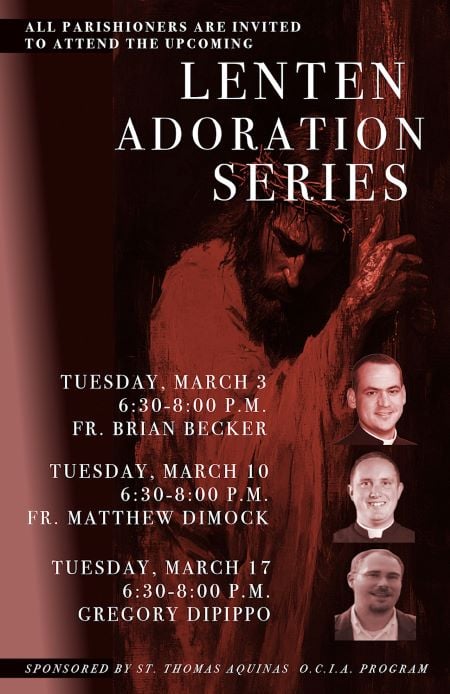
Lenten Adoration Series (Saint Thomas Aquinas) – The parish is holding a Lenten Adoration series on the following Tuesday evenings in March. Each evening will feature a reflection followed by Adoration of the Blessed Sacrament. The remaining speakers are:
- Tuesday March 10, 6:30-8:00 p.m. (Fr. Matthew Dimock, Sacred Heart parish)
- Tuesday March 17, 6:30-8:00 p.m. (Greg DiPippo - Editor, New Liturgical Movement)
Please see the flyer at the end of this update.
Support Saint Ann and Saint Thomas Parishes – Our parishes remain the anchor of our spiritual and community lives and continue to promote the sacred traditions, devotions, speakers and catechesis important for the spiritual growth of ourselves and our families. They also need our continued financial support (and occasional visits!). Both parishes would appreciate our continued generosity - especially in Lent.
Rosary for the Traditional Latin Mass – A Rosary is offered for the restoration of the Traditional Latin Mass in the church on Sundays after the 11:30 a.m. Novus Ordo Mass at Saint Thomas Aquinas Church.
Daily Holy Face Chaplet for Sacred Liturgy (perpetual novena) – For the preservation of the Traditional Latin Mass, it has been recommended to all friends of the sacred liturgy in the diocese to consider continually praying the powerful Holy Face chaplet, under the banner of Our Lady of the Holy Name. To pray the chaplet, please see this link.
Cardinal Burke’s Prayer for Pope Leo XIV – His Eminence Cardinal Raymond Burke has released a prayer for Pope Leo XIV. Please see the prayer at the links below and consider praying this daily for the Holy Father as he leads the Church. PDF copies can be accessed at these links: [English] [Español] [Latin]
Holy Face Devotions
Prayers of Reparation to the Holy Face of Jesus are offered each week at the following churches on the indicated days:
- St. James (Concord) – Monday, 10-10:30 a.m. (in the cry room)
- St. Mark – Tuesday, 5:30 p.m.
- St. Thomas Aquinas – Tuesday, 6:00 a.m.
- St. Ann – Tuesday, 7:30 a.m. (following 7:00 a.m. Mass)
- St. Michael the Archangel (Gastonia) – Tuesday, 8:30 a.m. (following 8:00 a.m. Mass)
- St. Vincent de Paul – Tuesday, 8:40 a.m.
- Holy Spirit (Denver) – Tuesday, 10-11:00 a.m. (following the 9:15 a.m. Mass)
- Saint Elizabeth of the Hill Country (Boone) – Third Tuesday, at 6:45 p.m. after Mass in the Youth Room
- St. John the Baptist (Tryon) - First Saturday, 9:30 a.m. (after 8:30 a.m Mass)
Note: Days and times may be subject to change due to holidays.
“Jesus, Your ineffable image is the star which guides my steps. Ah, You know, Your sweet Face is for me Heaven on earth” (from Canticle to the Holy Face by Saint Thérèse de Lisieux, the 19th century Discalced Carmelite nun who took the name in religion, Thérèse of the Child Jesus and the Holy Face).
Traditional Latin Mass and Liturgical News
- The Station Churches of the Ember Days of Lent by Greg DiPippo, New Liturgical Movement (February 21, 2024). [Stational Churches of the Ember Days of Lent]
- Pope Leo XIV explains why Catholics fast during Lent, by Courtney Mares, OSV News (February 13, 2026). [Why Catholics Fast]
- An Interesting Fact About Today’s Lenten Station by Greg DiPippo, New Liturgical Movement (March 4, 2026). [An Interesting Fact]
- The 40 Days of Lent by Fr. William Rock, FSSP, The Missive (February 18, 2024). [The 40 Days of Lent]
- Saints Perpetua and Felicity by Greg DiPippo, New Liturgical Movement (March 7, 2026). [Saints Perpetua and Felicity]
- Ave Regina Caelorum by Greg DiPippo, New Liturgical Movement (February 3, 2025). [Ave Regina Caelorum]
Saints and Special Observances
Saint Gregory, Pope, Confessor and Doctor of the Church, the first pope to take that name, has been revered by the faithful since his death in 604 A.D. as Saint Gregory the Great. A monumental figure in ecclesiastical history, he was one of the four saints originally proclaimed to be Doctors of the Church.
Born around the year 540, Gregory was the son of a wealthy patrician named Gordianus who served as prefect of Rome and also held a position in the administration of the Church. His mother, Silvia, was the daughter of prominent landholders in Sicily. Gregory’s great-great-grandfather was Pope Felix III who ruled as primate of the Church from 483 to 492.
The years prior to Gregory’s birth had witnessed the collapse of the Roman Empire in the West. During his early childhood, the region around Rome was decimated by plague. In 546 the city was sacked by the barbarian Ostrogoths, and eight years later the Franks attacked Rome.
Well-educated and an expert in the field of law, Gregory rose in the civil administration of Rome to become prefect of the city at the age of thirty-three; but he longed for the monk’s life of solitude and contemplation. When his father died, Gregory turned his family’s Roman villa into a monastery under the patronage of Saint Andrew and lived as a monk during what he would later call the happiest years of his life.
This happy period of religious seclusion ended in 578 when the pope ordered Gregory to submit to ordination as one of the seven deacons of Rome. In the following year, with the Lombards closing in on the city, the pope sent Gregory with a delegation to Constantinople to ask the Byzantine emperor for military assistance. He remained in the Eastern capital, as permanent ambassador to the Court of Byzantium, for about six years. While there, Gregory engaged in a theological dispute with Eutychius, the Patriarch of Constantinople, regarding the latter’s claim that the resurrected bodies of the elect would be substantially less material than they had been prior to death. Gregory successfully countered Eutychius by referring to Scriptural passages that described the risen Christ coming into physical contact with his apostles and other followers in ways that manifested the materiality of his body.
Gregory returned to Rome convinced that the West could no longer look to Constantinople for aid when needed. Happily back in the monastery he had established, he was elected abbot of Saint Andrew’s. An encounter at the Forum with a group of youths from Britain inspired in Gregory a great desire to evangelize the Angles in that distant corner of what had once been the Roman Empire. But when he left Rome with a missionary contingent of monks, the local populace, incensed at the pope for allowing his departure, demanded his return. Acceding to public pressure, Pope Pelagius II sent men to overtake Gregory; they caught up with the would-be missionaries on the third day and succeeded in turning them back.
In 589 devastating floods followed by the onset of pestilential disease carried off thousands in Italy and wrecked the Roman economy. Then, in February of the following year, Pope Pelagius died. In their time of need the clergy and people of Rome turned to Gregory as their unanimous choice to succeed Pelagius. Horrified at the prospect of having to leave his quiet life at Saint Andrew’s forever in order to rule the Church, Gregory attempted for some time to prevent the formal confirmation of his election as pope. Thwarted in his efforts to escape the papacy, he was consecrated pope on the third day of September in the year 590.
The achievements of Pope Gregory I during his fourteen years as primate are rendered all the more remarkable by the fact that he suffered almost continually from ill health. He refused to rest from his labors despite the ravages of indigestion, bouts of fevers and the onset of gout in his later years.
The collapse of imperial rule in the West left a gap in the administration of public affairs that Gregory filled as pope, establishing a new model of the papacy which was to prevail throughout the medieval era. Rome was overrun at the time by indigent refugees who crowded into the city to escape the advancing Lombards. Gregory provided for their relief by drawing on the sizable patrimony of the Church and organizing the seven diaconate districts to handle the distribution of food and other necessities to those in need.
Even as pope he continued to lead a life of monastic simplicity, fasting and foregoing the material comforts his predecessors had taken for granted. The charity he manifested in directing the affairs of the Church was mirrored in his personal life: Each day he would share his main meal with twelve needy individuals invited to sit at his table.
The first monk to be elected pope, his performance as primate revealed an unparalleled ability to manage ecclesiastical finances and supervise the undertakings which produced increasing wealth for the use of the Church. His dream of evangelizing the Angles was realized when he sent a mission headed by the future Saint Augustine of Canterbury to convert the inhabitants of Britain to Christianity. While it is uncertain to what degree he was responsible for the adoption of plainchant as the music of the liturgy, after fourteen centuries it continues in use under the name Gregorian chant. Gregory can certainly be credited with a number of lasting liturgical modifications, such as moving the Pater Noster to its present location immediately following the Canon of the Mass.
His extensive writings represent the only comprehensive body of work produced by a pope in the second half of the first millennium of Church history. They include dialogues, sermons, Scriptural studies and pastoral works, as well as more than 850 letters written during his papacy.
Saint Gregory the Great died on March 12th in the year 604 and was interred in Saint Peter’s Basilica the same day. His remains were subsequently relocated within the basilica on several occasions. Immediately proclaimed a saint after his death, his feast day is celebrated annually on the anniversary of that event.
Closing Commentary
As we continue in the penitential season of Lent, we offer excerpts from the commentary by Dom Prospér Guéranger on the Third Sunday of Lent followed by a link to the full text.
Third Sunday of Lent
The holy Church gave us, as the subject of our meditation for the First Sunday of Lent, the Temptation which our Lord Jesus Christ deigned to suffer in the Desert. Her object was to enlighten us how to conquer them. Today, she wishes to complete her instruction on the power and stratagems of our invisible enemies; and for this, she reads to us a passage from the Gospel of St. Luke. During Lent, the Christian ought to repair the past, and provide for the future; but he can neither understand how it was he fell, nor defend himself against a relapse, unless he have correct ideas as to the nature of the dangers which have hitherto proved fatal, and are again threatening him. Hence, the ancient Liturgists would have us consider it as a proof of the maternal watchfulness of the Church that she should have again proposed such a subject to us. As we shall find, it is the basis of all today’s instructions.
Assuredly, we should be the blindest and most unhappy of men if—surrounded as we are by enemies who unceasingly seek to destroy us, and are so superior to us both in power and knowledge—we were seldom or never to think of the existence of these wicked spirits. And yet, such is really the case with innumerable Christians nowadays; for truths are diminished from among the children of men. So common, indeed, is this heedlessness and forgetfulness of a truth which the Holy Scriptures put before us in almost every page, that it is no rare thing to meet with persons who ridicule the idea of Devils being permitted to be on this earth of ours! They call it a prejudice, a popular superstition, of the Middle Ages! Of course they deny that it is a dogma of Faith. When they read the History of the Church or the Lives of the Saints, they have their own way of explaining whatever is there related on this subject. To hear them talk, one would suppose that they look on Satan as a mere abstract idea, to be taken as the personification of evil…
But if there be one Season of the Year more than another in which the Faithful ought to reflect upon what is taught us by both Faith and experience, as to the existence and workings of the wicked spirits—it is undoubtedly this of Lent, when it is our duty to consider what have been the causes of our past sins, what are the spiritual dangers we have to fear for the future, and what means we should have recourse to for preventing a relapse. Let us, then, hearken to the holy Gospel. Firstly, we are told that the devil had possessed a man, and that the effect produced by this possession was dumbness. Our Savior cast out the devil, and immediately the dumb man spoke. So that, the being possessed by the devil is not only a fact which testifies to God’s impenetrable justice; it is one which may produce physical effects upon them that are thus tried or punished. The casting out the devil restores the use of speech to him that had been possessed. We say nothing about the obstinate malice of Jesus’ enemies, who would have it that his power over the devils came from his being in league with the prince of devils;—all we would now do is to show that the wicked spirits are sometimes permitted to have power over the body, and to refute, by this passage from the Gospel, the rationalism of certain Christians. Let these learn, then, that the power of our spiritual enemies is an awful reality; and let them take heed not to lay themselves open to their worst attacks by persisting in the disdainful haughtiness of their Reason. [Third Sunday of Lent]