Low Sunday
Friends in Christ,
Welcome to our weekly Sunday update. This Sunday is known as Low Sunday, but it is also listed in the Roman Calendar of 1962 as The Octave Day of Easter and Dominica in Albis. It was known as Quasimodo Sunday in the past, and in recent decades it has come to be called Divine Mercy Sunday.
The origin of Low Sunday is somewhat obscure, but the name apparently was meant to distinguish the Sunday after Easter from the preceding High Sunday celebration of Easter.
The designation of the Sunday after Easter as The Octave Day of Easter is self-evident if we begin counting at Easter Sunday, disregarding the Vigil of Easter, although that Saturday night marks the official beginning of Eastertide.
The Gospel reading for this Sunday tells us that late on the day of His Resurrection, Jesus appeared in the midst of His disciples in the closed room where they were gathered together, for fear of the Jews (John 20:19).
Thomas was not present and refused to believe, when he returned, what he was told about the appearance of the Risen Christ. He asserted that he would not believe Except I shall see in his hands the print of the nails, and put my finger into the place of the nails, and put my hand into His side (John 20:25).
Appearing again among His disciples on the eighth day after His Resurrection –– the Sunday we celebrate as the Octave of Easter – Jesus told Thomas, Put in thy finger hither, and see My hands, and bring hither thy hand, and put it into My side; and be not faithless, but believing (John 20:27).
We too are summoned by Jesus, in this season of joy, to be faithful and believe, giving thanks and saying with Saint Thomas the Apostle, “My Lord and My God” (John 20:28).
Calendar of Special Observances
Celebrations are those listed in the Roman Missal of 1962.
DAY, DATE – FEAST (CLASS)
Sunday, April 12 – Low Sunday (I)
Monday, April 13 – St. Hermenegild, Martyr (III)
Tuesday, April 14 – St. Justin, Martyr (III) – Commemoration of Ss. Tiburtius, Valerian and Maximus, Martyrs
Wednesday, April 15 – Feria of Paschaltide (IV)
Thursday, April 16 – Feria of Paschaltide (IV)
Friday, April 17 – St. Ancetus, Pope and Martyr (IV)
Saturday, April 18 – Our Lady on Saturday (IV)
Low Sunday
The links provided below can be used to download printable copies of the Proper Prayers for Low Sunday with English or Spanish translation, followed by commentary by Dr. Michael P. Foley.
Traditional Latin Mass Schedule
Diocese of Charlotte Sunday Masses
Chapel of the Little Flower (757 Oakridge Farm Road, Mooresville, NC)
- 10:00 a.m. (Low)
- 12:00 p.m. (Sung)
- Chaplain: Fr. Brandon Jones
- Chapel related questions? Email Father at: tlmchapel(at)rcdoc.org
- DONATE: To donate to the Chapel of the Little Flower click here (via Saint Ann Parish, Charlotte)
- More details: https://carolinaliturgy.org/chapel
Note: Only Sunday Latin Masses and Holy Days are offered at the Chapel. This is the only Diocese of Charlotte location which offers the Traditional Latin Mass.
Saint Thérèse of the Child Jesus and the Holy Face, the Little Flower, pray for us!
Diocese of Raleigh Sunday Masses
- 1:00 p.m., Sacred Heart (Dunn, NC)
- 4:30 p.m. - First Sunday, Holy Name Cathedral (Raleigh, NC)
- 5:00 p.m. - Fourth Sunday, Basilica of Saint Mary (Wilmington, NC)
- For additional locations and Masses please see our Mass Times webpage
Diocese of Charleston Sunday Masses
- 12:00 p.m., Prince of Peace (Taylors SC)
- 1:00 p.m., Our Lady of the Lake (Chapin SC)
- 12:00 p.m., Sacred Heart (Charleston SC)
- 5:30 p.m., Stella Maris (Sullivans Island, SC)
Diocese of Charleston Daily Traditional Latin Masses
- Prince of Peace (Taylors SC) – Monday-Friday, 12:00 p.m.
- Prince of Peace (Taylors SC) – Saturday, 8:00 a.m.
- For additional locations and Masses please see our Mass Times webpage
As a reminder, travelers are urged to consult parish websites or offices for up-to-date information regarding possible changes in the schedule of Mass times.
Chapel of the Little Flower Announcements
Mass Intentions for Sunday
Sunday April 12, 12:00 p.m. - Katherine and Mark Auth (+) by Karen and Les Auth
Easter Flowers Thank You
Many thanks to those who generously contributed toward the Easter Flowers that helped beautify the altar on the Chapel’s first Easter.
Donations for the Chapel of the Little Flower
There is a new procedure for making donations to the Chapel of the Little Flower. Please make out a check to “St. Ann Catholic Church” and carefully earmark it for “Latin Mass” or “Chapel of the Little Flower”. It can be mailed to the parish (3635 Park Road, Charlotte, NC 28209). To donate online, please visit the parish’s “Chapel of the Little Flower” online donation portal at this link.
Update on Mass intentions
Mass intentions have now been filled through the spring and new Masses are currently unavailable. The Mass intentions book will be opened sometime later this spring for the next quarter of Masses.
Lost and Found
The Chapel has a growing collection of items left behind after Mass. If one is missing a missal, book, or other item, please see the table in the cry room.
Father Jones’ Contact Info
If one has questions about the Chapel of the Little Flower, that are not related to one’s parish, please email Father Jones directly at: tlmchapel(at)rcdoc.org
Visiting the Chapel of the Little Flower
If you haven’t attended Mass at the Chapel of the Little Flower yet, you are welcome to join us in Eastertide. Seating is adequate at both Masses, and there is plenty of parking; a cry room; open space outside for the kids after Mass. Bulletins from Saint Ann and Saint Thomas Aquinas parishes are usually available.
General Announcements
Important Plenary Indulgence Offered This Sunday April 12 – The Church offers a plenary indulgence on Divine Mercy Sunday (Sunday after Easter). To receive the indulgence please see this article.
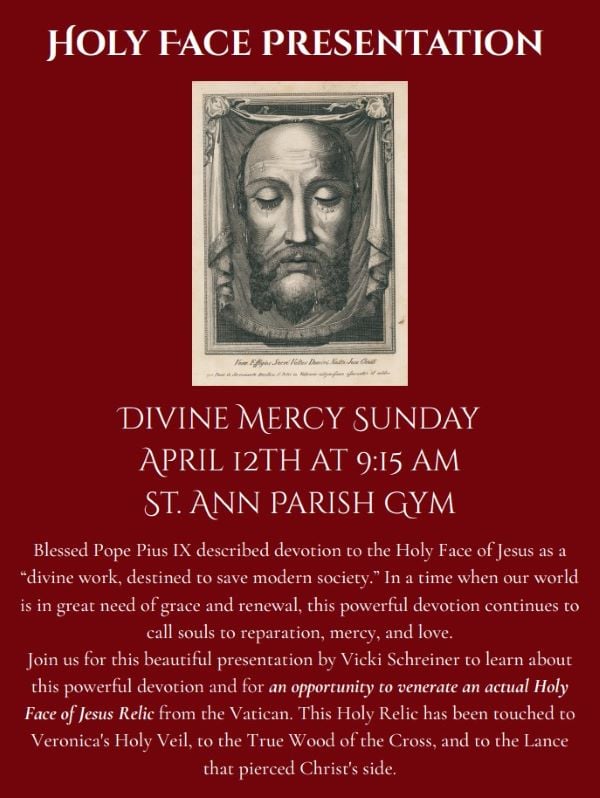
Special Talk on the Holy Face of Jesus This Sunday April 12 at 9:15 a.m. – Saint Ann parish will host a special talk on the Holy Face devotion by Vicki Schreiner to allow the faithful to learn about this powerful devotion. There will also be an opportunity to venerate an actual Holy Face of Jesus relic, which has been touched to Veronica’s Holy Veil, the True Cross, and to the Lance that pierced Christ’s side. The talk will be in the gym. See flyer at the end of this update.
First Sunday Food & Fellowship Potluck at Saint Thomas Aquinas – This Sunday (April 12) will be the monthly Sunday Food and Fellowship at Saint Thomas Aquinas from 1:30 p.m. – 3:00 p.m. If you attend Mass at the Chapel, you can always drop by after Mass.
LiveMass.net – Want to watch a Latin Mass online? The Priestly Fraternity of Saint Peter (FSSP) has a broadcast apostolate which streams its Latin Masses across the world at various times of the day. To view visit: https://www.livemass.net/
Reprinted Book on The Holy Face – Sensus Fidelium Press has just released a reprint of Father J.B. Fourault’s 19th century book, The Month of the Holy Face. According to the description, April is the month of the Holy Face and the book offers meditations for each day in honor of the Holy Face of Jesus. It seems a perfect opportunity to continue to practice the Holy Face of Jesus devotion to pray for the Traditional Latin Mass. To learn more or to order, click here.
Support Saint Ann and Saint Thomas Parishes – Our parishes remain the anchor of our spiritual and community lives and continue to promote the sacred traditions, devotions, speakers and catechesis important for the spiritual growth of ourselves and our families. They also need our continued financial support (and occasional visits!). Both parishes would appreciate our continued generosity.
Rosary for the Traditional Latin Mass – A Rosary is offered for the restoration of the Traditional Latin Mass in the church on Sundays after the 11:30 a.m. Novus Ordo Mass at Saint Thomas Aquinas Church.
Daily Holy Face Chaplet for Sacred Liturgy (perpetual novena) – For the preservation of the Traditional Latin Mass, it has been recommended to all friends of the sacred liturgy in the diocese to consider continually praying the powerful Holy Face chaplet, under the banner of Our Lady of the Holy Name. To pray the chaplet, please see this link.
Cardinal Burke’s Prayer for Pope Leo XIV – His Eminence Cardinal Raymond Burke has released a prayer for Pope Leo XIV. Please see the prayer at the links below and consider praying this daily for the Holy Father as he leads the Church. PDF copies can be accessed at these links: [English] [Español] [Latin]
Holy Face Devotions
(See Holy Face event on April 12 at the conclusion of this email update)
Prayers of Reparation to the Holy Face of Jesus are offered each week at the following churches on the indicated days:
- St. James (Concord) – Monday, 10-10:30 a.m. (in the cry room)
- St. Mark – Tuesday, 5:30 p.m.
- St. Thomas Aquinas – Tuesday, 6:00 a.m.
- St. Ann – Tuesday, 7:30 a.m. (following 7:00 a.m. Mass)
- St. Michael the Archangel (Gastonia) – Tuesday, 8:30 a.m. (following 8:00 a.m. Mass)
- St. Vincent de Paul – Tuesday, 8:40 a.m.
- Holy Spirit (Denver) – Tuesday, 10-11:00 a.m. (following the 9:15 a.m. Mass)
- Saint Elizabeth of the Hill Country (Boone) – Third Tuesday, at 6:45 p.m. after Mass in the Youth Room
- St. John the Baptist (Tryon) - First Saturday, 9:30 a.m. (after 8:30 a.m Mass)
Note: Days and times may be subject to change due to holidays.
“Jesus, Your ineffable image is the star which guides my steps. Ah, You know, Your sweet Face is for me Heaven on earth” (from Canticle to the Holy Face by Saint Thérèse de Lisieux, the 19th century Discalced Carmelite nun who took the name in religion, Thérèse of the Child Jesus and the Holy Face).
Traditional Latin Mass and Liturgical News
- The Paschal Lamb: Fish or Bait? by Dr. Michael P. Foley, New Liturgical Movement (April 4, 2026). [The Paschal Lamb]
- The Psalms of Easter Matins by Fr. William Rock, FSSP, The Missive (March 31, 2024). [The Psalms of Easter Matins]
- The Station Churches of the Easter Octave (Part 1) by Gregory DiPippo, New Liturgical Movement (April 6, 2026). [Station Churches of the Easter Octave]
- Pope urges liturgical unity, inclusion of Traditional Latin Mass faithful, ACI Stampa (March 25, 2026). [Pope urges liturgical unity]
- Christ the Lamb by Fr. William Rock, FSSP, The Missive (April 19, 2024). [Christ the Lamb]
- Vatican Affirms Future of Anglican Ordinariates: ‘A Precious Gift and a Treasure to Be Shared’ by Amira Abuzeid, National Catholic Register (March 30, 2026). [Vatican Affirms Future of Anglican Ordinariates]
- Gregorian Chant Courses This Summer at Clear Creek Abbey by Greg DiPippo, New Liturgical Movement (March 31, 2026). [Gregorian Chant Courses]
Saints and Special Observances
Blessed Emperor Charles (Karl) of Austria – Last Holy Wednesday, April 1, was the 104th anniversary of the death of Blessed Emperor Charles von Habsburg of Austria, otherwise known as Blessed Karl of Austria. We share excerpts (with some minor adaptations) of his life from the Emperor Karl League of Prayer website which promotes the cause of his canonization here in the United States:
Birth and Life
Karl
of the House of Austria was born on August 17, 1887, at Schloss
Persenbeug in Lower Austria. His parents were Archduke Otto and Princess
Maria Josepha of Saxony, daughter of the last king of Saxony. Emperor
Franz Joseph I was Karl's great uncle. From an early age, Karl fostered a
great devotion to the Blessed Sacrament and the Sacred Heart of Jesus.
He used prayer to guide him in making all important decisions.
On October 21, 1911, he married Princess Zita of Bourbon-Parma. During
the ten good years of their happy and exemplary marriage, the pair were
given eight children.
On June 28, 1914, because of the assassination of Archduke Franz
Ferdinand, Karl became the heir apparent of the throne of
Austria-Hungary. In the middle of the First World War, the death of
Emperor Franz Joseph on November 21, 1916, made Karl the Emperor of
Austria. On December 20, 1916, he was crowned Apostolic King of Hungary.
Karl became the last Emperor of the Austro-Hungarian Empire in 1916,
during the First World War.
His Faith
Blessed Karl loved to pray throughout his life. He received Holy Communion daily, and at the end of mass prayed "Veni Creator." He prayed Morning Prayer, Evening Prayer, and the rosary daily. He frequently prayed the Litanies of the Sacred Heart, the Blessed Virgin Mary, and Saint Joseph; he was a member of Our Lady's Confraternity and wore the scapular. Karl was devoted to adoring the Blessed Sacrament, and could happily spend hours in adoration.
Karl of Austria was obedient to the Holy Father, acknowledging him to be the Vicar of Christ; and he treated bishops and priests with respect. From the testimony of those who knew him well, it is clear that Blessed Karl took his faith seriously and fostered his relationship with God, devoutly following the teachings of the Roman Catholic Church.
The Peacemaker
The most sacred obligation of a king—to provide peace—became the primary focus of Karl's efforts during this horrific war. The only world leader to do so, he supported the peace proposals of Pope Benedict XV.
From the very beginning of his reign, Karl worked to create peace for his empire. He had been against the declaration of war, and now he was in a position to put an end to the needless killing and fighting. In his accession speech he proclaimed: "I will do all within my power to banish the horrors and sacrifices of war at the earliest possible date and to win back for my peoples the sorely missed blessings of peace . . ."
During a most difficult time domestically, he offered extensive assistance to his people and gave example to them by passing social legislation in conformity with Catholic social teachings.
His stance prevented civil war from occurring during the post-war transition of government. Yet still he was banished from his homeland.
His Death
At the request of the pope, who feared that communism would overtake Central Europe, Karl attempted to restore his government and return to the throne of Hungary. Two attempts failed because he wanted to avoid civil war at all costs. Karl was then sent into exile on Madeira. He saw his abandonment there as a commission from God, a duty he could not put aside.
In exile on the island of Madeira, he lived with his family in poverty, in a damp house. There, Karl contracted a fatal illness, which he accepted as a sacrifice to make for the peace and unity of his people.
His wife stayed with him throughout most of his final ordeal. He forgave those who betrayed him, and prayed for his subjects. On the evening before he died, he uttered: "I must suffer like this so that my peoples can come together again." But his most frequent prayer was: "Thy Will be done!"
He later requested Holy Communion, which a priest, Father Zsambóki, administered to him, and anointed him a final time. The Eucharist was exposed in his room, and he prayed in the Lord's presence. About ten minutes before he died, he prayed: "Thy Holy Will be done. Jesus, Jesus, come! Yes-yes. My Jesus, as You will it-Jesus."
Then he whispered "Jesus" softly, and died. It was shortly after noon on Saturday, April 1, 1922. He was only 34 years old.
Canonization Process
In 1949, Karl was given the title, Servant of God. In 1972, on the fiftieth anniversary of his death, the tomb of Karl was opened and his remains were found remarkably well preserved. In April 2003 he was declared Venerable and in December the first miracle necessary for beatification was approved: a nun in Brazil with a debilitating illness was miraculously cured after praying for Karl’s intercession.
On October 3, 2004, Pope Saint John Paul II beatified Emperor and King Karl (whom the late pontiff, Karol Wojtiya, was named after as his father fondly served in Blessed Karl’s army). Blessed Karl's feast day is October 21, the date of his marriage to Empress Zita. In 2023, an investigation into a miracle for his canonization was opened.
The cause for Empress Zita’s canonization is also open and Clear Creek Abbey in Oklahoma is promoting her cause in the United States.
At a time when traditional marriage has been undermined, war and strife afflicts many regions of the world, and saintly virtues among public officials are sorely needed, Blessed Karl can be a powerful intercessor for our times.
Source: Emperor Charles League of Prayer
Post Script: Charlotte Connection to Blessed Karl
Locally, a granddaughter of Blessed Karl, the Countess of Arco (Archduchess Maria Beatrice) and her late husband, Count Arco (Riprand of Arco-Zinneberg, d. 2021), resided in Charlotte in the 1980s, attended Saint Gabriel parish, and began a successful business enterprise here.
On Low/Divine Mercy Sunday 2018 the couple returned to Charlotte and providentially attended the Latin Mass at Saint Ann parish and happily saw the Blessed Karl image on the welcome table which has also greeted thousands of other attendees over the years.
After Count Arco passed away in 2021, the family traveled from Austria to Charlotte and requested Saint Ann parish for a local memorial Mass for the Count's friends and associates, due, in part, to the Blessed Karl image the royal couple saw on their prior visit.
Closing Commentary
To close this update, we share three brief descriptions of the various names of Low Sunday over the years, followed by a brief excerpt from Dom Prosper Guéranger’s commentary on “Quasimodo, or Low Sunday: The Octave of the Pasch” followed by a link to the complete entry in The Liturgical Year.
Low Sunday
Dominica in Albis (“White Sunday”) is a name for the Sunday after Easter that originated in a custom observed among early Christians, requiring those who had been newly baptized at Easter to continue wearing their white baptismal garments for one week. Then, on the Sunday following Easter, the neophytes would be allowed to shed the white robes that set them apart in order to be recognized as full-fledged members of the body of Christ.
Quasimodo Sunday, a name which has been applied to the Sunday after Easter for centuries, is based on the opening words of the Introit for this Sunday: Quasi modo géniti infántes, which is translated, “As newborn babes. . . .” In Victor Hugo’s 1831 novel, Notre-Dame de Paris (set in 1482 and published in English under the title, The Hunchback of Notre-Dame), the severely malformed protagonist had been abandoned at the cathedral as a newborn babe on Quasimodo Sunday. Raised by the archdeacon of the cathedral to serve as the bell-ringer of Notre Dame, he had been given the rather ungainly name of Quasimodo to commemorate the day of his arrival.
Divine Mercy Sunday does not appear on the traditional calendar as it was not proclaimed for celebration throughout the Church until the Great Jubilee Year of 2000. On the 30th of April in that year, in his homily during the canonization of the Polish nun born Faustina Kowalska, the future Saint John Paul II announced, “The Second Sunday of Easter from now on throughout the Church will be called ‘Divine Mercy Sunday.’” Five days later, the Congregation for Divine Worship and the Discipline of the Sacraments issued a decree officially establishing the Sunday following Easter as “Divine Mercy Sunday.” While the day had been observed in Poland and a number of other countries for some years, the path to official acceptance by the universal Church was not an easy one, as evidenced by the treatment of Saint Faustina during her life and of her writings after her death.
The Church offers a plenary indulgence on Divine Mercy Sunday. To receive the indulgence please see this article.
On a local note, Saint Ann parish has a statue of Divine Mercy in front of the church in honor of the late seminarian Michael Kitson who passed away on Divine Mercy Sunday several years ago.
The Octave of the Pasch
Jesus’ apparition to the Eleven, and the victory He gains over the incredulous Thomas, — these are the special subjects the Church brings before us today. By this apparition, which is the seventh since His Resurrection, our Saviour wins the perfect faith of His disciples. It was impossible not to recognise God, in the patience, the majesty, and the charity of Him who showed Himself to them. Here again, our human thoughts are disconcerted; we should have thought this delay excessive; it would have seemed to us, that our Lord ought to have, at once, either removed the sinful doubt from Thomas’ mind, or punished him for his disbelief. But no: Jesus is infinite wisdom, and infinite goodness. In His wisdom, He makes this tardy acknowledgment of Thomas become a new argument of the truth of the Resurrection; in His goodness, He brings the heart of the incredulous disciple to repentance, humility, and love, yea, to a fervent and solemn retractation of all his disbelief. We will not here attempt to describe this admirable scene, which holy Church is about to bring before us. We will select, for our today’s instruction, the important lesson given by Jesus to His disciple, and, through him, to us all. It is the leading instruction of the Sunday, the Octave of the Pasch, and it behooves us not to pass it by, for, more than any other, it tells us the leading characteristic of a Christian, shows us the cause of our being so listless in God’s service, and points out to us the remedy for our spiritual ailments. [Quasimodo or Low Sunday]
~
We wish our readers a blessed Eastertide. Christus Resurréxit! Resurréxit Vere!